Knaresborough in North Yorkshire, England, United Kingdom — Northwestern Europe (the British Isles)
Blind Jack
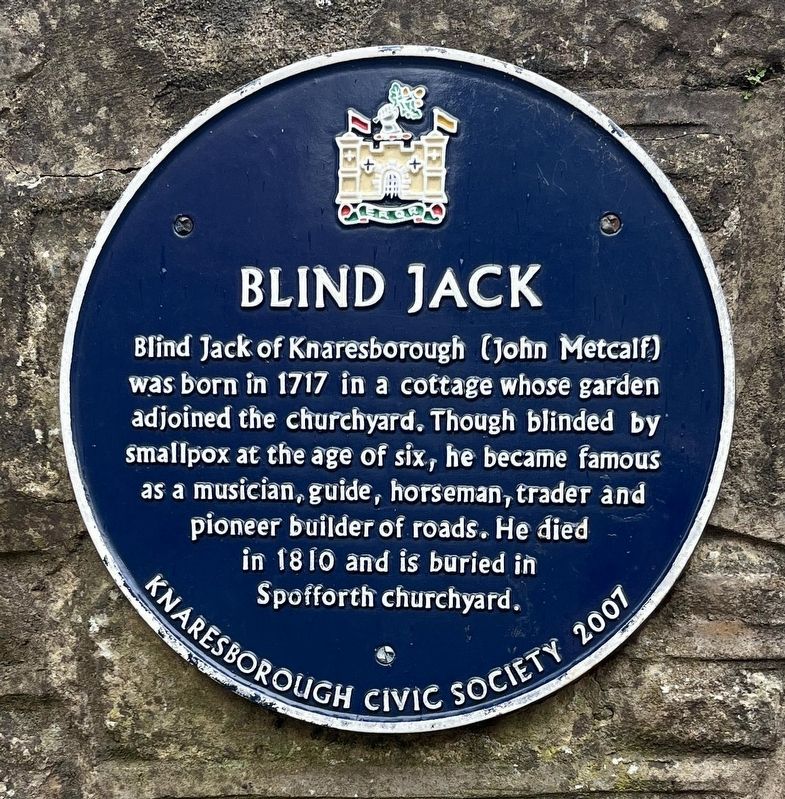
Photographed by Ray Gurganus, April 18, 2025
1. Blind Jack Marker
Erected 2007 by Knaresborough Civic Society.
Topics. This historical marker is listed in this topic list: Arts, Letters, Music. A significant historical year for this entry is 1717.
Location. 54° 0.555′ N, 1° 28.301′ W. Marker is in Knaresborough, England, in North Yorkshire. It is on Waterside. Touch for map. Marker is at or near this postal address: 13 Waterside, Knaresborough, England HG5 9AE, United Kingdom. Touch for directions.

Regionally, this marker is in Yorkshire & The Humber. Globally, it is on the Atlantic Ocean, in the North Atlantic Region, in Europe, in Atlantic Europe, on one of the British Isles, in the Western World, and in the Anglosphere. Historically, it finds itself in what was once the Roman Empire.
Other nearby markers. At least 8 other markers are within walking distance of this marker:
this page online
Also see . . . John Metcalf (civil engineer) (Wikipedia). Overview:
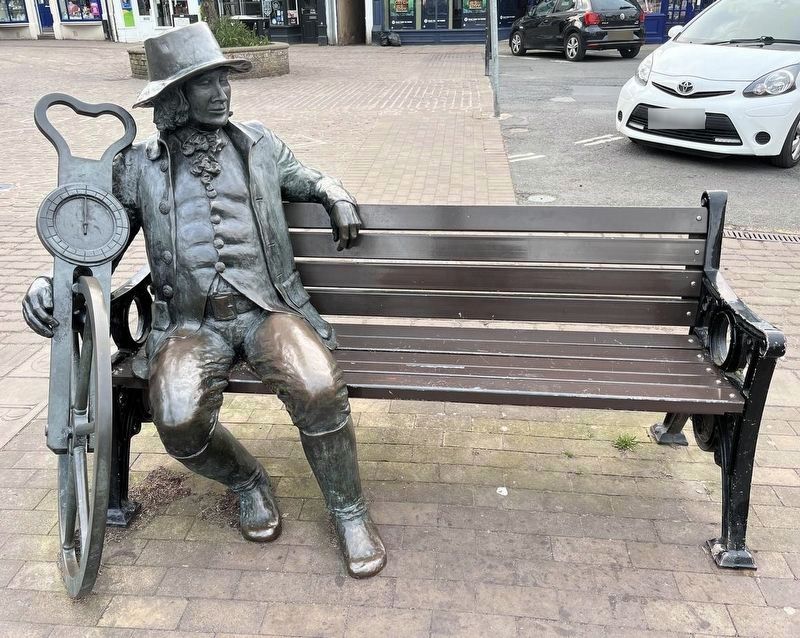
John Metcalf (15 August 1717 – 26 April 1810), known as Blind Jack of Knaresborough or Blind Jack Metcalf, was an English road builder, the first professional road builder to emerge during the Industrial Revolution. Blind from the age of six, Metcalf had an eventful life, which was documented by his own account just before his death. He was an accomplished diver, swimmer, card player and fiddler, but was better known for the period between 1765 and 1792 when he built about 180 miles (290 km) of turnpike road, mainly in the north of England and as such, he became(Submitted on July 7, 2025.)known as one of the fathers of the modern road.Photographed by Ray Gurganus, April 18, 20252. Sculpture of Blind Jack, Town CentreNote that the statue is not particularly close to the blue plaque.
Credits. This page was last revised on July 7, 2025. It was originally submitted on July 5, 2025, by Ray Gurganus of Washington, District of Columbia. This page has been viewed 88 times since then and 28 times this year. Photos: 1, 2. submitted on July 5, 2025, by Ray Gurganus of Washington, District of Columbia. • Andrew Ruppenstein was the editor who published this page.
