West Englewood in Chicago in Cook County, Illinois — The American Midwest (Great Lakes)
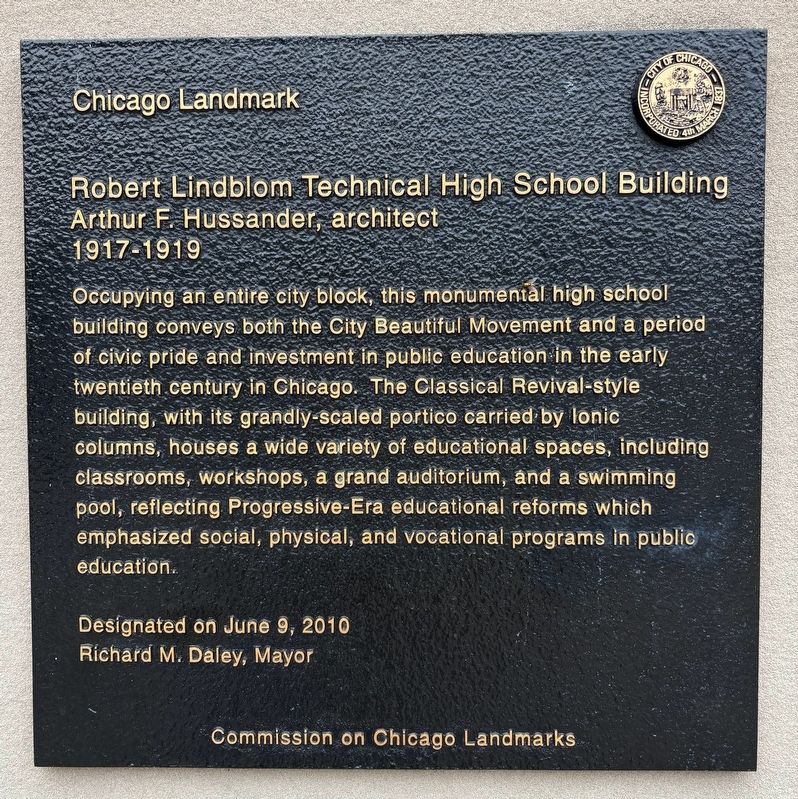
Robert Lindblom Technical High School Building
Arthur F. Hussander, architect; 1917-1919
| — | Chicago Landmark | — |
Photographed by Sean P. Flynn, July 4, 2025
1. Robert Lindblom Technical High School Building Marker
Designated on June 9, 2010
Richard M. Daley, Mayor
Erected by Commission on Chicago Landmarks, City of Chicago.
Topics and series. This historical marker is listed in these topic lists: Architecture • Education. In addition, it is included in the Illinois, Chicago Landmarks Commission series list. A significant historical year for this entry is 1917.
Location. 41° 46.93′ N, 87° 40.313′ W. Marker is in Chicago, Illinois, in Cook County. It is in West Englewood. It is on South Wolcott Avenue north of West 62nd Street, on the left when traveling north. The marker
this page online

Regionally, this marker is on Chicago’s South Side. It is also in the American Midwest. Globally, it is in North America, on the Great Lakes, in the Western Hemisphere, in the Western World, and in the Anglosphere. Historically, it finds itself in what was once the Viceroyalty of New France, the territory of the Mississippian Culture, and the Northwest Territory.
Other nearby markers. At least 8 other markers are within 3 miles of this marker, measured as the crow flies: (Former) Marquette Park State Bank (approx. 0.7 miles away); Darius and Girenas Memorial (approx. 1.3 miles away); St. Bakhita (approx. 1½ miles away); Our Lady of Fatima (approx. 1½ miles away); Martin Luther King, Jr. Living Memorial (approx. 1.8 miles away); The MLK Living Memorial (approx. 1.8 miles away); Marquette Park World War I Memorial (approx. 2 miles away); Five Holy Martyrs Parish Veterans Memorial (approx. 2.6 miles away). Touch for a list and map
Photographed by Sean P. Flynn, July 4, 2025
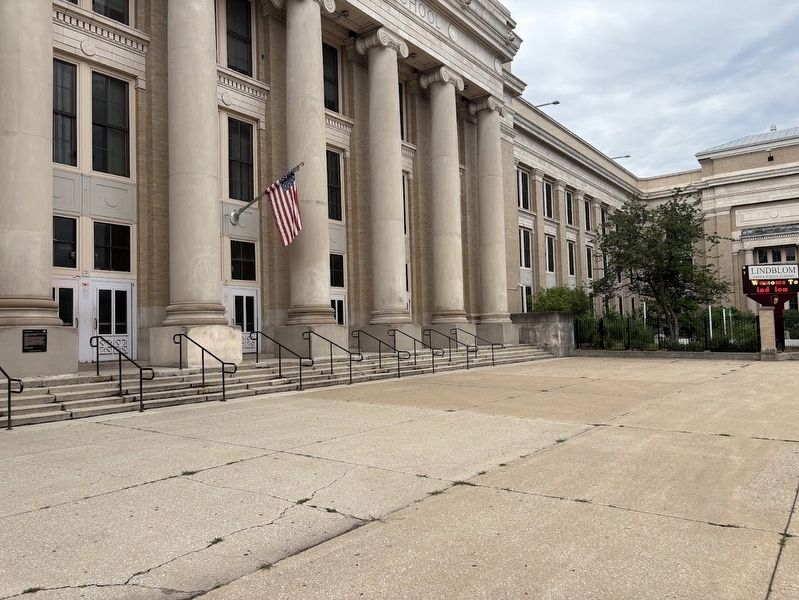
2. Robert Lindblom Technical High School Building Marker
The marker is affixed to the third column from the left. It is visible on the far left side of this photo.
Regarding Robert Lindblom Technical High School Building. Construction on Lindblom Technical High School began in 1917, but was delayed due to material and labor shortages caused by the United States' entry into World War I. It opened officially on September 2, 1919, at a final cost of $1.3 million. The school closed in 2003 for a complete renovation, and reopened in 2005 as the Lindblom Math and Science Academy.
Architect Arthur Hussander served as Chicago Public Schools' lead architect between 1910 and 1921. In addition to Lindblom, he also designed Senn High School on the north side of Chicago, which also is notable for its colonnade.
The school is named after Robert Lindblom, a native of Sweden who emigrated to the United States at age 20. He became a prominent figure in the grain industry at Chicago's Board of Trade, a Chicago school board member and a philanthropist.
Also see . . .
1. Chicago Landmark Designation Report: Lindblom Technical High School Building.
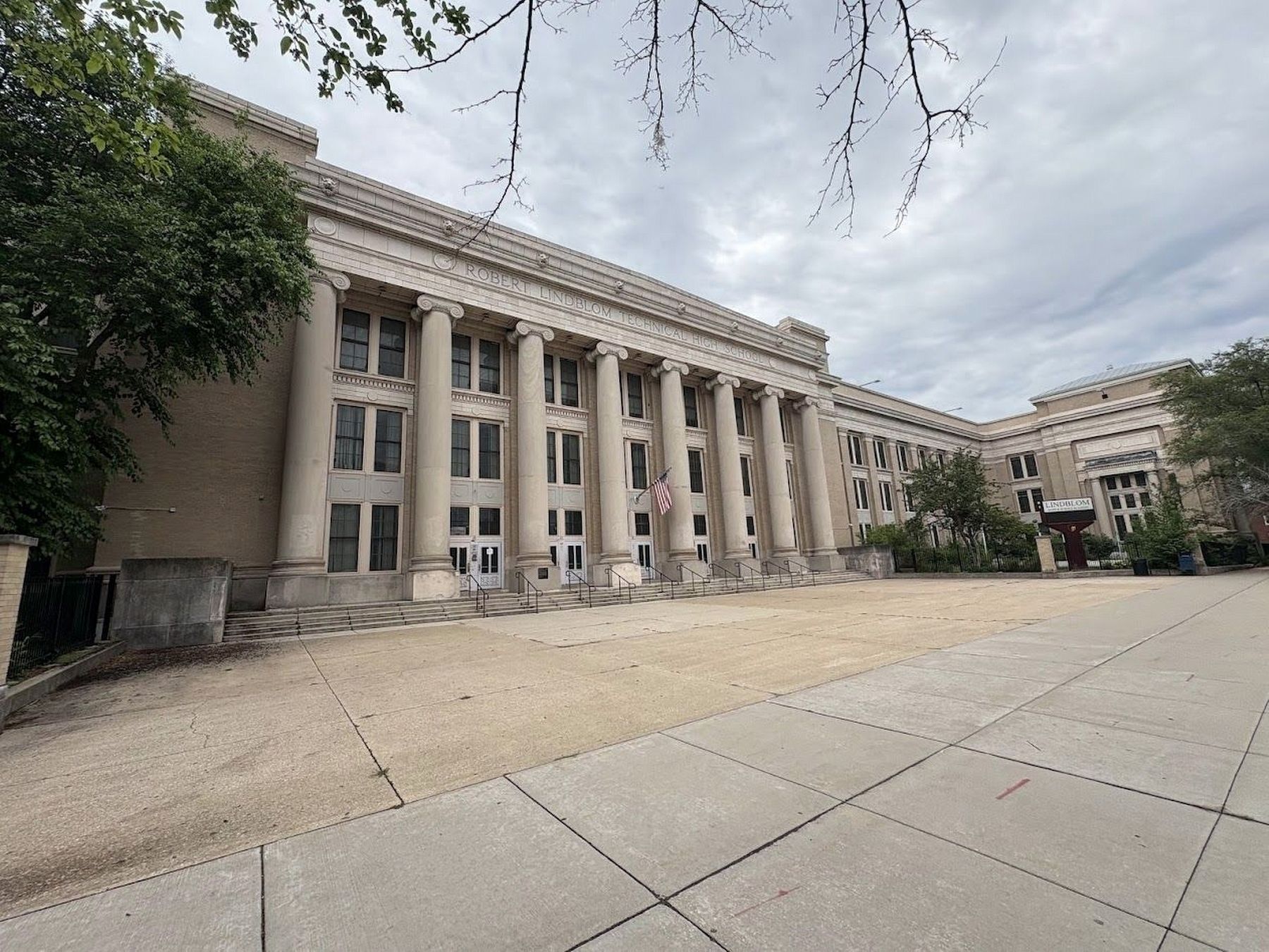
Excerpt: "Lindblom is a particularly distinguished example of the Beaux Arts style of architecture, a reinterpretation of(Submitted on July 5, 2025, by Sean P. Flynn of Oak Park, Illinois.)Classical architecture that was promoted at the World’s Columbian Exposition in Chicago in 1893. The light color palette and restrained classical ornament (upper left) are characteristic features of the style. Grand entrances were another feature of the Beaux Arts, exemplified by the giant order limestone columns (upper right) which mark the formal main entrance to the building."Photographed by Sean P. Flynn, July 4, 20253. Lindblom Math and Science Academy
2. Chicago Historic Schools blog: Arthur F. Hussander (1865–1943).
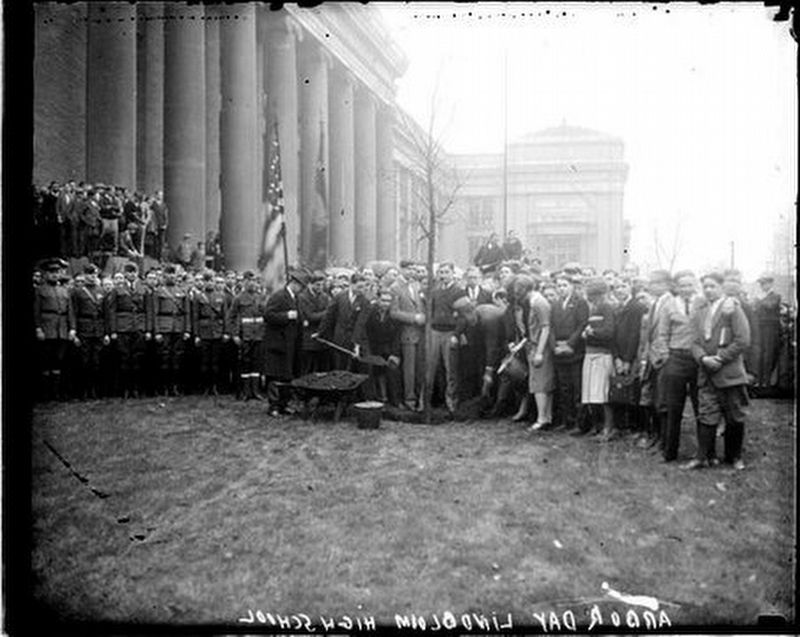
Excerpt: "In contrast to the progressive design of schools during the tenure of Dwight H. Perkins, Hussander produced handsome schools in a Classical style. He did, however, follow up on some of Perkins’s design philosophies such as providing windows in every classroom, raising the grade levels of basements to provide healthier spaces, and improving ventilation. Hussander prepared plans for more than 60 new Chicago Public School buildings and 45 additions to existing structures. His school designs include Lindblom Technical School; Senn High School; Carter Harrison Technical School (now Maria Saucedo Scholastic(Submitted on July 5, 2025, by Sean P. Flynn of Oak Park, Illinois.)Academy); and Bell, Herzl, Parkside, Peirce, Pope, Thorp, and Riis elementary schools are examples of his work."Chicago Daily News Collection, Chicago History Museum, April 19264. Lindblom tree planting, 1926Lindblom students and teachers gather in front of the school for a tree planting in honor of Arbor Day 1926.
3. Encyclopedia of Chicago: City Beautiful Movement.
Excerpt: "Despite its preoccupation with aesthetic effect, the [City Beautiful Movement] concerned far more than facade: the quest for beauty paralleled the search for the functional and humane city. Urban planning as the twentieth century would know it developed out of the City Beautiful—both as a phase of it and a reaction to it—and its coalition of planners, of paid experts and unpaid volunteers, of architects, artists, civic officials, journalists, business people, and interested ordinary citizens."(Submitted on July 5, 2025, by Sean P. Flynn of Oak Park, Illinois.)
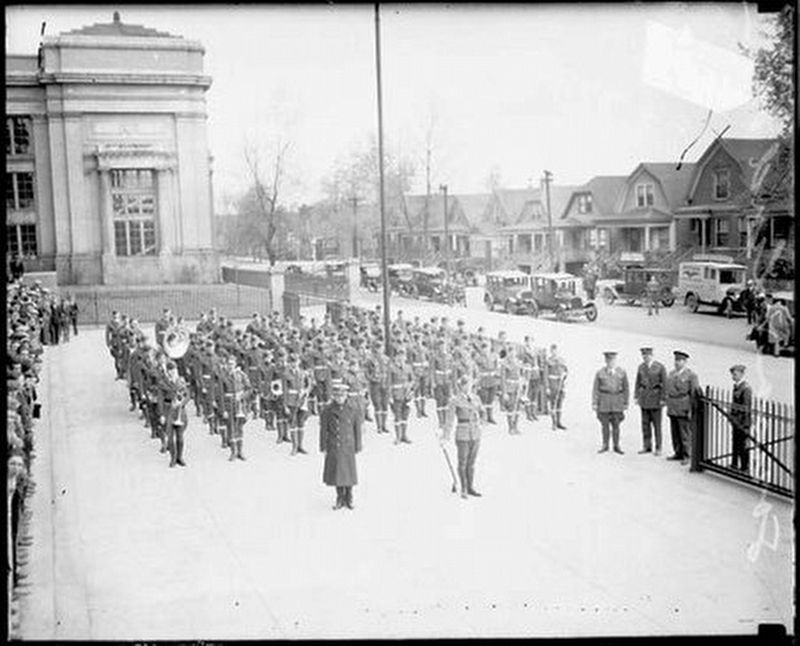
Chicago Daily News Collection, Chicago History Museum, 1927
5. John Philip Sousa at Lindblom Technical High School
According to the description provided by the Chicago History Museum, the famed American composer is standing in front of Lindblom's R.O.T.C. marching band in the plaza in front of the school.
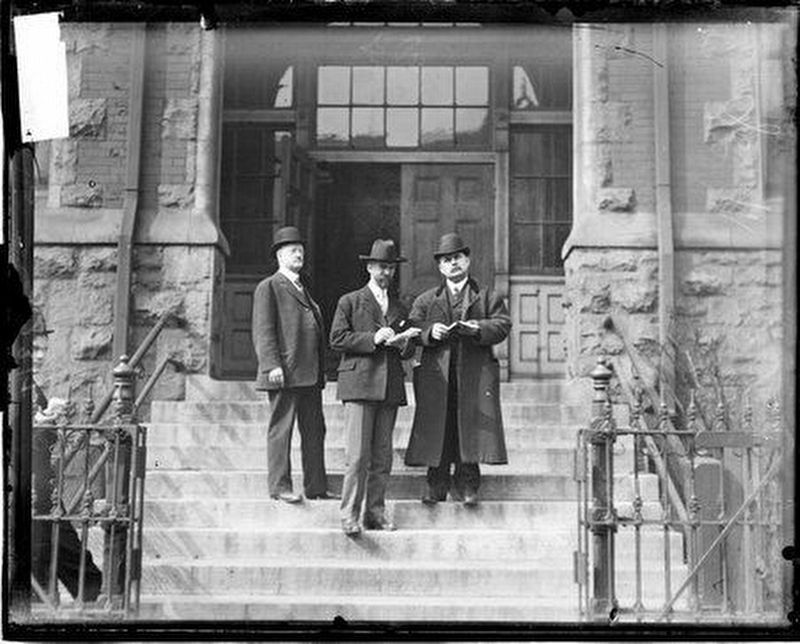
Chicago Daily News Collection, Chicago History Museum, circa 1908
6. Arthur Hussander, architect
Arthur F. Hussander, on the right in this photo, served as the chief architect for Chicago Public Schools from roughly 1910 to 1921. In the center of the photo is Dwight H. Perkins, Hussander's predecessor as chief architect, who was forced from the role in 1910. On the left is Joseph G. Magrady, a school board member.
Credits. This page was last revised on September 25, 2026. It was originally submitted on July 5, 2025, by Sean P. Flynn of Oak Park, Illinois. This page has been viewed 328 times since then and 147 times this year. Photos: 1, 2, 3, 4, 5. submitted on July 5, 2025, by Sean P. Flynn of Oak Park, Illinois. 6. submitted on September 2, 2024, by Sean P. Flynn of Oak Park, Illinois.
