
Stadtamhof in Regensburg, Bavaria, Germany — Central Europe
KZ-Außenlager Regensburg
⎯⎯⎯
Regensburg Subcamp
Photographed by James Hulse, June 25, 2025
1. KZ-Außenlager Regensburg / Regensburg Subcamp Marker

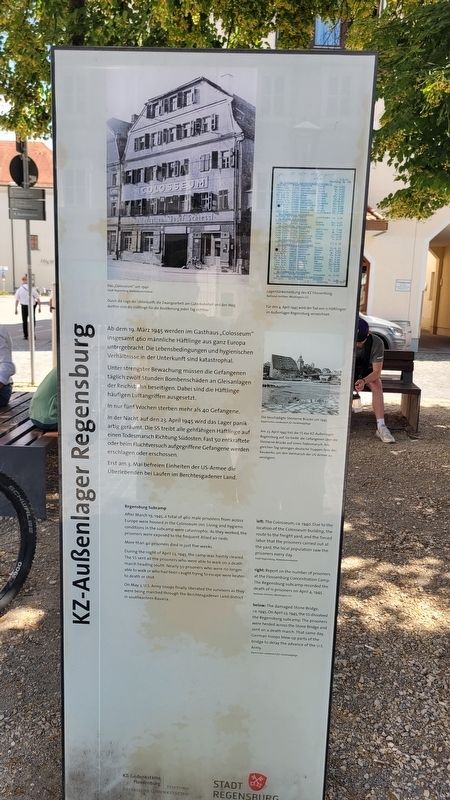
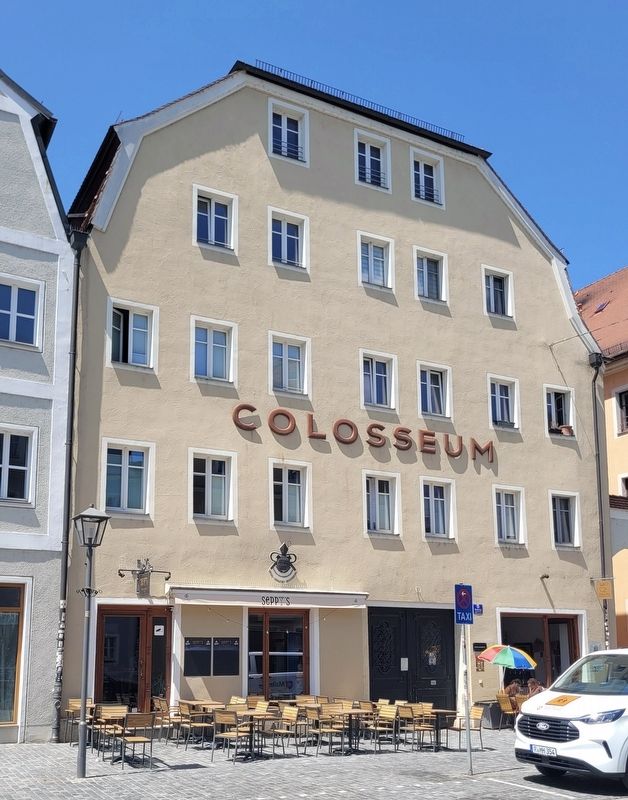
Ab dem 19. März 1945 werden im Gasthaus „Colosseum“ insgesamt 460 männliche Häftlinge aus ganz Europa untergebracht. Die Lebensbedingungen und hygienischen Verhältnisse in der Unterkunft sind katastrophal.
Unter strengster Bewachung müssen die Gefangenen täglich zwölf Stunden Bombenschäden an Gleisanlagen der Reichsbahn beseitigen. Dabei sind die Häftlinge häufigen Luftangriffen ausgesetzt.
In nur fünf Wochen sterben mehr als 40 Gefangene.
In der Nacht auf den 23. April 1945 wird das Lager panikartig geräumt. Die SS treibt alle gehfähigen Häftlinge auf einen Todesmarsch Richtung Südosten. Fast 50 entkräftete oder beim Fluchtversuch aufgegriffene Gefangene werden erschlagen oder erschossen.
Erst am 3. Mai befreien Einheiten der US-Armee die Überlebenden bei Laufen im Berchtesgadener Land.
Bildunterschriften
(Foto #1) Das „Colosseum“ um 1940 Stadt Regensburg, Bilddokumentation. Durch die Lage der Unterkunft, die Zwangsarbeit am Güterbahnhof und den Weg dorthin sind die Häftlinge für die Bevölkerung jeden Tag sichtbar.
(Foto #2) Lagerstärkemeldung des KZ Flossenbürg National Archives, Washinaton DC. Für den 4. April 1945 wird der Tod von 11 Häftlingen im Außenlager Regensburg verzeichnet.
(Foto #3) Die beschädigte Steinerne Brücke um 1945 Bayerisches Landesamt für Denkmalpflege. Am 23. April 1945 löst die SS das KZ-Außenlager Regensburg auf. Sie treibt die Gefangenen über die Steinerne Brücke auf einen Todesmarsch. Am gleichen Tag sprengen deutsche Truppen Teile des Bauwerks, um den Vormarsch der US-Armee zu verzögern.
Rückseite
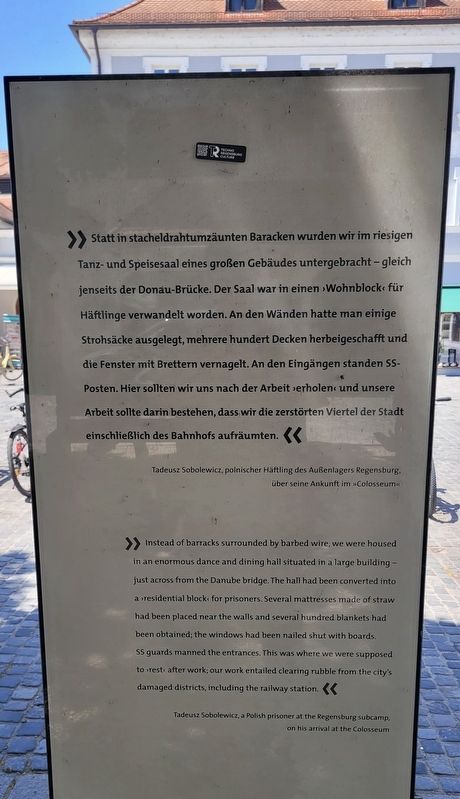
Statt in stacheldrahtumzäunten Baracken wurden wir im riesigen Tanz- und Speisesaal eines großen Gebäudes untergebracht - gleich jenseits der Donau-Brücke. Der Saal war in einen Wohnblock für Häftlinge verwandelt worden. An den Wänden hatte man
this page online
Bildunterschriften
(Foto #1) Tadeusz Sobolewicz, polnischer Häftling des Außenlagers Regensburg, über seine Ankunft im „Colosseum“
After March 19, 1945, a total of 460 male prisoners from across Europe were housed in the Colosseum inn. Living and hygienic conditions in the subcamp were catastrophic. As they worked, the prisoners were exposed to the frequent Allied air raids.
More than 40 prisoners died in just five weeks.
During the night of April 23, 1945, the camp was hastily cleared. The SS sent all the prisoners who were able to walk on a death march heading south. Nearly 50 prisoners who were no longer able to walk or who had been caught trying to escape were beaten to death or shot.
On May 3, U.S. Army troops finally liberated the survivors as they were being marched through the Berchtesgadener
Photographed by James Hulse, June 25, 2025
2. KZ-Außenlager Regensburg / Regensburg Subcamp Marker - Reverse Side
Captions
(Photo #1) left: The Colosseum, ca. 1940. Due to the location of the Colosseum building, the route to the freight yard, and the forced labor that the prisoners carried out at the yard, the local population saw the prisoners every day. Stadt Regensburg, Bilddokumentation.
(Photo #2) right: Report on the number of prisoners at the Flossenbürg Concentration Camp. The Regensburg subcamp recorded the death of 11 prisoners on April 4, 1945. National Archives, Washington DC.
(Photo #3) below: The damaged Stone Bridge, ca. 1945. On April 23, 1945, the SS dissolved the Regensburg subcamp. The prisoners were herded across the Stone Bridge and sent on a death march. That same day, German troops blew up parts of the bridge to delay the advance of the U.S. Army. Bayerisches Landesamt für Denkmalpflege.
Reverse Side
Instead of barracks surrounded by barbed wire, we were housed in an enormous dance and dining hall situated in a large building - just across from the Danube bridge. The hall had been converted into a residential block for prisoners. Several mattresses made of straw had been placed near the walls and several hundred blankets had been obtained; the windows had been nailed shut with boards. SS guards manned the entrances. This was where we were supposed to rest after work; our work entailed clearing rubble from the city's damaged districts, including the railway station.
Captions
(Photo #1) Tadeusz Sobolewicz, a Polish prisoner at the Regensburg subcamp, on his arrival at the Colosseum
Erected by KZ-Gedenkstätte Flossenbürg, Stiftung Bayerische Gedenkstätten, Stadt Regensburg.
Topics. This historical marker is listed in this topic list: War, World II. A significant historical date for this entry is March 19, 1945.
Location. 49° 1.469′ N, 12° 5.851′ E. Marker
Photographed by James Hulse, June 25, 2025
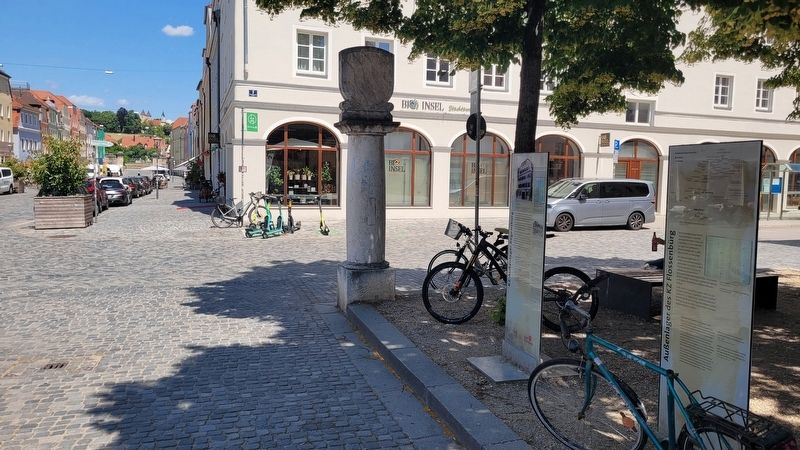
3. KZ-Außenlager Regensburg / Regensburg Subcamp Marker (left side)

Regionally, it is in Europe, the European Union, Atlantic Europe, Central Europe, the Schengen Area, Western Europe, and the Western World. Historically, it finds itself in what was once the Roman Empire, the Holy Roman Empire, and the former West Germany.
Other nearby markers. At least 8 other markers are within walking distance of this marker: Außenlager des KZ Flossenbürg / Subcamps of the Flossenbürg Concentration Camps (here, next to this marker); KZ-Außenkommandos Ossenburg / Ossenburg Concentration Subcamp (here, next to this marker); Stadtamhof (within shouting distance of this marker); Ehem. Rathaus von Stadtamhof / Former town hall of Stadtamhof (within shouting distance of this marker); Dr. Franz Xaver Haberl (about 90 meters away, measured in a direct line); St. Mang / Saint Magnus (about 90 meters away);
Photographed by James Hulse, June 25, 2025
4. Colosseum building
Credits. This page was last revised on July 7, 2025. It was originally submitted on July 5, 2025, by James Hulse of Medina, Texas. This page has been viewed 96 times since then and 34 times this year. Photos: 1, 2, 3, 4. submitted on July 7, 2025, by James Hulse of Medina, Texas.
