Harrogate in North Yorkshire, England, United Kingdom — Northwestern Europe (the British Isles)
Yorkshire Hotel
Photographed by Ray Gurganus, April 18, 2025
1. Yorkshire Hotel Marker
Inscription.
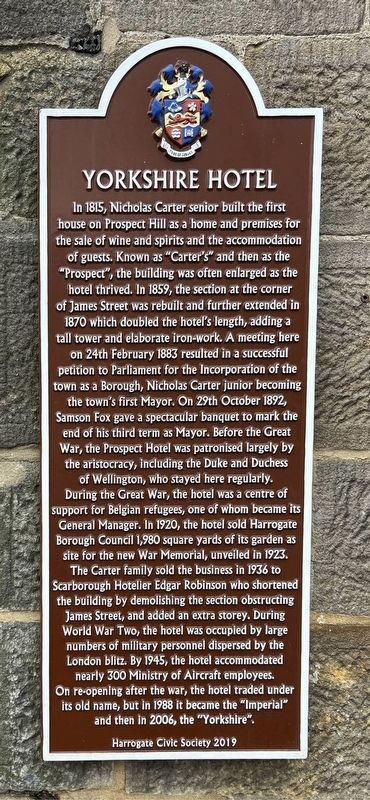
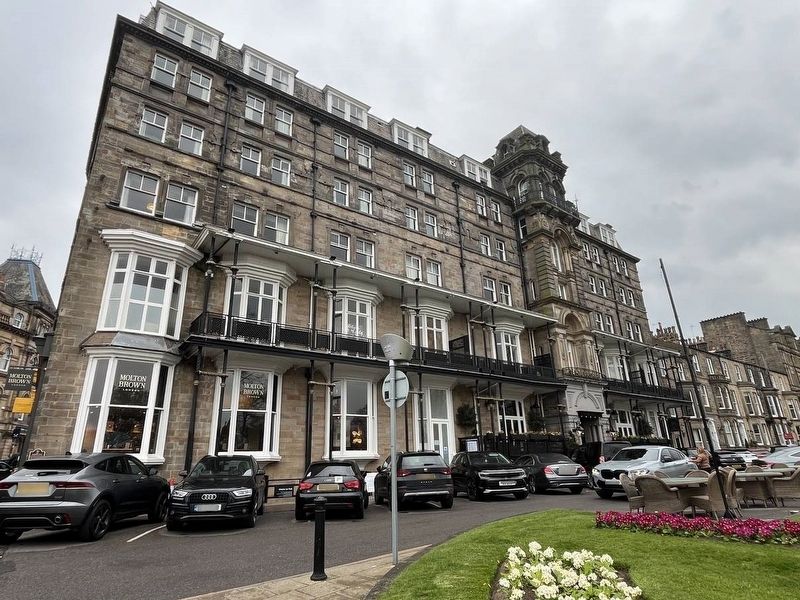
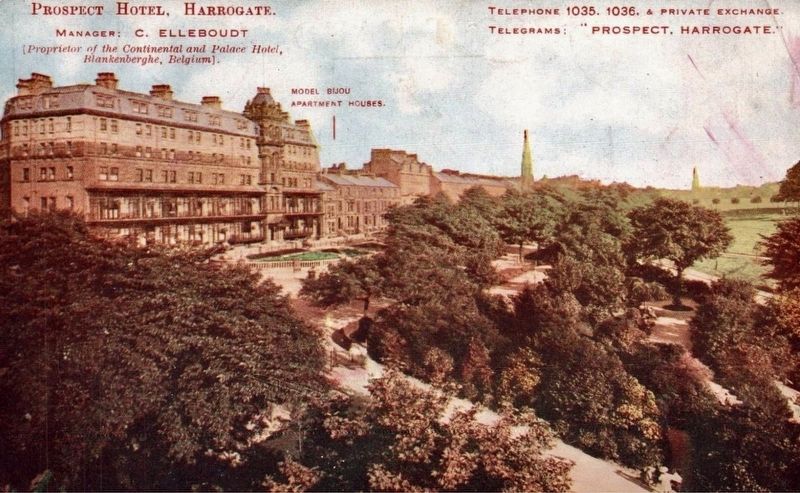
In 1815, Nicholas Carter senior built the first house on Prospect Hill as a home and premises for the sale of wine and spirits and the accommodation of guests. Known as "Carter's" and then as the "Prospect", the building was often enlarged as the hotel thrived. In 1859, the section at the corner of James Street was rebuilt and further extended in 1870 which doubled the hotel's length, adding a tall tower and elaborate iron-work. A meeting here on 24th February 1883 resulted in a successful petition to Parliament for the Incorporation of the town as a Borough, Nicholas Carter junior becoming the town's first Mayor. On 29th October 1892, Samson Fox gave a spectacular banquet to mark the end of his third term as Mayor. Before the Great War, the Prospect Hotel was patronised largely by the aristocracy, including the Duke and Duchess of Wellington, who stayed here regularly. During the Great War, the hotel was a centre of support for Belgian refugees, one of whom became its General Manager. In 1920, the hotel sold Harrogate Borough Council 1,980 square yards of its garden as site for the new War Memorial, unveiled in 1923. The Carter family sold the business in 1936 to Scarborough Hotelier Edgar Robinson who shortened the building by demolishing the section obstructing James Street, and added an extra storey. During World War Two, the hotel was occupied by large numbers of military personnel dispersed by the London blitz. By 1945, the hotel accommodated nearly 300 Ministry of Aircraft employees. On re-opening after the war, the hotel traded under its old name, but in 1988 it became the "Imperial" and then in 2006, the "Yorkshire".
Topics. This historical marker is listed in this topic list: Industry & Commerce. A significant historical year for this entry is 1815.
Location. 53° 59.546′ N, 1° 32.497′ W. Marker is in
Click or scan to see this page online
Harrogate, England, in North Yorkshire. It is on Prospect Place West Park. Touch for map. Marker is at or near this postal address: 19 Prospect Place West Park, Harrogate, England HG1 1LA, United Kingdom. Touch for directions.
Regionally, this marker is in Yorkshire & The Humber. Globally, it is on the Atlantic Ocean, in the North Atlantic Region, in Europe, in Atlantic Europe, on one of the British Isles, in the Western World, and in the Anglosphere. Historically, it finds itself in what was once the Roman Empire.
Credits. This page was last revised on July 7, 2025. It was originally submitted on July 5, 2025, by Ray Gurganus of Washington, District of Columbia. This page has been viewed 307 times since then and 165 times this year. Photos:1, 2. submitted on July 5, 2025, by Ray Gurganus of Washington, District of Columbia. 3. submitted on July 7, 2025. • Andrew Ruppenstein was the editor who published this page.