Niagara Falls in Niagara Region, Ontario — Central Canada (North America)
The "A.B.C." Peace Conference in Niagara Falls, Canada, May - July 1914
Photographed by Kevin Westell, July 3, 2025
1. The "A.B.C." Peace Conference in Niagara Falls, Canada, May - July 1914 - Marker

[ English ]
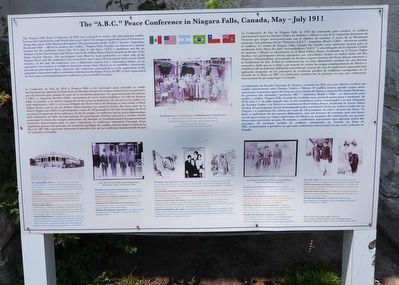
The Niagara Falls Peace Conference of 1914 was convened to resolve the international conflict between the United States and Mexico that arose when U.S. troops occupied the port of Veracruz to change the course of the Mexican Revolution. The governments of the "A.B.C." powers — Argentina, Brazil and Chile — offered to mediate the conflict. Niagara Falls, Canada was chosen as a neutral location for the mediation. From May 20 to July 1st the three "A.B.C." mediators and the six delegates of the United States and Mexico met in the Clifton House Hotel, located on the site of the Oakes Garden Theatre. The participants were fêted by local authorities on either side of the Niagara River and the conference was covered by more than 150 journalists from across North America. In the end, the conference was a diplomatic success but a substantive failure, as no agreement was reached to withdraw American troops from Mexico or to establish a democratic provisional government there. However, the conference represented an early application of the principles of peaceful conflict resolution, enshrined in
this page online
[ French ]
La Conférence de Paix de 1914 à Niagara Falls a été convoquée pour résoudre le conflit international qui opposait les États-Unis au Mexique lorsque les troupes américaines occupaient le port de Veracruz pour changer le cours de la révolution mexicaine. Les gouvernements des nations « A.B.C. » - Argentine, Brésil et Chili - ont proposé de servir d'intermédiaires. La ville de Niagara Falls, au Canada, a été choisie comme lieu neutre pour la médiation. Du 20 mai au 1er juillet, les trois médiateurs « A.B.C.» et les six délégués des Etats-Unis et du Mexique se sont réunis l'hôtel Clifton House, ssur le site du théâtre Oakes Garden. Les autorités locales des deux côtés de la rivière Niagara ont célébré les participants, et plus de 150 journalistes de toute l'Amérique du Nord ont assuré le reportage de la conférence. En fin de compte, la conférence fut un succès diplomatique mais représenta un échec de fond puisque les participants n'étaient parvenus à aucune entente concernant le retrait des
Photographed by Kevin Westell, July 3, 2025
2. The "A.B.C." Peace Conference in Niagara Falls, Canada, May - July 1914 - Marker in context
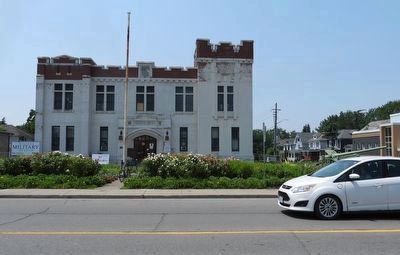
The marker is just left of the main entrance to the Niagara Military Museum.
[ Spanish ]
La Conferencia de Paz de Niagara Falls de 1914 fue convocada para resolver el conflicto internacional entre los Estados Unidos de América y México a raiz de la ocupación del puerto de Veracruz por tropas norteamericanas con el objetivo de cambiar el curso de la Revolución mexicana. Los gobiernos de las "Potencias A.B.C." — Argentina, Brasil y Chile — ofrecieron mediar el conflicto. La ciudad de Niagara Falls, Canada fue elegida como ubicación neutral para la mediación. Entre Mayo 20 y Julio 1 los mediadores "A.B.C." y seis delegados de los Estados Unidos de América y México se encontraron en el Hotel Clifton House, localizado en el Teatro Oakes Garden. Los participantes fueron agasajados por autoridades locales en ambos lados del Rio Niágara y 150 periodistas provenientes de distintos lugares América del Norte dieron cobertura a la Conferencia de Paz. Si bien la conferencia fue un éxito diplomático también fue una derrota sustantiva, dado que no se Ilegó a un acuerdo de retirar las tropas estadounidenses de México o establecer allí un gobierno diplomático provisional. A pesar de esto, la conferencia representó una aplicación temprana de los principios de resolución pacífica de conflictos consignados en el Tratado de la Haya en 1907. La conferencia también fue la primera vez que una conferencia internacional de paz tenga lugar en Canadá.
[ Portuguese ]
A Conferência de Paz das Cataratas do Niágara, ocorrida em 1914, teve por objetivo resolver um conflito internacional entre Estados Unidos e México. O conflito iniciou quando tropas norte-americanas ocuparam o porto de Veracruz com o intuito de alterar o curso da Revolução Mexicana. Os governos das chamadas "potências ABC "- Argentina, Brasil e Chile - se ofereceram para mediar o conflito. Niagara Falls, Canada foi escolhida como um local neutro para a mediação. De 20 de maio a 1° de julho daquele ano, os três mediadores acima mencionados e os seis delegados dos Estados Unidos e do México se reuniram no Hotel Clifton House, localizado no Teatro Oakes Garden. Os participantes foram homenageados pelas autoridades locais em ambos os lados do rio Niagara e a conferência foi coberta por mais de 150 jornalistas de toda a América do Norte. No final, a conferência foi um sucesso diplomático, mas um fracasso de conteúdo, pois não houve acordo para retirar as tropas americanas do México ou tampouco foi estabelecido um governo democrático provisório no pais. No entanto, a conferência representou uma aplicação inicial dos principios da resolução pacífica de conflitos, consagrados no Tratado da Haia de 1907, sendotambém a primeira vez que uma conferência internacional de paz seria realizada no Canadá.
Topics. This historical marker is listed in this topic list: Peace. A significant historical date for this entry is May 20, 1914.
Location. 43° 6.067′ N, 79° 4.401′ W. Marker is in Niagara Falls, Ontario, in Niagara Region. It is at the intersection of Victoria Avenue and Armoury Street, on the right when traveling south on Victoria Avenue. This marker is a large white board on two posts, just left of the main entrance to the Niagara Military Museum (formerly the Niagara Falls Armoury). Touch for map. Marker is at or near this postal address: 5049 Victoria Avenue, Niagara Falls ON L2E 4E2, Canada. Touch for directions.

Regionally, this marker is on the Golden Horseshoe and in Niagara Canada. It is also in Central Canada. Globally, it is in North America, on the Great Lakes, in the Western Hemisphere, in the Western World, and in the Anglosphere. Historically, it finds itself in what was once a British colony, the Viceroyalty of New France, the Haudenosaunee (Iroquois) Confederacy, and Rupert’s Land.
Other nearby markers. At least 8 other markers are within walking distance of this marker: Niagara Falls Internment Camp (here, next to this marker); This Gun Was Presented To The City Of Niagara Falls In October, 1918 (a few steps from this marker); Carnegie Library 1910 (within shouting distance of this marker); Seneca Theatre Erected in 1940 (approx. 0.7 kilometers away); Post Office Building Erected In 1931 (approx. 0.8 kilometers away); On This Site Stood St. Andrew's Church 1856 - 1961 (approx. 0.8 kilometers away); Gay Brothers Bakery Building - Erected In 1907 (approx. 0.9 kilometers away); 1904 - 2004 City of Niagara Falls Canada Celebrating 100 Years (approx. 0.9 kilometers away). Touch for a list and map of all markers in Niagara Falls.
Regarding The "A.B.C." Peace Conference in Niagara Falls, Canada, May - July 1914. Four languages are on this sign:
- English - for United States and Canada
- French - for Canada
- Spanish - for Argentina, Chile and Mexico
- Portuguese - for Brazil
Credits. This page was last revised on July 9, 2025. It was originally submitted on July 5, 2025, by Kevin Westell of St. Catharines, Ontario. This page has been viewed 290 times since then and 110 times this year. Photos: 1, 2. submitted on July 5, 2025, by Kevin Westell of St. Catharines, Ontario. • Andrew Ruppenstein was the editor who published this page.
