
Beverley in East Riding of Yorkshire, England, United Kingdom — Northwestern Europe (the British Isles)
Beverley Station History
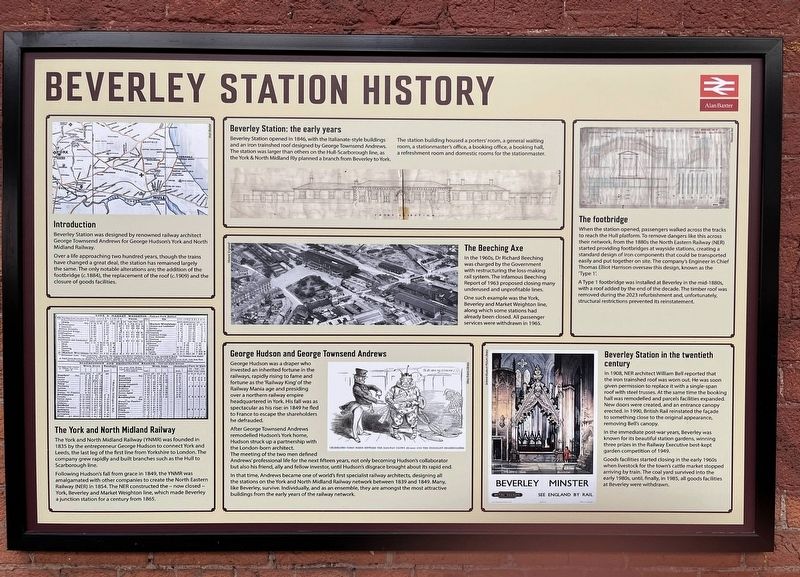
Photographed by Ray Gurganus, April 15, 2025
1. Beverley Station History Marker
Introduction
Beverley Station was designed by renowned railway architect George Townsend Andrews for George Hudson's York and North Midland Railway.
Over a life approaching two hundred years, though the trains have changed a great deal, the station has remained largely the same. The only notable alterations are the addition of the footbridge (c.1884), the replacement of the roof (c.1909) and the closure of goods facilities.
The York and North Midland Railway
The York and North Midland Railway (YNMR) was founded in 1835 by the entrepreneur George Hudson to connect York and Leeds, the last leg of the first line from Yorkshire to London. The company grew rapidly and built branches such as the Hull to Scarborough line.
Following Hudson's fall from grace in 1849, the YNMR was amalgamated with other companies to create the North Railway in 1854, The NER constructed the - now closed - York, Beverley and Market Weighton line, which made Beverley a junction station for a century from 1865.
Beverley Station: the early years
Beverley Station opened in 1846, with the Italianate style buildings and an iron trainshed
this page online
The station building housed a porters' room general waiting room, a stationmaster's office, a booking office, a booking a refreshment room and domestic rooms for the stationmaster.
The Beeching Axe
In the 1960s, Dr Richard Beeching was changed by the Government with restructuring the loss-making rail system. The infamous Beeching Report of 1963 proposed closing many underused and unprofitable lines.
One such example was the York, Beverley and Market Weighton line, along which some stations had already been closed. All passenger services were withdrawn in 1965.
George Hudson and George Townsend Andrews
George Hudson was a draper who invested an inherited fortune in the railways, rapidly rising to fame and fortune as the 'Railway King' of the Railway Mania age and presiding over a northern railway empire headquartered in York. His fall was as spectacular as his rise: in 1849 he fled to France to escape the shareholders he defrauded.
After

From The Marker
2. Beverley Station
In that time, Andrews became one of world's first specialist railway architects, designing all the stations on the York and North Midland Railway network between 1839 and 1849. Many like Beverley, survive. Individually, and as an ensemble, they are amongst the most attractive buildings from the early years of the railway network.
The footbridge
When the station opened, passengers walked across the tracks to reach the Hull platform. To remove dangers like this across their network, from the 1880s the North Eastern Rahway (NER) started providing footbridges at wayside stations, creating a standard design of iron components that could be transported easily and put together on site. The company's Engineer in Chief Thomas Eliot Harrison oversaw this design, known as the 'Type 1'.
A Type 1 footbridge was installed at Beverley in the mid-1880 with a roof added by the end of the decade. The timber roof was removed during the 2023 refurbishment and, unfortunately, structural restrictions prevented its reinstatement.
Beverley Station in the twentieth century
In 1908, NER architect William Bell reported that the iron trainshed roof was worn out. He was soon given permission to replace it with a single-span roof with steel trusses. At the same time the booking hall was remodeled and parcels facilities expanded. New doors were created, and an entrance canopy erected. In 1990, British Rail reinstated the facade to something close to the original appearance, removing Bell's canopy.
In the immediate post-war years, Beverley was known for its beautiful station gardens, winning three prizes in the Railway Executive best-kept garden competition of 1949.
Goods facilities started closing in the early 1960s when livestock for the town's cattle market stopped arriving by train. The coal yard survived into the early 1980s, until finally, in 1905, all goods facilities at Beverley were withdrawn.
Topics. This historical marker is listed in this topic list: Railroads & Streetcars. A significant historical year for this entry is 1846.
Location. 53° 50.526′ N, 0° 25.378′ W. Marker is in Beverley, England, in East Riding of Yorkshire. It can be reached from no nearby street. On the Beverley station platform. Touch for map. Marker is in this post office area: Beverley, England HU17 0DS, United Kingdom. Touch for directions.

Regionally, this marker is in England’s Yorkshire & The Humber. Globally, it is on the Atlantic Ocean, in the North Atlantic Region, in Europe, in Atlantic Europe, on one of the British Isles, in the Western World, and in the Anglosphere. Historically, it finds itself in what was once the Roman Empire.
Other nearby markers. At least 7 other markers are within 13 kilometers of this marker, measured as the crow flies: Welcome to Beverley (approx. 0.3 kilometers away); The Spring Bank West Quaker Burial Ground (approx. 10.7 kilometers away); Hull General Cemetery (approx. 10.8 kilometers away); Amy Johnson's Famous Flight, May 1930 (approx. 11.9 kilometers away); Amy Johnson, 1903-1941 (approx. 11.9 kilometers away); The Story of the Neptune Inn (approx. 12.4 kilometers away); Old Grammar School (approx. 12.6 kilometers away).
Credits. This page was last revised on June 20, 2026. It was originally submitted on July 5, 2025, by Ray Gurganus of Washington, District of Columbia. This page has been viewed 214 times since then and 52 times this year. Photos: 1, 2. submitted on July 5, 2025, by Ray Gurganus of Washington, District of Columbia. • Andrew Ruppenstein was the editor who published this page.
