Norman in Cleveland County, Oklahoma — The American South (West South Central)
Dale Hall
Photographed by Duane and Tracy Marsteller, June 19, 2025
1. Dale Hall Marker
Inscription.
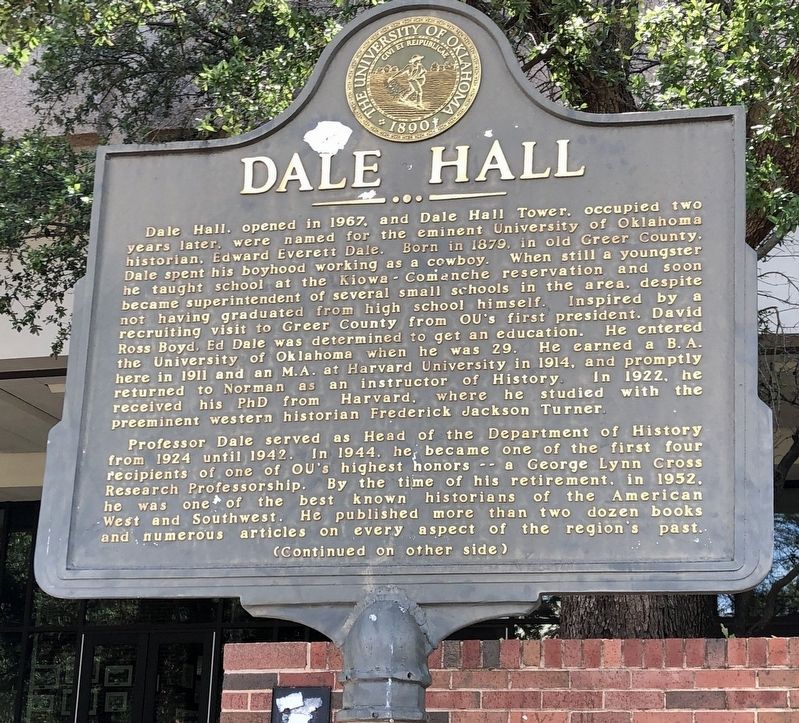
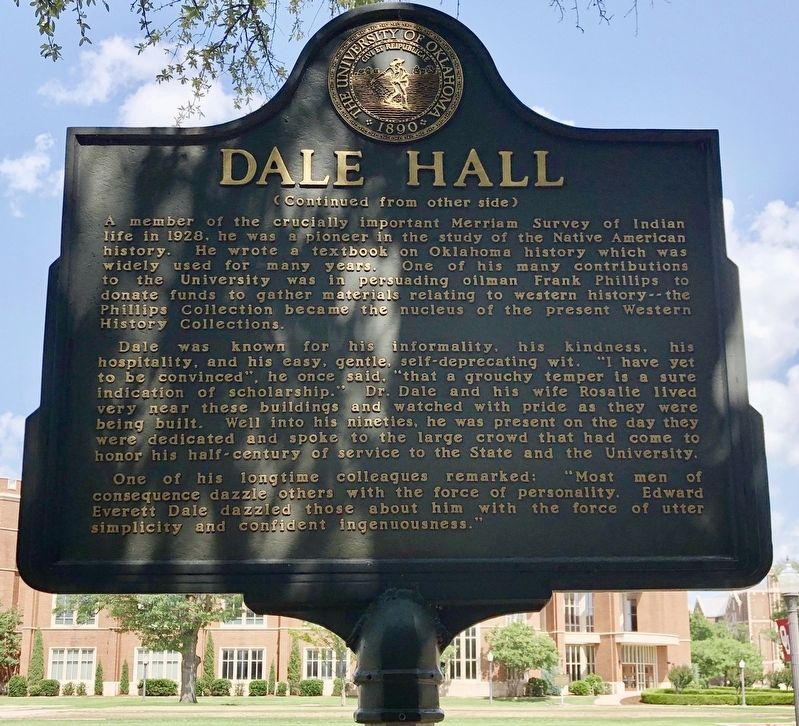
Dale Hall, opened in 1967, and Dale Hall Tower, occupied two years later, were named for the eminent University of Oklahoma historian, Edward Everett Dale. Born in 1879, in old Greer County, Dale spent his boyhood working as a cowboy. When still a youngster he taught school at the Kiowa-Comanche reservation and soon became superintendent of several small schools in the area, despite not having graduated from high school himself. Inspired by a recruiting visit to Greer County from OU's first president, David Ross Boyd, Ed Dale was determined to get an education. He entered the University of Oklahoma when he was 29. He earned a B.A. here in 1911 and an M.A. at Harvard University in 1914, and promptly returned to Norman as an instructor of history. In 1922, he received his Ph.D. from Harvard, where he studied with the preeminent western historian Frederick Jackson Turner. , Professor Dale served as head of the Department of History from 1924 until 1942. In 1944, he became one of the first four recipients of one of OU's highest honors a George Lynn Cross Research Professorship. By the time of his retirement, in 1952, he was one of the best-known historians of the American West and Southwest. He published more than two dozen books and numerous articles on every aspect of the region's past. , A member of the crucially important Merriam Survey of Indian life in 1928, he was a pioneer in the study of the Native American history. He wrote a textbook on Oklahoma history which was widely used for many years. One of his many contributions to the university was in persuading oilman Frank Phillips to donate funds to gather materials relating to western history the Phillips Collection became the nucleus of the present Western History Collections. , Dale was known for his informality, his kindness, his hospitality, and his easy, gentle, self-deprecating wit. I have yet to be convinced, he once said, that a grouchy temper is a sure indication of scholarship. Dr. Dale and his wife Rosalie lived very near these buildings and watched with pride as they were being built. Well into his nineties, he was present on the day they were dedicated and spoke to the large crowd that had come to honor his half-century of service to the state and the university. , One of his longtime colleagues remarked: Most men of consequence dazzle others with the force of personality. Edward Everett Dale dazzled those about him with the force of utter simplicity and confident ingenuousness.
Dale Hall, opened in 1967, and Dale Hall Tower, occupied two years later, were named for the eminent University of Oklahoma historian, Edward Everett Dale. Born in 1879, in old Greer County, Dale spent his boyhood working as a cowboy. When still a youngster he taught school at the Kiowa-Comanche reservation and soon became superintendent of several small schools in the area, despite not having graduated from high school himself. Inspired by a recruiting visit to Greer County from OU's first president, David Ross Boyd, Ed Dale was determined to get an education. He entered the University of Oklahoma when he was 29. He earned a B.A. here in 1911 and an M.A. at Harvard University in 1914, and promptly returned to Norman as an instructor of history. In 1922, he received his Ph.D. from Harvard, where he studied with the preeminent western historian Frederick Jackson Turner.
Professor Dale served as head of the Department of History from 1924 until 1942. In 1944, he became one of the first four recipients of one of OU's highest honors a George Lynn Cross Research Professorship. By the time of his retirement, in 1952, he was one of the best-known historians of the American West and Southwest. He published more than two dozen books and numerous articles on every aspect of the region's past.
A member of the crucially important
Click or scan to see this page online
Merriam Survey of Indian life in 1928, he was a pioneer in the study of the Native American history. He wrote a textbook on Oklahoma history which was widely used for many years. One of his many contributions to the university was in persuading oilman Frank Phillips to donate funds to gather materials relating to western history the Phillips Collection became the nucleus of the present Western History Collections.
Dale was known for his informality, his kindness, his hospitality, and his easy, gentle, self-deprecating wit. I have yet to be convinced, he once said, that a grouchy temper is a sure indication of scholarship. Dr. Dale and his wife Rosalie lived very near these buildings and watched with pride as they were being built. Well into his nineties, he was present on the day they were dedicated and spoke to the large crowd that had come to honor his half-century of service to the state and the university.
One of his longtime colleagues remarked: Most men of consequence dazzle others with the force of personality. Edward Everett Dale dazzled those about him with the force of utter simplicity and confident ingenuousness.
Erected by The University of Oklahoma.
Topics and series. This historical marker is listed in these topic lists: Arts, Letters, Music
Photographed by Duane and Tracy Marsteller, June 19, 2025
2. Dale Hall Marker
• Education. In addition, it is included in the University of Oklahoma series list. A significant historical year for this entry is 1967.
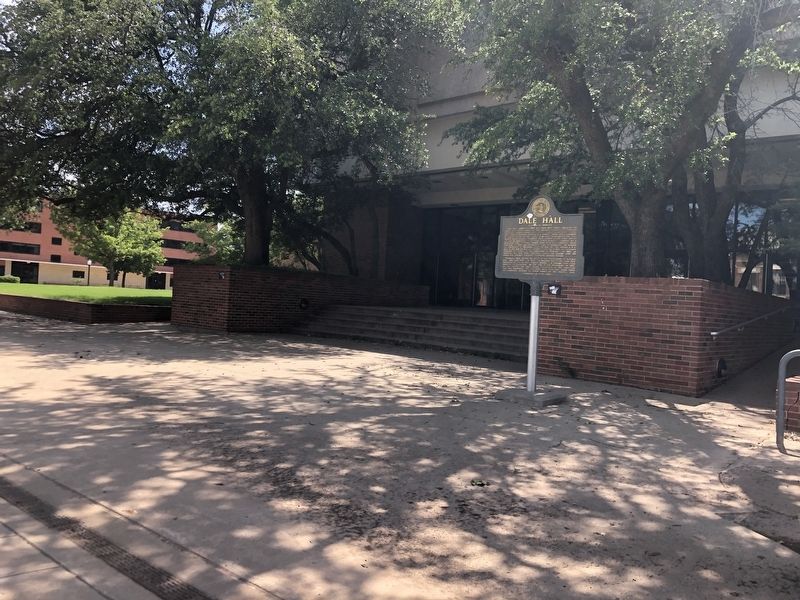
Location. 35° 12.261′ N, 97° 26.766′ W. Marker is in Norman, Oklahoma, in Cleveland County. It is on Van Vleet Oval north of West Lindsey Street, on the left when traveling north. Touch for map. Marker is at or near this postal address: 455 W Lindsey St, Norman OK 73069, United States of America. Touch for directions.

Regionally, this marker is in Central Oklahoma Frontier Country and in Greater Oklahoma City. It is also in the American South, specifically on the prairies, and on the Southern Plains. Globally, it is in North America, the Western Hemisphere, the Western World, and the Anglosphere. Historically, it finds itself in what was once the territory of the Mississippian Culture and also the Louisiana Purchase.
Other nearby markers. At least 8 other markers are within walking distance of this marker: Gaylord Hall (within shouting distance of this marker); Copeland Hall (within shouting distance of this marker); Cate Center (about 300 feet away, measured in a direct line); Collings Hall (about 400 feet away); Gould Hall (about 500 feet away); Craddock Hall (about 600 feet away); Kaufman Hall (about 700 feet away); Dunham College (about 700 feet away). Touch for a list and map of all markers in Norman.
Photographed by Duane and Tracy Marsteller, June 19, 2025
3. Dale Hall Marker
Unknown, University of Oklahoma Sooner yearbook (1924) via Wikipedia (Public Domain), circa 1924
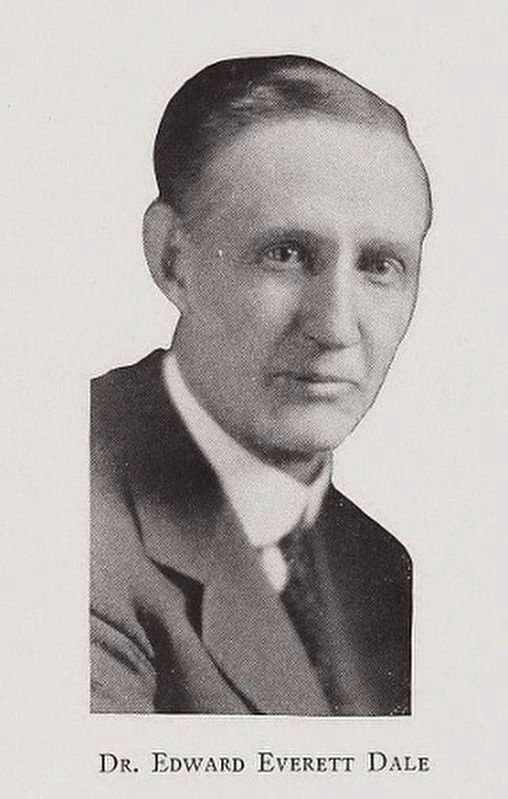
4. Edward Everett Dale (1879-1972)
Among his many works were History of Oklahoma, Indians of the Southwest, Tales of the Teepee, and his autobiography entitled The West Wind Blows.
Credits. This page was last revised on July 6, 2025. It was originally submitted on July 5, 2025, by Duane and Tracy Marsteller of Murfreesboro, Tennessee. This page has been viewed 111 times since then and 25 times this year. Photos:1, 2, 3, 4. submitted on July 5, 2025, by Duane and Tracy Marsteller of Murfreesboro, Tennessee.
