Esmond Township near Carthage in Kingsbury County, South Dakota — The American Midwest (Upper Plains)
Esmond United Methodist Church
June 26, 2025
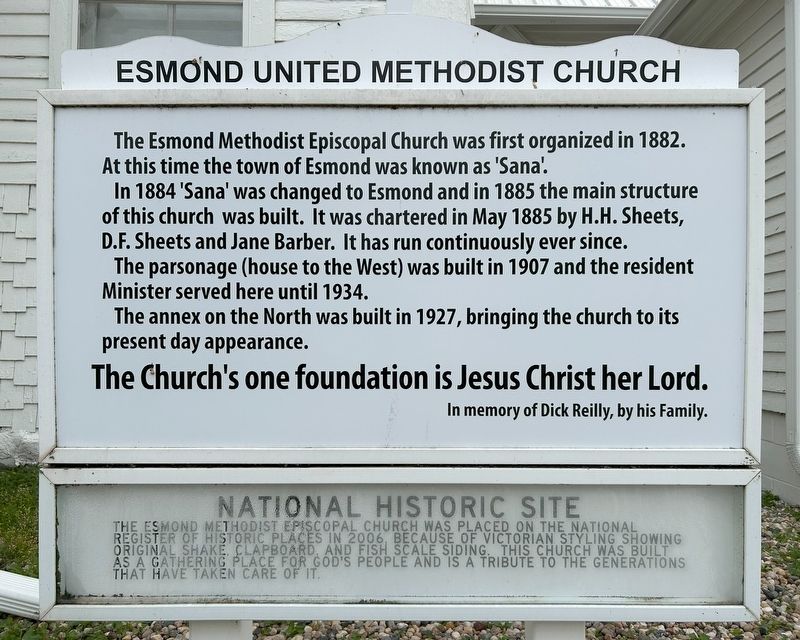
1. Esmond United Methodist Church Marker
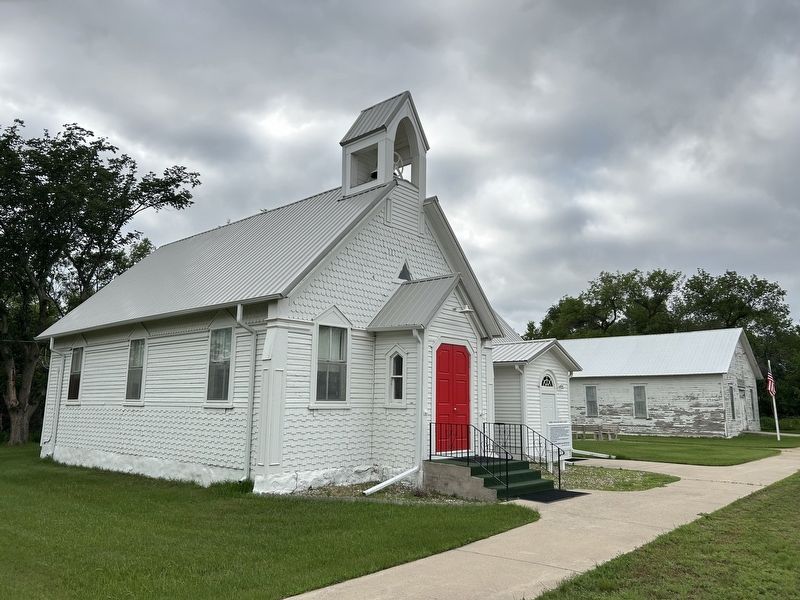
The Esmond Methodist Episcopal Church was first organized in 1882. At this time the town of Esmond was known as 'Sana'.
In 1884 'Sana' was changed to Esmond and in 1885 the main structure of this church was built. It was chartered in May 1885 by H.H. Sheets, D.F. Sheets and Jane Barber. It has run continuously ever since.
The parsonage (house to the West) was built in 1907 and the resident Minister served here until 1934.
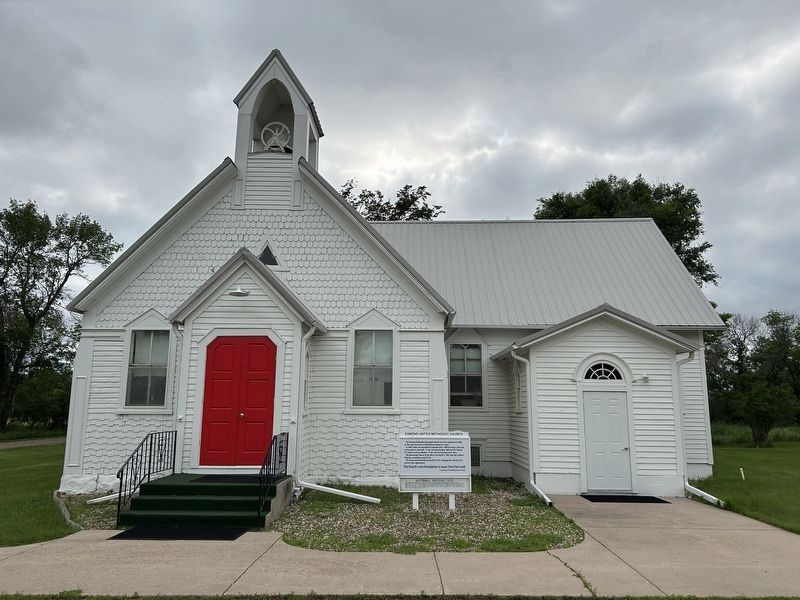
The annex on the North was built in 1927, bringing the church to its present day appearance.
The Church's one foundation is Jesus Christ her Lord.
National Historic Site
The Esmond Methodist Episcopal Church was placed on the National Register of Historic Places in 2006, because of Victorian styling showing original shake, clapboard, and fish scale siding. This church was built as a gathering place for God's people and is a tribute to the generations that have taken care of it.
Erected by the family of Dick Reilly, in his memory.
Topics and series. This historical marker is listed in these topic lists: Architecture • Religion & Religious Structures. In addition, it is
this page online
Location. 44° 15.753′ N, 97° 46.309′ W. Marker is near Carthage, South Dakota, in Kingsbury County. It is in Esmond Township. It is at the intersection of Center Street and Elm Street, on the right when traveling south on Center Street. Located in the old town of Esmond. Touch for map. Marker is in this post office area: Iroquois SD 57353, United States of America. Touch for directions.

Regionally, this marker is in East River. It is also in the American Midwest, in the Lewis & Clark Corridor, in the Corn Belt, on the prairies, and on the Northern Plains. Globally, it is in North America, the Western Hemisphere, the Western World, and the Anglosphere. Historically, it finds itself in what was once Rupert’s Land and also the Louisiana Purchase.
Other nearby markers. At least 8 other markers are within 8 miles of this marker, measured as the crow flies: Flour Mill (approx. 6.8 miles away); Coughlin House (approx. 6.8 miles away); Carthage Veterans Memorial (approx. 6.9 miles away); Manchester (approx. 7.8
June 26, 2025
2. Esmond United Methodist Church & Marker
Also see . . .
1. Homecoming at Esmond, South Dakota | South Dakota Magazine. (Submitted on July 6, 2025.)
2. South Dakota SP Esmond Methodist Episcopal Church and Township Hall | National Archives Catalog. From the National Register of Historic Places Continuation Sheet (2006) Significance statement:
"The Esmond Methodist Episcopal Church and Township Hall ... embody distinctive characteristics of a type, period, and method of construction. The church was constructed in 1885 according to a pattern-book design. This design was a nave plan that featured more decoration than was typical of other first-generation churches in South Dakota. The Esmond Township Hall is representative of local, rural South Dakota government construction during the late nineteenth century."(Submitted on July 6, 2025.)
"The Esmond Methodist Episcopal Church ... was constructed accordingto Church Plan Number 40 from the Catalog of Architectural Plans for Churches and Parsonages produced by the Methodist Board of Church Extension. This particular design featured six different sized nave plans with a five by seven foot vestibule with seating capacity ranging from 108 seats at the smallest to 200 seats at the largest. The estimated cost for construction in the 1889 edition of the catalog was between $800 and $1,500. This design also featured three horizontal bands of different siding, a decorated bell tower, and triangle-peaked windows."June 26, 20253. Esmond United Methodist Church
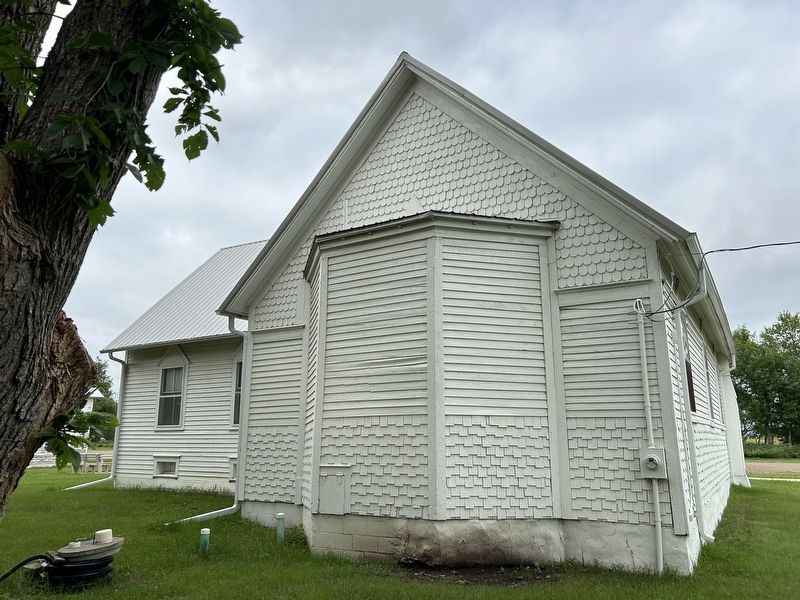
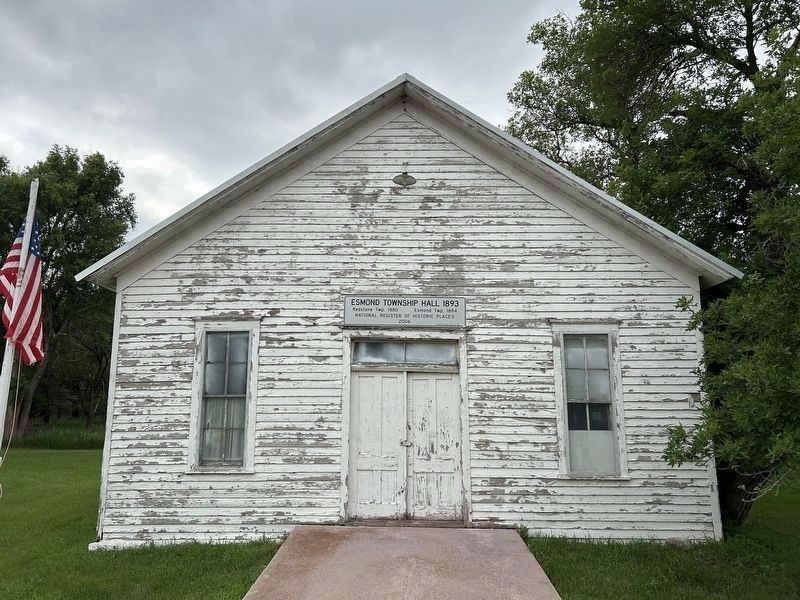
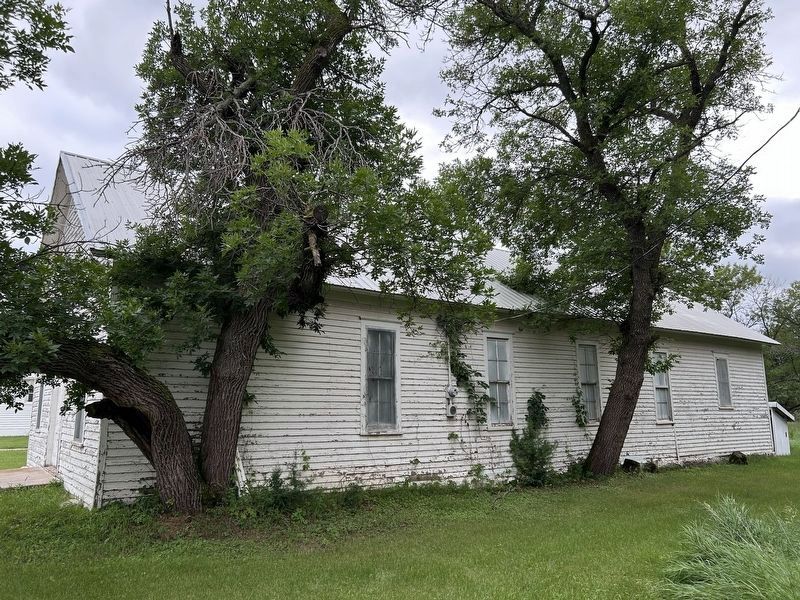
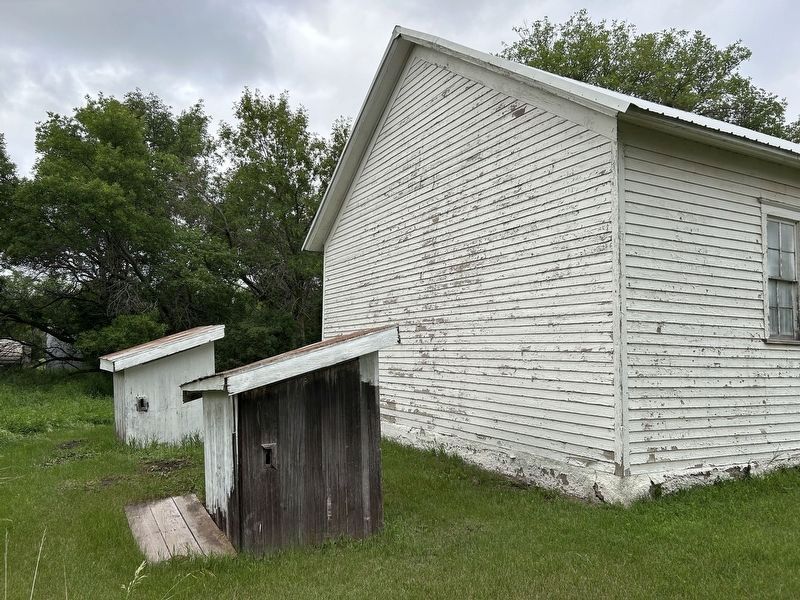
"The Esmond Township Hall is ... an excellent example of a rural, local governmental building constructed in South Dakota toward the end of the nineteenth century. In South Dakota, most buildings constructed by local governments, especially the township level, were simple, wooden, one- to two-story vernacular structures often with a gable or false-parapet front. These types of buildings were generally simply constructed because of the limited amount of funds most townships had during the late nineteenth century. The Esmond Township Hall is representative of this type of constructionas it is a simple, vernacular woodframe building with a front gable."June 26, 20254. Esmond United Methodist Church, west side
June 26, 2025
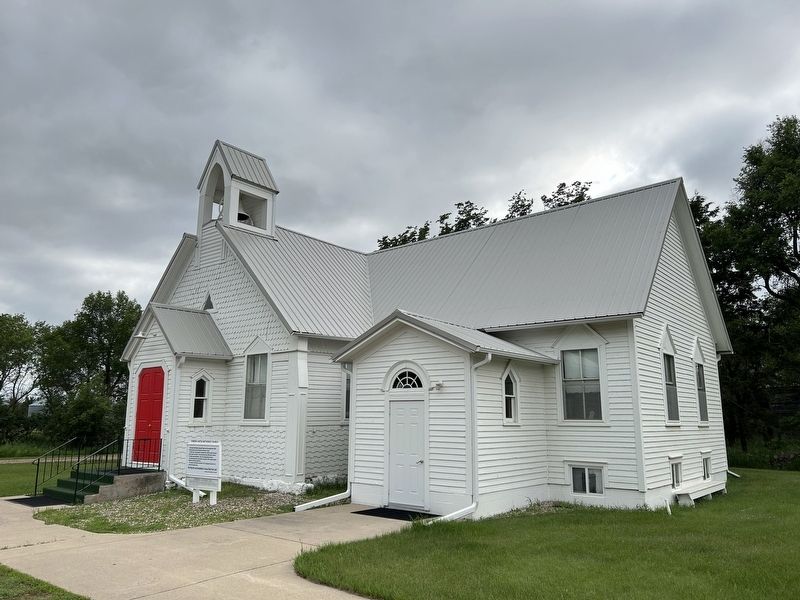
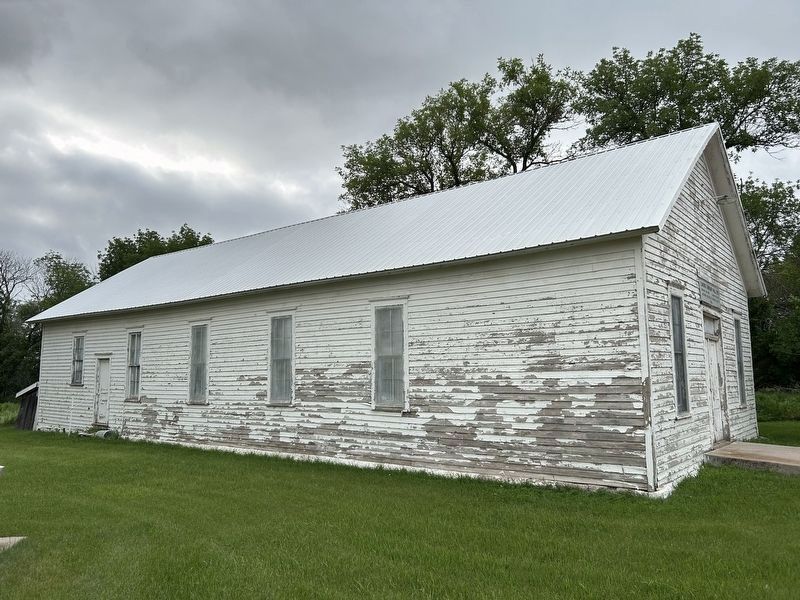
5. Esmond United Methodist Church and Esmond Township Hall
June 26, 2025
6. Esmond Township Hall
Marker:
Esmond Township Hall 1893
Redstone Twp. 1880
Esmond Twp. 1884
National Register of Historic Place's 2006
Donated By Esmond Social Club 2008
Esmond Township Hall 1893
Redstone Twp. 1880
Esmond Twp. 1884
National Register of Historic Place's 2006
Donated By Esmond Social Club 2008
June 26, 2025
7. Esmond Township Hall
June 26, 2025
8. Esmond Township Hall
June 26, 2025
9. Esmond Township Hall
Credits. This page was last revised on July 7, 2025. It was originally submitted on July 6, 2025. This page has been viewed 148 times since then and 43 times this year. Photos: 1, 2, 3, 4, 5, 6, 7, 8, 9. submitted on July 6, 2025.
