Cartersville in Bartow County, Georgia — The American South (South Atlantic)
Etowah Mounds
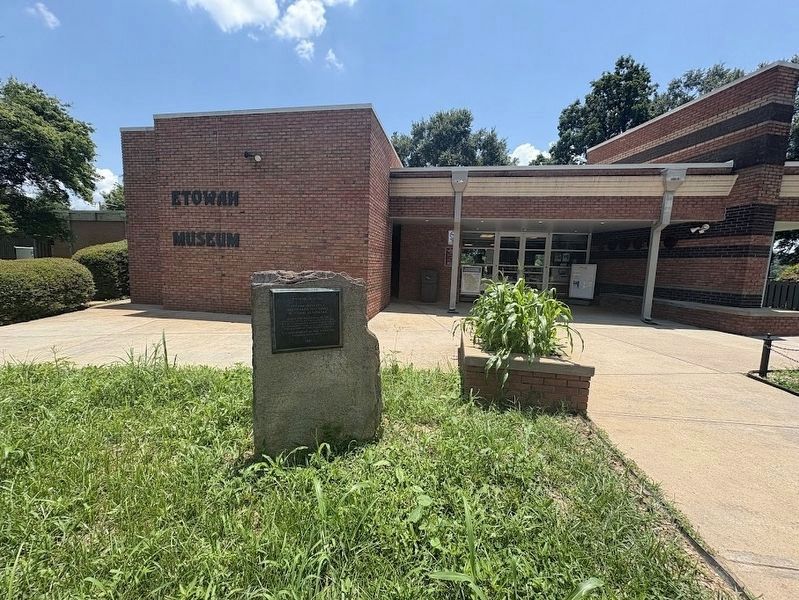
Photographed by Darren Jefferson Clay, June 22, 2025
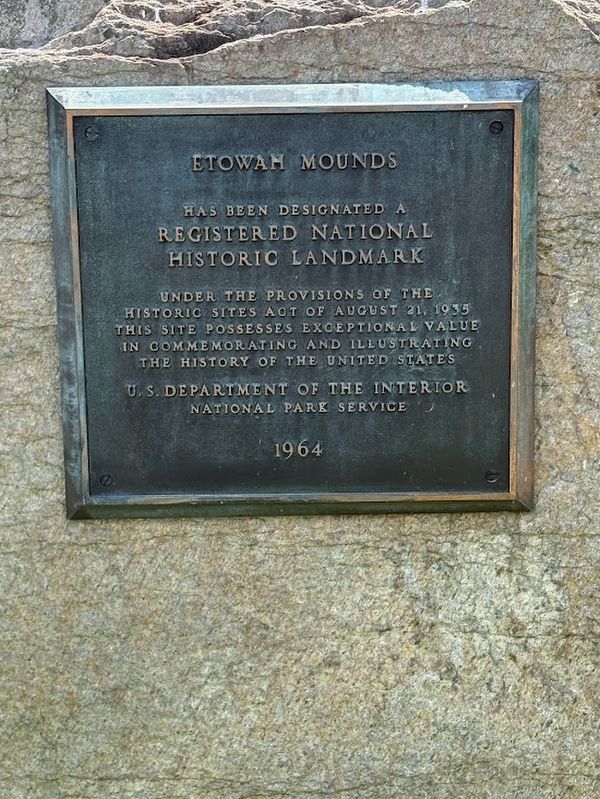
1. Etowah Mounds
has been designated a
Registered National Historic Landmark
under the provisions of the
Historic Sites Act of August 21, 1935
This site possesses exceptional value
in commemorating and illustrating
the history of the United States
U.S. Department of the Interior
National Park Service
1964
Erected 1964 by National Park Service, U.S. Department of the Interior.
Topics. This historical marker is listed in this topic list: Landmarks.
Location. 34° 7.69′ N, 84° 48.432′ W. Marker is in Cartersville, Georgia, in Bartow County. It can be reached from Indian Mound Road Southeast 0.2 miles south of Sequoyah Circle, on the left when traveling south. Touch for map. Marker is at or near this postal address: 813 Indian Mound Rd SE, Cartersville GA 30120, United States of America. Touch for directions.

Regionally, this marker is in the Mountains. It is also in the American South and specifically in the Deep South. Globally, it is in North America, the Western Hemisphere, the Western World, and the Anglosphere. Historically, it finds itself in
this page online
Other nearby markers. At least 8 other markers are within walking distance of this marker: Remote Sensing at Etowah (a few steps from this marker); Etowah’s Wattle and Daub House (within shouting distance of this marker); The Defensive Ditch/Borrow Pit (within shouting distance of this marker); A Return to Native Grasses (about 300 feet away, measured in a direct line); Etowah (Tumlin) Mounds (about 500 feet away); A Chiefly Village on the Etowah (about 600 feet away); Mound A - Symbol of a Chiefdom (approx. 0.2 miles away); Etowah’s Past, Present, and Future (approx. ¼ mile away). Touch for a list and map of all markers in Cartersville.
Regarding Etowah Mounds. Citation from the National Register of Historic Places nomination form:
Etowah is located in a State Park near Cartersville, Georgia, on the north bank of the Etowah at the point of the river's emergence from the Piedmont province where it begins flowing toward the west acrossthe southern end of the Great Valley section of the Ridge and Valley Province. This location is also at the point where the Etowah Valley widens to permit the development of a considerable floodplain area and alluvial soils necessary for cultivation. The site is thus on the boundary between two major physiographic provinces (Piedmont Province and Great Valley Section)—an ideal location for the exploitation of various resources.Photographed by Darren Jefferson Clay, June 22, 20252. Etowah Mounds
Etowah consists of three large platform mounds, two plaza areas, associated village debris, and a surrounding ditch attached to large borrow pits. Early reports indicate that there were at least four other small mound structures within the enclosed area; but these have been destroyed by cultivation and are now only barely / visible at the surface, if at all. Refer to the accompanying Map B for a clarification of the features evident on the site in the late 1920's.
Mound A, the largest at the site, is a flat-topped mound which covers several acres, measures about 330 by 380 feet at its base, and rises to a height of about 50 to 60 or 65 feet. A clay ramp stepped with logs leads up its eastern side to the mound top. The northwest corner of Mound A is lower than the eastern half; the southwest corner is even lower than the northwest corner. There are thus different levels of Mound A. These levels may have formed an alternative access route to the mound top. Mound B, a rectangular truncated pyramid, is slightly south and slightly east of the dominant Mound A. Mound C, also flat-topped, is situated slightly southwest of Mound B. Early reports indicate that Mound C had a ramp facing east. One of the plaza areas is situated between Mounds B and C and south of Mound A, and another is to the east of Mound A.
For nearly a hundred years, excavations have been conducted at Etowah. Sometime between 1883 and 1885, John P. Rogan, under the direction of Cyrus Thomas of the Bureau of American Ethnology, conducted excavations of Mound C and tested Mound B and several of the other small mounds (not now visible) on the site. Then, in 1925, 1926, and 1927, Warren K. Moorehead of the Phillips Academy at Andover, Massachusetts conducted intensive excavations of Mound C. Moorehead also tested Mound B and investigated small portions of the village area. Sometime between 1938, and 1941, Robert Wauchope of the Georgia Department of Natural Resources and the University of Georgia sunk several trenches near the moat on the west side of the concentration of village debris. In 1952 and 1953, William Sears of the Georgia Historical Commission conducted excavations in the village area and in the vicinity of Mounds B and C. Lewis Larson of the Georgia Historical Commission investigated Mound C in 1954; and in the same year, Roger Kelly of the University of Georgia excavated in Etowah, located near Carterville, Georgia, is a Mississippian center serving numerous smaller contemporary village sites in the Etowah Valley and consisting of three large platform mounds, a village area, and an encircling ditch or moat which was originally paralleled by a palisade. Overlooking the Etowah River, the site is important as an expression of the eastern expansion of Mississippian culture and of the forms Mississippian culture took as a result of interaction with other Southeastern cultural traditions (e.g. Gulf Coast Tradition). Even more significant is the vast quantity of unusual and elaborate ceremonial material which the site has yielded. Many of these objects exhibit design elements characteristic of the Southeastern Ceremonial Complex, also known as the Southern Cult, which was evident in the Southeast during Late Mississippian times. Etowah stands as one of three major sites in the country to provide extensive evidence for this complex.
Archeologists have discerned three general phases of occupation at Etowah: Etowah, Wilbanks, and Lamar. The exact date of the initial occupation of the site is unclear as is the initial period of mound construction; and in fact, the dates of the various phases have been a subject of controversy. Larson, the most recent excavator at the site, believes that the Etowah phase dates from about 1350 - 1450, Wilbanks from about 1450 - 1550, and Lamar from post-1540, although he readily points out that other archeologists would take issue with his feelings concerning the lateness of these dates (Larson, personal communication). Dates as early as 1000 A.D. and 1200 A.D. have been proposed for the beginnings of occupation at the site (e.g. Willey, 1966). As mentioned in the preceding description (No. 7), some scatterings of Woodland material have been noted, but no Woodland living floor has been discerned. Woodland sites do exist in other areas of the Etowah Valley, and it is thus no surprise that some Woodland artifacts were recovered.
Several of the reports on Etowah (e.g. Caldwell, 1954) imply that the Etowah phase is composed of several sub-phases (Etowah I, II, III, and IV) on the basis of subtle changes in pottery types. Larson, however, doubts the existence of Etowah I and believes that Etowah IV is indistinguishable from the Wilbanks phase (personal communication, 1977). Larson 1 s basic interpretation from his excavations is that there is only one Etowah phase.
Credits. This page was last revised on July 8, 2025. It was originally submitted on July 6, 2025, by Darren Jefferson Clay of Duluth, Georgia. This page has been viewed 135 times since then and 44 times this year. Photos: 1, 2. submitted on July 6, 2025, by Darren Jefferson Clay of Duluth, Georgia. • Bernard Fisher was the editor who published this page.
