Near Glenville in Schenectady County, New York — The American Northeast (Mid-Atlantic)
Korean War
1950-1953
Photographed by Steve Stoessel, June 30, 2025
1. Korean War Marker
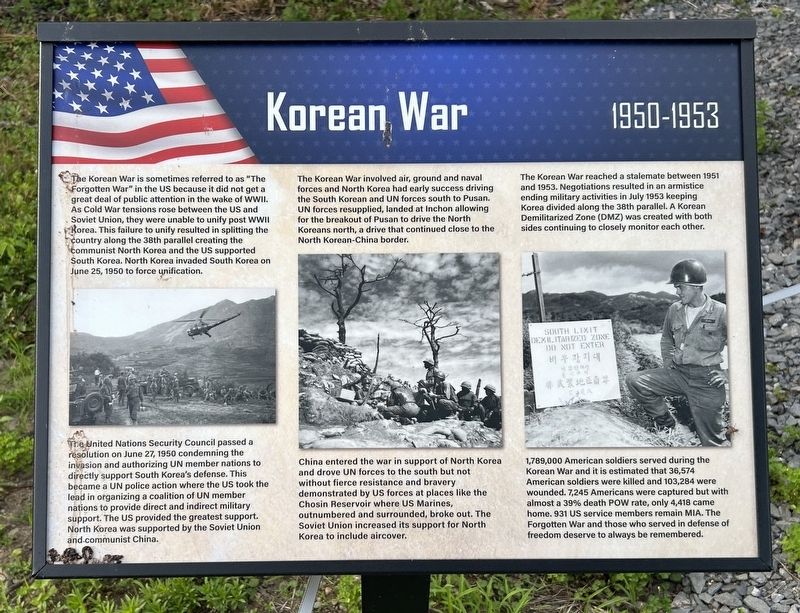
The Korean War is sometimes referred to as "The Forgotten War" in the US because it did not get a great deal of public attention in the wake of WWII. As Cold War tensions rose between the US and Soviet Union, they were unable to unify post WWIl Korea. This failure to unity resulted in splitting the country along the 38th parallel creating the communist North Korea and the US supported South Korea. North Korea invaded South Korea on June 25, 1950 to force unification.
The United Nations Security Council passed a resolution on June 27, 1950 condemning the invasion and authorizing UN member nations to directly support South Korea's defense. This became a UN police action where the US took the lead in organizing a coalition of UN member nations to provide direct and indirect military support. The US provided the greatest support. North Korea was supported by the Soviet Union and Communist China.
The Korean War involved air, ground and naval forces and North Korea had early success driving the South Korean and UN forces south to Pusan. UN forces resupplied, landed at Inchon allowing for the breakout of Pusan to drive the
this page online
China entered the war in support of North Korea and drove UN forces to the south but not without fierce resistance and bravery demonstrated by US forces at places like the Chosin Reservoir where US Marines, outnumbered and surrounded, broke out. The Soviet Union increased its support for North Korea to include aircover.
The Korean War reached a stalemate between 1951 and 1953. Negotiations resulted in an armistice ending military activities in July 1953 keeping Korea divided along the 38th parallel. A Korean Demilitarized Zone (DMZ) was created with both sides continuing to closely monitor each other.
1,789,000 American soldiers served during the Korean War and it is estimated that 36,574 American soldiers were killed and 103,284 were wounded. 7,245 Americans were captured but with almost a 39% death POW rate, only 4,418 came home. 931 US service members remain MIA. The Forgotten War and those who served in defense of freedom deserve to always be remembered.
Topics. This historical marker is listed in this topic list: War, Korean. A significant historical date for this entry is June 25, 1950.
Location. 42° 50.312′ N,
Photographed by Steve Stoessel, June 30, 2025
2. Korean War Marker

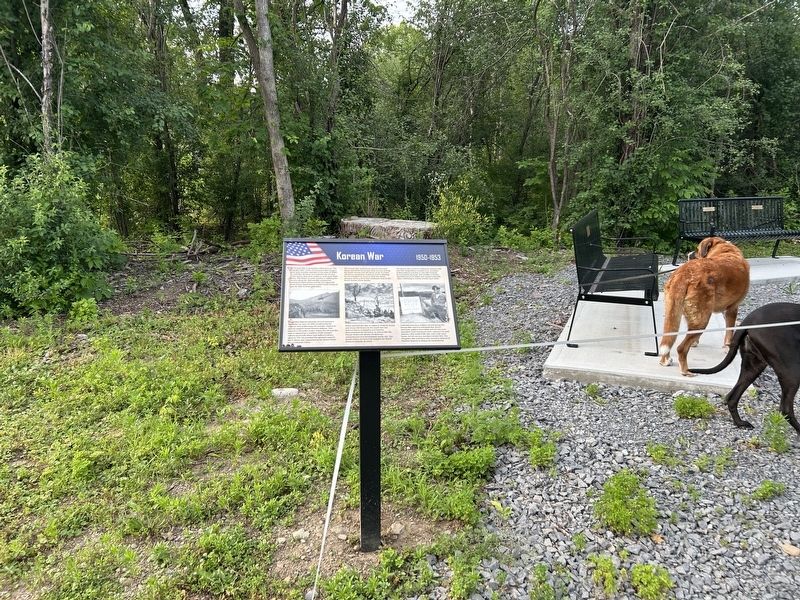
Regionally, this marker is in Upstate New York, in the Capital District, and in the Albany Metropolitan Area. It is also in the American Northeast and in the Mid-Atlantic. Globally, it is in North America, the Western Hemisphere, the Western World, and the Anglosphere. Historically, it finds itself in what was once New Netherland and also one of the original Thirteen Colonies.
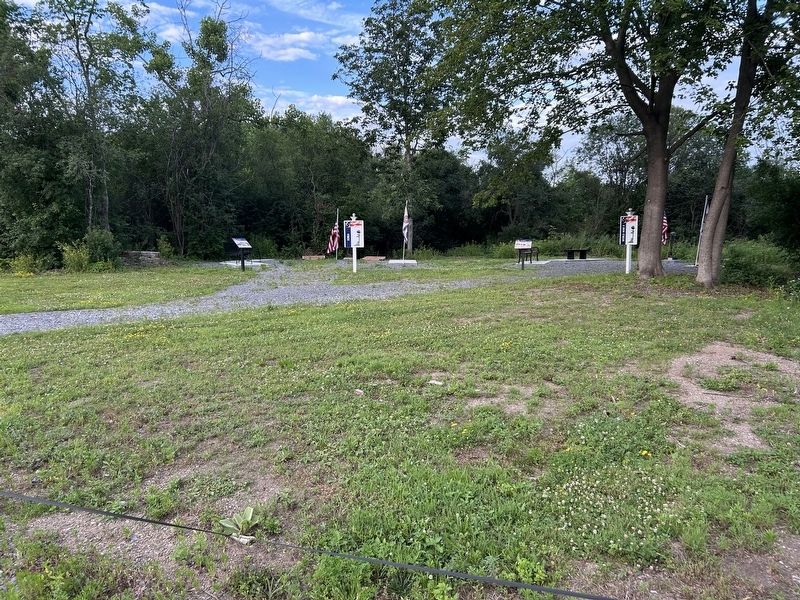
Other nearby markers. At least 8 other markers are within walking distance of this marker: World War II (a few steps from this marker); Persian Gulf War (within shouting distance of this marker); Vietnam War (within shouting distance of this marker); Iraq War (within shouting distance of this marker); World War I (within shouting distance of this marker); War in Afghanistan (within
Photographed by Steve Stoessel, June 30, 2025
3. Korean War Marker
Also see . . . The Korean War (Wikipedia).
The Korean War (25 June 1950 – 27 July 1953) was an armed conflict on the Korean Peninsula fought between North Korea (Democratic People's Republic of Korea; DPRK) and South Korea (Republic of Korea; ROK) and their allies. North Korea was supported by China and the Soviet Union, while South Korea was supported by the United Nations Command (UNC) led by the United States. The conflict was one of the first major proxy wars of the Cold War. Fighting ended in 1953 with an armistice but no peace treaty, leading to the ongoing Korean conflict.(Submitted on July 8, 2025, by Steve Stoessel of Niskayuna, New York.)
Credits. This page was last revised on July 8, 2025. It was originally submitted on July 7, 2025, by Steve Stoessel of Niskayuna, New York. This page has been viewed 105 times since then and 25 times this year. Photos: 1. submitted on July 7, 2025, by Steve Stoessel of Niskayuna, New York. 2, 3. submitted on July 8, 2025, by Steve Stoessel of Niskayuna, New York.
