Milford Mine Memorial Park near Wolford in Crow Wing County, Minnesota — The American Midwest (Upper Plains)
Welcome to Milford Mine Memorial Park
Photographed by McGhiever, June 27, 2025
1. Welcome to Milford Mine Memorial Park Marker
Inscription.
Welcome to Milford Mine Memorial Park. .
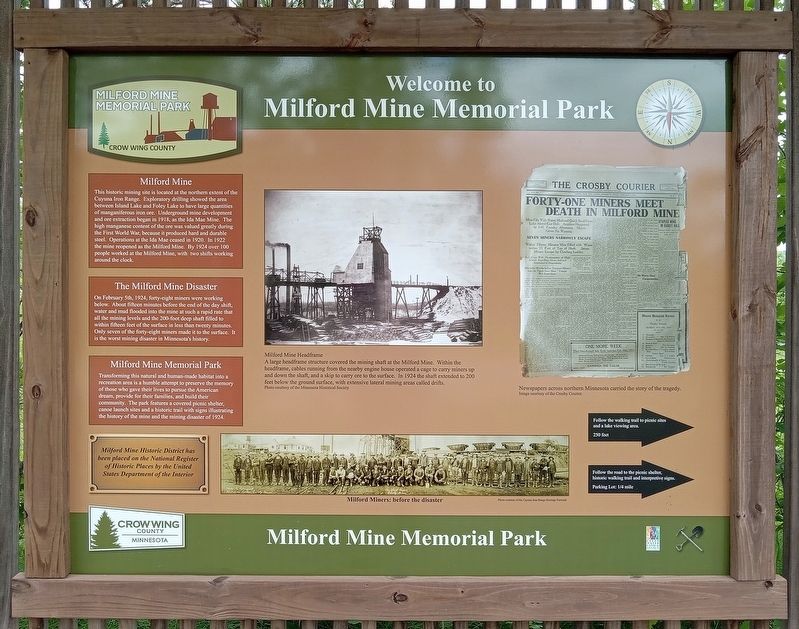
Milford Mine. This historic mining site is located at the northern extent of the Cuyuna Iron Range. Exploratory drilling showed the area between Island Lake and Foley Lake to have large quantities of manganiferous iron ore. Underground mine development and ore extraction began in 1918, as the Ida Mae Mine. The high manganese content of the ore was valued greatly during the First World War, because it produced hard and durable steel. Operations at the Ida Mae ceased in 1920. In 1922 the mine reopened as the Milford Mine. By 1924 over 100 people worked at the Milford Mine, with two shifts working around the clock.,
The Milford Mine Disaster. On February 5th, 1924, forty-eight miners were working below. About fifteen minutes before the end of the day shift, water and mud flooded into the mine at such a rapid rate that all the mining levels and the 200-foot deep shaft filled to within fifteen feet of the surface in less than twenty minutes. Only seven of the forty-eight miners made it to the surface. It is the worst mining disaster in Minnesota's history.,
Milford Mine Memorial Park. Transforming this natural and human-made habitat into a recreation area is a humble attempt to preserve the memory of those who gave their lives to pursue the American dream, provide for their families, and build their community. The park features a covered picnic shelter, canoe launch sites and a historic trail with signs illustrating the history of the mine and the mining disaster of 1924., Milford Mine Historic District has been placed on the National Register of Historic Places by the United States Department of the Interior, Milford Mine Headframe A large headframe structure covered the mining shaft at the Milford Mine. Within the headframe, cables running from the nearby engine house operated a cage to carry miners up and down the shaft, and a skip to carry ore to the surface. In 1924 the shaft extended to 200 feet below the ground surface, with extensive lateral mining areas called drifts. Photo courtesy of the Minnesota Historical Society, Newspapers across northern Minnesota carried the story of the tragedy. Image courtesy of the Crosby Courier, Milford Miners: before the disaster Photo courtesy of the Cuyuna Iron Range Heritage Network, Follow the walking trail to picnic sites and a lake viewing area. 250 feet, Follow the road to the picnic shelter, historic walking trail and interpretive signs Parking Lot: 1/4 mile
Milford Mine
This historic mining site is located at the northern extent of the Cuyuna Iron Range. Exploratory drilling showed the area between Island Lake and Foley Lake to have large quantities of manganiferous iron ore. Underground mine development and ore extraction began in 1918, as the Ida Mae Mine. The high manganese content of the ore was valued greatly during the First World War, because it produced hard and durable steel. Operations at the Ida Mae ceased in 1920. In 1922 the mine reopened as the Milford Mine. By 1924 over 100 people worked at the Milford Mine, with two shifts working around the clock.
The Milford Mine Disaster
On February 5th, 1924, forty-eight miners were working below. About fifteen minutes before the end of the day shift, water and mud flooded into the mine at such a rapid rate that all the mining levels and the 200-foot deep shaft filled to within fifteen feet of the surface in less than twenty minutes. Only seven of the forty-eight miners made it to the surface. It is the worst mining disaster in Minnesota's history.
Milford Mine Memorial Park
Transforming this natural and human-made habitat into a recreation area is a humble attempt to preserve the memory of those who gave their lives to pursue
Click or scan to see this page online
the American dream, provide for their families, and build their community. The park features a covered picnic shelter, canoe launch sites and a historic trail with signs illustrating the history of the mine and the mining disaster of 1924.
Milford Mine Historic District has been placed on the National Register of Historic Places by the United States Department of the Interior
Milford Mine Headframe
A large headframe structure covered the mining shaft at the Milford Mine. Within the headframe, cables running from the nearby engine house operated a cage to carry miners up and down the shaft, and a skip to carry ore to the surface. In 1924 the shaft extended to 200 feet below the ground surface, with extensive lateral mining areas called drifts.
Photo courtesy of the Minnesota Historical Society
Newspapers across northern Minnesota carried the story of the tragedy.
Image courtesy of the Crosby Courier
Milford Miners: before the disaster
Photo courtesy of the Cuyuna Iron Range Heritage Network
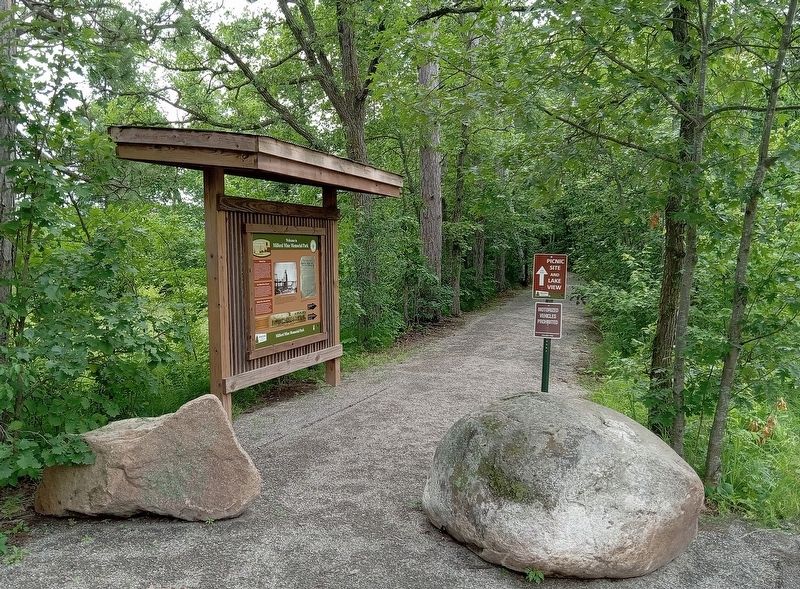
Follow the walking trail to picnic sites and a lake viewing area.
250 feet
Follow the road to the picnic shelter, historic walking trail and interpretive signs
Parking Lot: 1/4 mile
Erected by Crow Wing
Photographed by McGhiever, June 27, 2025
2. Welcome to Milford Mine Memorial Park Marker
County.
Topics. This historical marker is listed in these topic lists: Disasters • Industry & Commerce. A significant historical date for this entry is February 5, 1924.
Location. 46° 32.268′ N, 93° 57.903′ W. Marker is near Wolford, Minnesota, in Crow Wing County. It is in Milford Mine Memorial Park. It is on Milford Lake Drive south of County Road 30, on the left when traveling west. Touch for map. Marker is in this post office area: Crosby MN 56441, United States of America. Touch for directions.

Regionally, this marker is in Minnesota’s Northland. It is also in the American Midwest, in the Corn Belt, and in the Great River Road Region. Globally, it is in North America, the Great North Woods, the Western Hemisphere, the Western World, and the Anglosphere. Historically, it finds itself in what was once Ruperts Land, the territory of the Mississippian Culture, and the Northwest Territory.
Credits. This page was last revised on July 16, 2025. It was originally submitted on July 7, 2025, by McGhiever of Minneapolis, Minnesota. This page has been viewed 125 times since then and 19 times this year. Photos:1, 2. submitted on July 7, 2025, by McGhiever of Minneapolis, Minnesota.
