
First Ward in Buffalo in Erie County, New York — The American Northeast (Mid-Atlantic)
The Buffalo Harbor's Grain Elevators — Childs Street
Photographed by Paige Miller, April 23, 2017
1. The Buffalo Harbor's Grain Elevators — Childs Street Marker
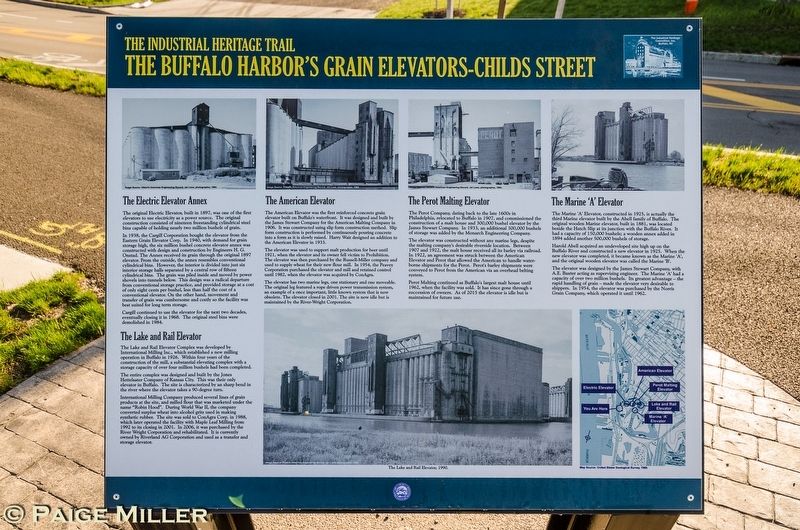
The Electric Elevator Annex
1897 elevator. From the outside, the annex resembles conventional cylindrical bins. However, the interior is divided into just six interior storage halls separated by a central row of fifteen cylindrical bins. The grain was piled inside and moved by power shovels into tunnels below. This design was a radical departure from convention The original Electric Elevator, built in 1897, was one of the first elevators to use electricity as a power source. The original construction consisted of nineteen freestanding cylindrical steel bins capable of holding nearly two million bushels of grain.
In 1938, the Cargill Corporation bought the elevator from the Eastern Grain Elevator Corp. In 1940, with demand for grain storage high, the six million bushel concrete elevator annex was constructed with design and construction by Engineers H. G. Onstad. The Annex received its grain through the original al storage practice, and provided storage at a cost of only eight cents per bushel, less than half the cost of a conventional elevator. On the other hand, movement and transfer of grain was cumbersome and
this page online
Cargill continued to use the elevator for the next two decades, eventually closing it in 1968. The original steel bins were demolished in 1984.
The Lake and Rail Elevator
The Lake and Rail Elevator Complex was developed by International Milling Inc., which established a new milling operation in Buffalo in 1926. Within four years of the construction of the mill, a substantial elevating complex with a storage capacity of over four million bushels had been completed.
The entire complex was designed and built by the Jones Hettelsater Company of Kansas City. This was their only elevator in Buffalo. The site is characterized by an sharp bend in the river where the elevator takes a 90-degree turn.
International Milling Company produced several lines of grain products at the site, and milled flour that was marketed under the name "Robin Hood". During World War II, the company converted surplus wheat into alcohol grits used in making synthetic rubber. The site was sold to ConAgra Corp. in 1988, which later operated the facility with Maple Leaf Milling from 1992 to its
Photographed by Paige Miller, July 5, 2025
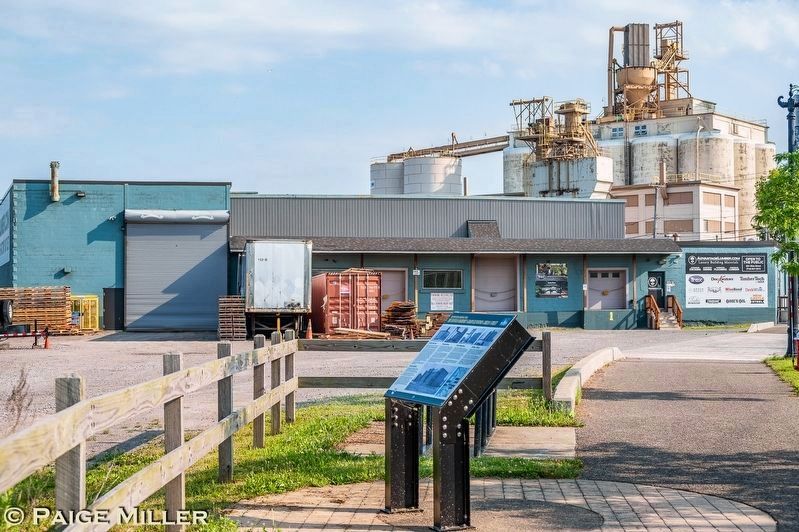
2. The Buffalo Harbor's Grain Elevators — Childs Street Marker
The American Elevator
The American Elevator was the first reinforced concrete grain elevator built on Buffalo's waterfront. It was designed and built by the James Stewart Company for the American Malting Company in 1906. It was constructed using slip form construction method. Slip form construction is performed by continuously pouring concrete into a form as it is slowly raised. Harry Wait designed an addition to the American Elevator in 1933.
The elevator was used to support malt production for beer until 1921, when the elevator and its owner fell victim to Prohibition. The elevator was then purchased by the Russell-Miller company and used to supply wheat for their new flour mill. In 1954, the Peavey Corporation purchased the elevator and mill and retained control until 1982, when the elevator was acquired by ConAgra.
The elevator has two marine legs, one stationary and one moveable. The original leg featured a rope driven power transmission
Photographed by Paige Miller, July 5, 2025
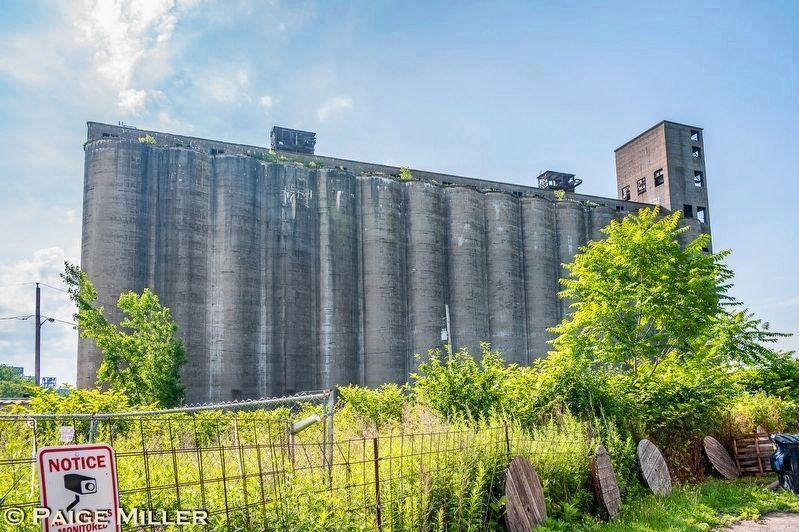
3. Marine 'A' Grain Elevator
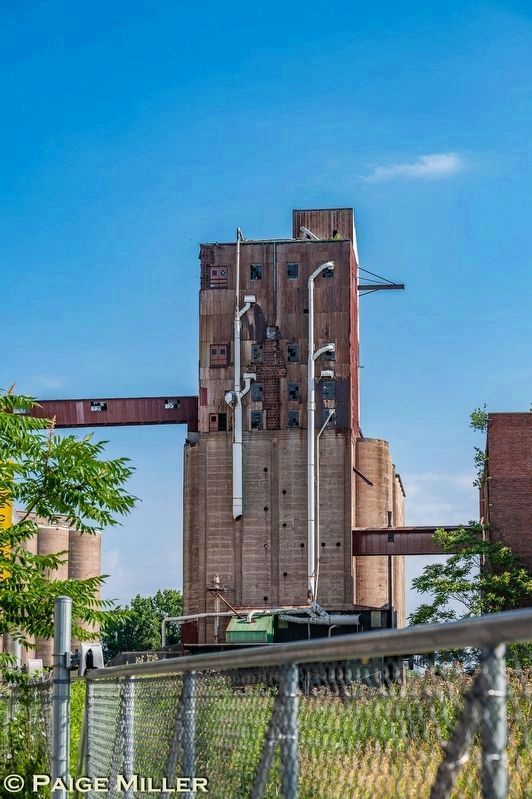
The Perot Malting Elevator
The Perot Company, dating back to the late 1600s in Philadelphia, relocated to Buffalo in 1907, and commissioned the construction of a malt house and 300,000 bushel elevator by the James Stewart Company. In 1933, an additional 300,000 bushels of storage was added by the Monarch Engineering Company.
The elevator was constructed without any marine legs, despite the malting company's desirable riverside location. Between 1907 and 1922, the malt house received all its barley via railroad. In 1922, an agreement was struck between the American Elevator and Perot that allowed the American to handle water-borne shipments for the Perot. Perot's barley shipments were conveyed to Perot from the American via an overhead belting system.
Perot Malting continued as Buffalo's largest malt house until 1962, when the facility was sold. It has since gone through a succession of owners. As of 2015 the elevator is idle but is maintained
Photographed by Paige Miller, July 5, 2025
4. Perot Malting Grain Elevator
The Marine 'A' Elevator
The Marine 'A' Elevator, constructed in 1925, is actually the third Marine elevator built by the Abell family of Buffalo. The original wooden Marine elevator, built in 1881, was located beside the Hatch Slip at its junction with the Buffalo River. It had a capacity of 150,000 bushels; a wooden annex added in 1894 added another 500,000 bushels of storage.
Harold Abell acquired an undeveloped site high up on the Buffalo River and constructed a new elevator in 1925. When the new elevator was completed, it became known as the Marine 'A', and the original wooden elevator was called the Marine 'B'.
The elevator was designed by the James Stewart Company, with A.E. Baxter acting as supervising engineer. The Marine 'A' had a capacity of over two million bushels. Its greatest advantage - the rapid handling of grain - made the elevator very desirable to shippers. In 1954, the elevator was purchased by the Norris Grain Company, which operated it until 1962.
Erected by Industrial Heritage Trail.
Topics. This historical marker is listed in this topic list: Industry & Commerce. A significant historical year for this entry is 1897.
Location. 42° 51.589′ N,
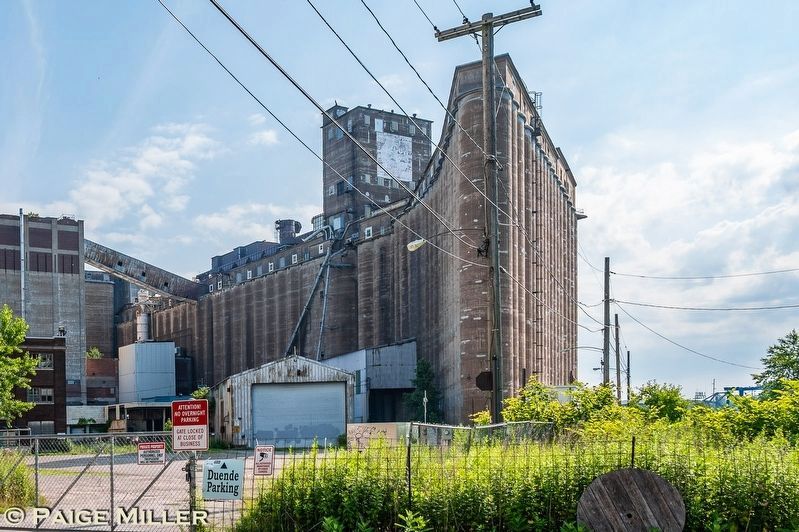
Photographed by Paige Miller, July 5, 2025
5. Lake and Rail Grain Elevator

Regionally, this marker is in Upstate New York and specifically in Western New York. It is also in the American Northeast, on the Great Lakes, and in the Mid-Atlantic. Globally, it is in the North Atlantic Region, North America, the Western Hemisphere, the Western World, and the Anglosphere. Historically, it finds itself in what was once the Viceroyalty of New France, the Haudenosaunee (Iroquois) Confederacy, New Netherland, and one of the original Thirteen Colonies.
Other nearby markers. At least 8 other markers are within walking distance of this marker: Ohio Street Bridge (about 500 feet away, measured in a direct line); The Grain Industry Decline / Buffalo's Grain Legacy (approx. 0.2 miles away); The First Grain Elevator / Early Grain Elevators (approx. 0.2 miles away); The Grain Elevators (approx.
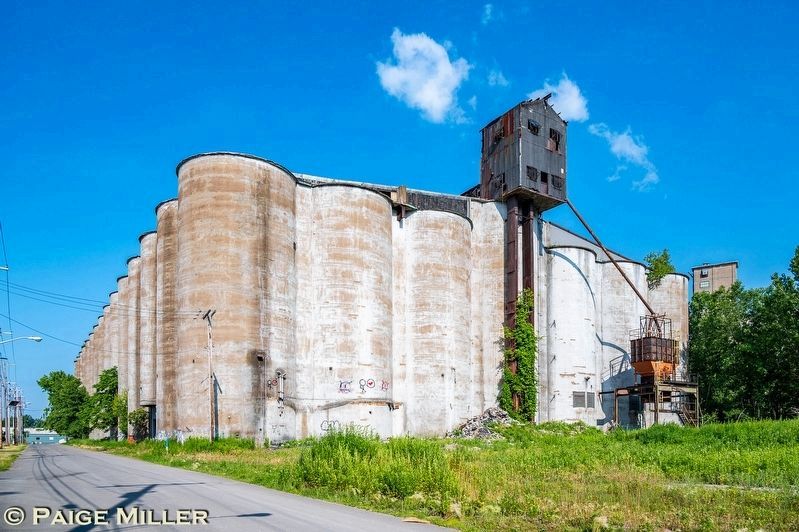
Photographed by Paige Miller, July 5, 2025
6. American Grain Elevator
More about this marker. Ohio Street is shown on most maps as Empire State Trail. Childs Street is shown on most maps as Silo City Row. You can walk part of the way down Silo City Row for a closer look at many of these huge structures.
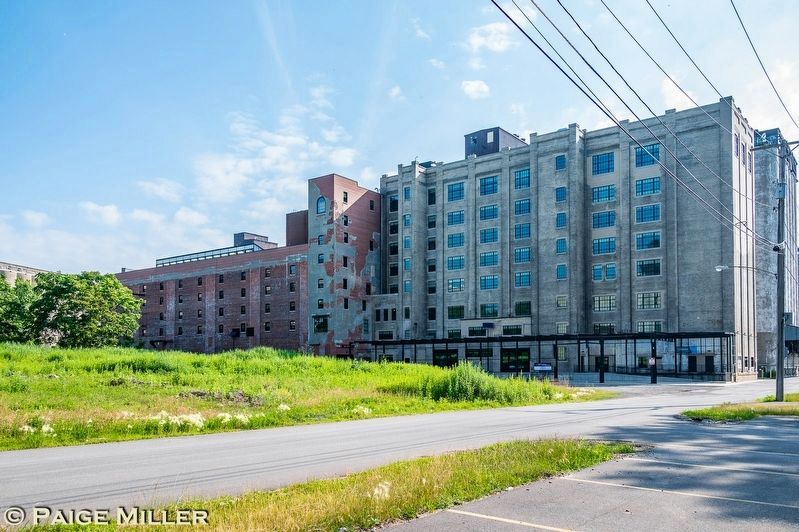
Photographed by Paige Miller, July 5, 2025
7. The Buffalo Harbor's Grain Elevators — Childs Street Marker
American Elevator
Credits. This page was last revised on July 16, 2025. It was originally submitted on July 8, 2025, by Paige Miller of Getzville, New York. This page has been viewed 183 times since then and 42 times this year. Photos: 1, 2, 3, 4, 5, 6. submitted on July 8, 2025, by Paige Miller of Getzville, New York. 7. submitted on July 11, 2025, by Paige Miller of Getzville, New York. • Michael Herrick was the editor who published this page.
