Hudson Heights in Manhattan in New York County, New York — The American Northeast (Mid-Atlantic)
Maintaining the Bridge
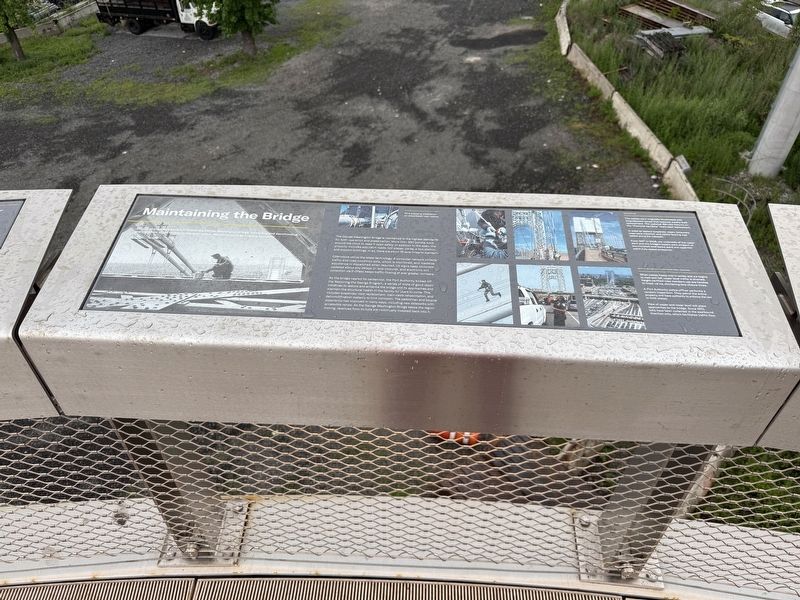
Structural engineers work full time at the George Washington Bridge, inspecting and documenting every element of the facility in two-year cycles. Maintenance is an ongoing necessity.
The George Washington Bridge is maintained to the highest standards for both operation and preservation. More than 300 people work around the clock to keep it open safely. In addition to the span, the property includes approach roads, toll plazas, a bus station, and support buildings. In all, there area bout 75 lane-miles to maintain.
Operations utilize the latest technology. A computer network collects traffic and road condition data, which is monitored, and roadside assistance is dispatched when required. Lit signs keep motorists updated about any delays or lane closures, and electronic toll collection via E-ZPass keeps traffic flowing at ever greater numbers.
As the bridge neared its centennial, the Port Authority kicked off the Restoring the George program, a series of state of good repair initiatives to restore and enhance the bridge and its approaches and maintain the structural health of the facility for years to come. This
this page online
[Captions:]
The cables were originally illuminated with incandescent lamps that required weekly bulb replacement. The updated 156 LED fixtures on the "diamond necklace" rarely needs replacement.
In order to replace suspender ropes, temporary ones were installed, and safety fencing was added along the sidewalk.
From 1997 to 2006, the underside of the upper deck and the bridge's towers were stripped of accumulated lead-based paint and repainted within fully sealed enclosures.
When cables freeze over in winter and ice begins to melt and fall, upper level traffic is diverted. Height-certified crew members use axe handles to break up ice, shortening lane closure times.
A Port Authority police officer performs a random inspection. They patrol the entire property and have authority to
Photographed by Devry Becker Jones (CC0), July 3, 2025
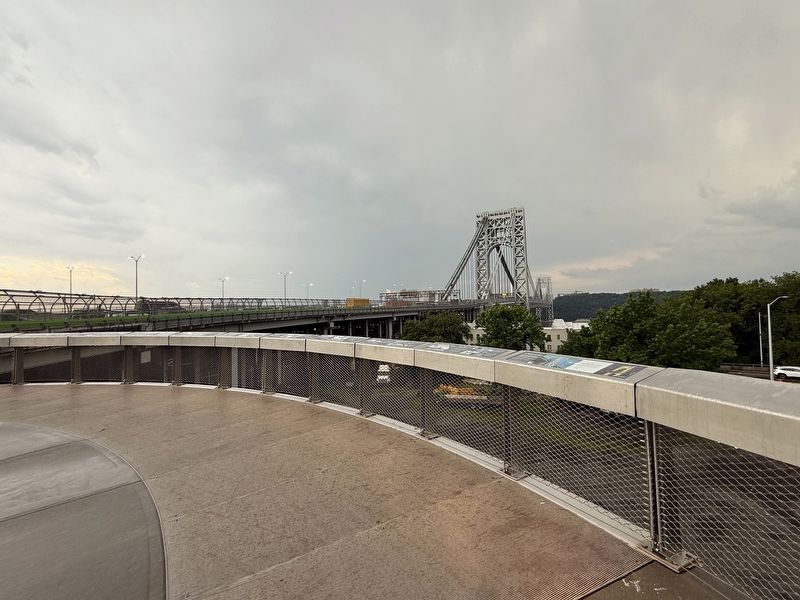
2. Markers on display at George Washington Bridge Park
View of upper and lower level toll plaza approaches to the bridge. Since 1970, tolls have been collected in the eastbound direction only, which facilitates traffic flow.
Erected by Port Authority of New York and New Jersey.
Topics. This historical marker is listed in these topic lists: Bridges & Viaducts • Industry & Commerce. A significant historical year for this entry is 1997.
Location. 40° 51.004′ N, 73° 56.478′ W. Marker is in Manhattan, New York, in New York County. It is in Hudson Heights. It can be reached from the intersection of Cabrini Boulevard and West 180th Street, on the right when traveling south. Touch for map. Marker is at or near this postal address: 47 Cabrini Blvd, New York NY 10033, United States of America. Touch for directions.

Regionally, this marker is in New York City. It is also in the American Northeast, in the Mid-Atlantic, and on the Eastern Seaboard. Globally, it is in the North Atlantic Region, North America, the Western Hemisphere, the Western World, and the Anglosphere. Historically, it finds itself in what was once New Netherland and also one of the original Thirteen Colonies.
Other nearby markers. At least 8 other markers are within walking distance of this marker: A Work of Art (here, next to this marker); Modern Updates (here, next to this marker); Next Level (here, next to this marker); Making History (here, next to this marker); Opening Celebration (here, next to this marker); Building the Bridge (here, next to this marker); a different marker also named Building the Bridge (here, next to this marker); The Winning Plan (a few steps from this marker). Touch for a list and map of all markers in Manhattan.
Credits. This page was last revised on July 12, 2025. It was originally submitted on July 12, 2025, by Devry Becker Jones of Washington, District of Columbia. This page has been viewed 139 times since then and 33 times this year. Photos: 1, 2. submitted on July 12, 2025, by Devry Becker Jones of Washington, District of Columbia.
