Hudson Heights in Manhattan in New York County, New York — The American Northeast (Mid-Atlantic)
The Winning Plan
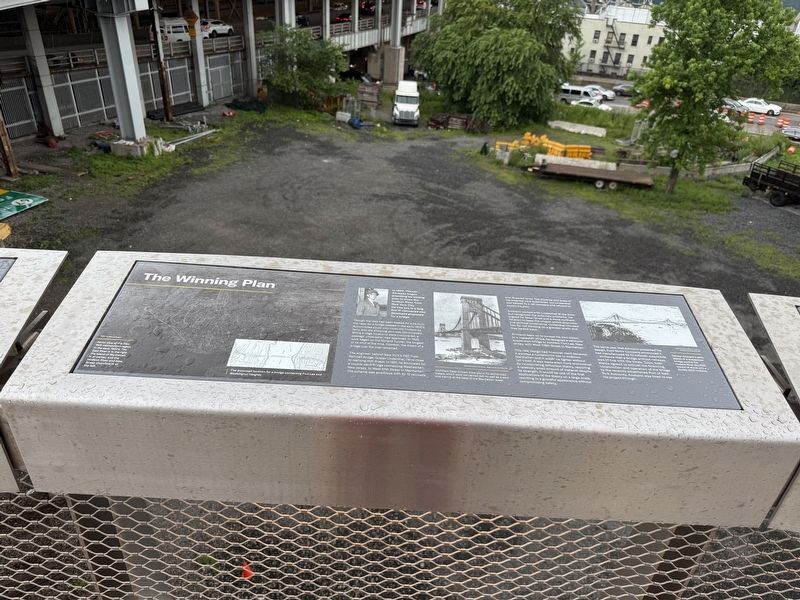
In 1924, Othmar Amman began promoting his winning plan to cross the Hudson River from New York City. He was one in a long line of visionaries who developed proposals for a bridge.
Though the idea had been floated for a century, the need for a bridge peaked in the early 1900's. Automobiles could only cross the Hudson by ferry, and the shipping port was overcrowded. While bridge locations were considered, a passage underwater was approved. In 1920, work began on the Holland Tunnel, the longest of its kind at the time. However, the dream of a bridge over the river remained.
The engineer behind New York's Hell Gate Railroad Bridge, Gustav Lindenthal, came close to realizing that dream. In 1921, he advocated for a double-deck bridge connecting Weehawken, New Jersey, to West 57th Street in Manhattan. The scheme was ambitious with its 12 railroads and 16 paved lanes. The expense and scale of the proposal were questioned, but Lindenthal was backed by rail company and refused to modify his plan.
Ammann worked with Lindenthal at the time, but recognized the scheme's problems. He argued for fewer lanes and a more northern
this page online
Ammann went on to pursue his own vision. In a makeshift office, he designed a vehicular suspension bridge to connect Fort Lee, New Jersey, with West 178th Street in Manhattan.
This new design had financial merit because it avoided a contentious site in midtown Manhattan and it would be lighter without rail travel. It was made even more economical by incorporating deflection theory, requiring a relatively small amount of material despite its strength. It would be one of the first applications of the theory on a large scale, resulting in a graceful appearance without compromising safety.
The same year that Ammann presented his design, Ford Motor Company announced it had manufactured its 10 millionth automobile — evidence that a bridge without railways was in line with the times. Soon, both states agreed to entrust the financing, construction and operation of the bridge to the recently established Port of New York Authority. Ammann was hired to see his project through.
[Captions:]
Aerial view of the New York metropolitan region in the early 1920's. The East River is to the right, the island of Manhattan is at center, and the Hudson River and New Jersey shoreline is at the left.
The proposed location for a bridge connecting Fort Lee and Washington Heights.
Architect Cass Gilbert drew plans for stone-clad towers, which were not carried out, as well as a park and marina at the base of the Manhattan tower.
Othmar Ammann's early sketch of a suspension bridge across the Hudson River depicted towers of stone and a double deck roadway.
Erected by Port
Photographed by Devry Becker Jones (CC0), July 3, 2025
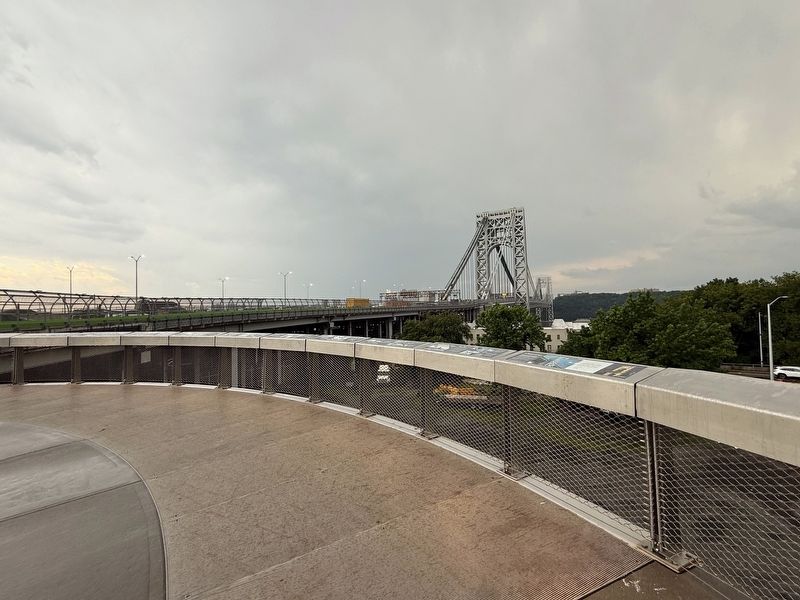
2. Markers on display at George Washington Bridge Park
Topics. This historical marker is listed in these topic lists: Architecture • Bridges & Viaducts • Industry & Commerce. A significant historical year for this entry is 1924.
Location. 40° 51′ N, 73° 56.479′ W. Marker is in Manhattan, New York, in New York County. It is in Hudson Heights. It can be reached from the intersection of Cabrini Boulevard and West 180th Street, on the right when traveling south. Touch for map. Marker is at or near this postal address: 41 Cabrini Blvd, New York NY 10033, United States of America. Touch for directions.

Regionally, this marker is in New York City. It is also in the American Northeast, in the Mid-Atlantic, and on the Eastern Seaboard. Globally, it is in the North Atlantic Region, North America, the Western Hemisphere, the Western World, and the Anglosphere. Historically, it finds itself in what was once New Netherland and also one of the original Thirteen Colonies.
Other nearby markers. At least 8 other markers are within walking distance of this marker: A Marvel of Engineering (here, next to this marker); Building the Bridge (here, next to this marker); a different marker also named Building the Bridge (here, next to this marker); Opening Celebration (here, next to this marker); Making History (here, next to this marker); Next Level (here, next to this marker); Modern Updates (here, next to this marker); Maintaining the Bridge (a few steps from this marker). Touch for a list and map of all markers in Manhattan.
Credits. This page was last revised on July 12, 2025. It was originally submitted on July 12, 2025, by Devry Becker Jones of Washington, District of Columbia. This page has been viewed 100 times since then and 27 times this year. Photos: 1, 2. submitted on July 12, 2025, by Devry Becker Jones of Washington, District of Columbia.
