Tompkinsville on Staten Island in Richmond County, New York — The American Northeast (Mid-Atlantic)
Joseph H. Lyons Memorial
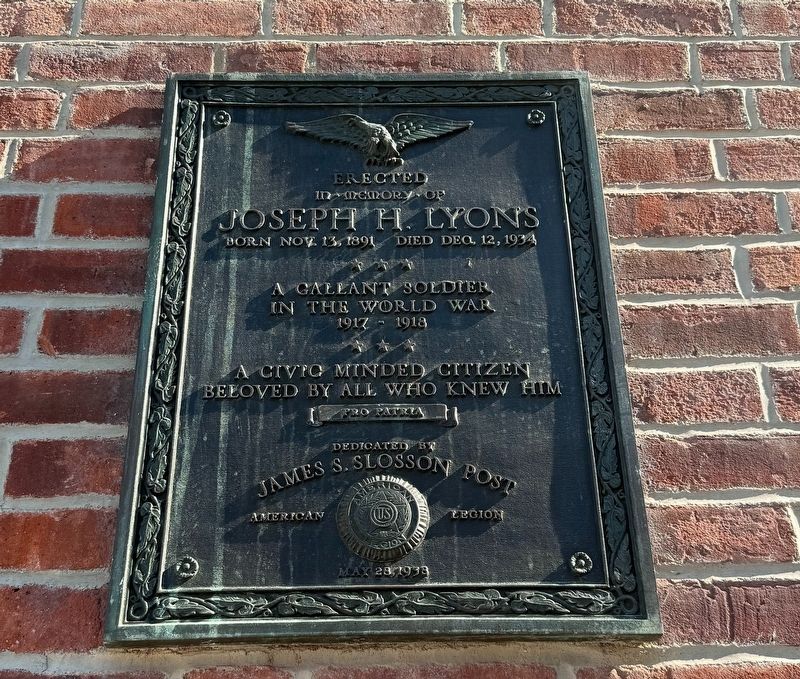
in memory of
Joseph H. Lyons
Born Nov. 13, 1891 - Died Dec. 12, 1934
A gallant soldier
in the World War
1917 - 1918
A civic minded citizen
beloved by all who knew him
Pro patria
Erected 1938 by James S. Slosson Post, American Legion.
Topics. This memorial is listed in this topic list: War, World I.
Location. 40° 38.259′ N, 74° 4.488′ W. Memorial is on Staten Island, New York, in Richmond County. It is in Tompkinsville. It is on Victory Boulevard east of Bay Street, on the right when traveling east. Touch for map. Memorial is at or near this postal address: 14 Victory Blvd, Staten Island NY 10304, United States of America. Touch for directions.

Regionally, this memorial is in New York City. It is also in the American Northeast, in the Mid-Atlantic, and on the Eastern Seaboard. Globally, it is in the North Atlantic Region, North America, the Western Hemisphere, the Western World, and the Anglosphere. Historically, it finds itself in what was once New Netherland and also one of the original Thirteen Colonies.
Other nearby markers. At
this page online
Other markers no longer nearby. The 1907 Lamp Shop (was approx. ¼ mile away but has been permanently removed); Maritime New York (was approx. ¼ mile away but has been permanently removed); The Administration Building (was approx. ¼ mile away but has been permanently removed).
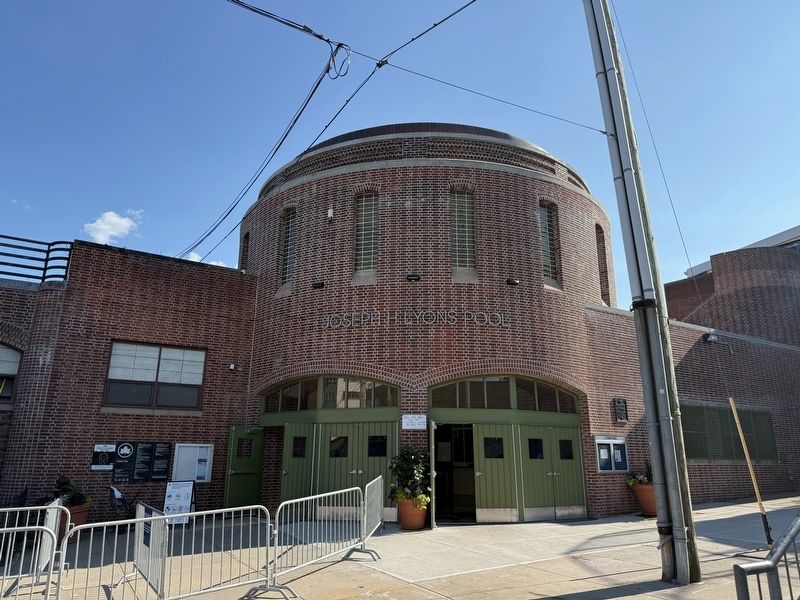
Photographed by Devry Becker Jones (CC0), July 4, 2025
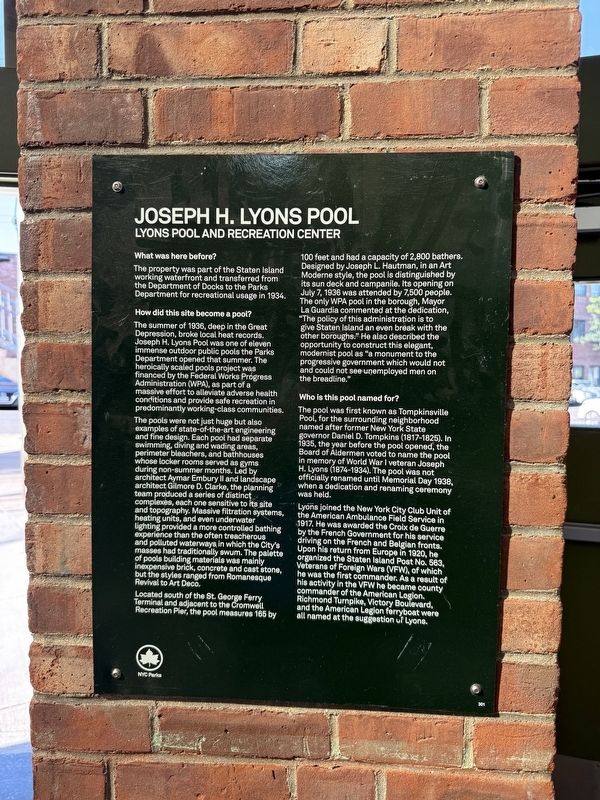
3. Joseph H. Lyons Pool signage just inside the building
Joseph H. Lyons Pool
Lyons Pool and Recreation Center
What was here before?
The property was part of the Staten Island working waterfront and transferred from the Department of Docks to the Parks Department for recreational usage in 1934.
How did this site become a pool?
The summer of 1936, deep in the Great Depression, broke local heat records. Joseph H. Lyons Pool was one of eleven immense outdoor public pools the Parks Department opened that summer. The heroically-scaled pools project was financed by the Federal Works Progress Administration (WPA), as part of a massive effort to alleviate adverse health conditions and provide safe recreation in predominantly working-class communities.
The pools were not just huge but also examples of state-of-the-art engineering and fine design. Each pool had separate swimming, diving and wading areas, perimeter bleachers, and bathhouses whose locker rooms served as gyms during non-summer months. Led by architect Aymar Embury II and landscape architect Gilmore D. Clarke, the planning team produced a series of distinct complexes, each one sensitive to its site and topography. Massive filtration systems, heating units, and even underwater lighting provided a more controlled bathing experience than the often treacherous and polluted waterways in which the City’s masses had traditionally swum. The palette of pools building materials was mainly inexpensive brick, concrete and cast stone, but the styles ranged from Romanesque Revival to Art Deco.
Located south of the St. George Ferry Terminal and adjacent to the Cromwell Recreation Pier, the pool measures 165 by 100 feet and had a capacity of 2,800 bathers. Designed by Joseph L. Hautman, in an Art Moderne style, the pool is distinguished by its sun deck and campanile. Its opening on July 7, 1936 was attended by 7,500 people. The only WPA pool in the borough, Mayor La Guardia commented at the dedication, “The policy of this administration is to give Staten Island an even break with the other boroughs.” He also described the opportunity to construct this elegant, modernist pool as “a monument to the progressive government which would not and could not see unemployed men on the breadline.”
Who is this pool named for?
The pool was first known as Tompkinsville Pool, for the surrounding neighborhood named after former New York State governor Daniel D. Tompkins (1817-1825). In 1935, the year before the pool opened, the Board of Aldermen voted to name the pool in memory of World War I veteran Joseph H. Lyons (1874-1934). The pool was not officially renamed until Memorial Day 1938, when a dedication and renaming ceremony was held.
Lyons joined the New York City Club Unit of the American Ambulance Field Service in 1917. He was awarded the Croix de Guerre by the French Government for his service driving on the French and Belgian fronts. Upon his return from Europe in 1920, he organized the Staten Island Post No. 563, Veterans of Foreign Wars (VFW), of which he was the first commander. As a result of his activity in the VFW, he became county commander of the American Legion. Richmond Turnpike, Victory Boulevard, and the American Legion ferryboat were all named at the suggestion of Lyons.
Lyons Pool and Recreation Center
What was here before?
The property was part of the Staten Island working waterfront and transferred from the Department of Docks to the Parks Department for recreational usage in 1934.
How did this site become a pool?
The summer of 1936, deep in the Great Depression, broke local heat records. Joseph H. Lyons Pool was one of eleven immense outdoor public pools the Parks Department opened that summer. The heroically-scaled pools project was financed by the Federal Works Progress Administration (WPA), as part of a massive effort to alleviate adverse health conditions and provide safe recreation in predominantly working-class communities.
The pools were not just huge but also examples of state-of-the-art engineering and fine design. Each pool had separate swimming, diving and wading areas, perimeter bleachers, and bathhouses whose locker rooms served as gyms during non-summer months. Led by architect Aymar Embury II and landscape architect Gilmore D. Clarke, the planning team produced a series of distinct complexes, each one sensitive to its site and topography. Massive filtration systems, heating units, and even underwater lighting provided a more controlled bathing experience than the often treacherous and polluted waterways in which the City’s masses had traditionally swum. The palette of pools building materials was mainly inexpensive brick, concrete and cast stone, but the styles ranged from Romanesque Revival to Art Deco.
Located south of the St. George Ferry Terminal and adjacent to the Cromwell Recreation Pier, the pool measures 165 by 100 feet and had a capacity of 2,800 bathers. Designed by Joseph L. Hautman, in an Art Moderne style, the pool is distinguished by its sun deck and campanile. Its opening on July 7, 1936 was attended by 7,500 people. The only WPA pool in the borough, Mayor La Guardia commented at the dedication, “The policy of this administration is to give Staten Island an even break with the other boroughs.” He also described the opportunity to construct this elegant, modernist pool as “a monument to the progressive government which would not and could not see unemployed men on the breadline.”
Who is this pool named for?
The pool was first known as Tompkinsville Pool, for the surrounding neighborhood named after former New York State governor Daniel D. Tompkins (1817-1825). In 1935, the year before the pool opened, the Board of Aldermen voted to name the pool in memory of World War I veteran Joseph H. Lyons (1874-1934). The pool was not officially renamed until Memorial Day 1938, when a dedication and renaming ceremony was held.
Lyons joined the New York City Club Unit of the American Ambulance Field Service in 1917. He was awarded the Croix de Guerre by the French Government for his service driving on the French and Belgian fronts. Upon his return from Europe in 1920, he organized the Staten Island Post No. 563, Veterans of Foreign Wars (VFW), of which he was the first commander. As a result of his activity in the VFW, he became county commander of the American Legion. Richmond Turnpike, Victory Boulevard, and the American Legion ferryboat were all named at the suggestion of Lyons.
Credits. This page was last revised on July 12, 2025. It was originally submitted on July 12, 2025, by Devry Becker Jones of Washington, District of Columbia. This page has been viewed 113 times since then and 19 times this year. Photos: 1, 2, 3. submitted on July 12, 2025, by Devry Becker Jones of Washington, District of Columbia.
