Dronfield in Derbyshire, England, United Kingdom — Northwestern Europe (the British Isles)
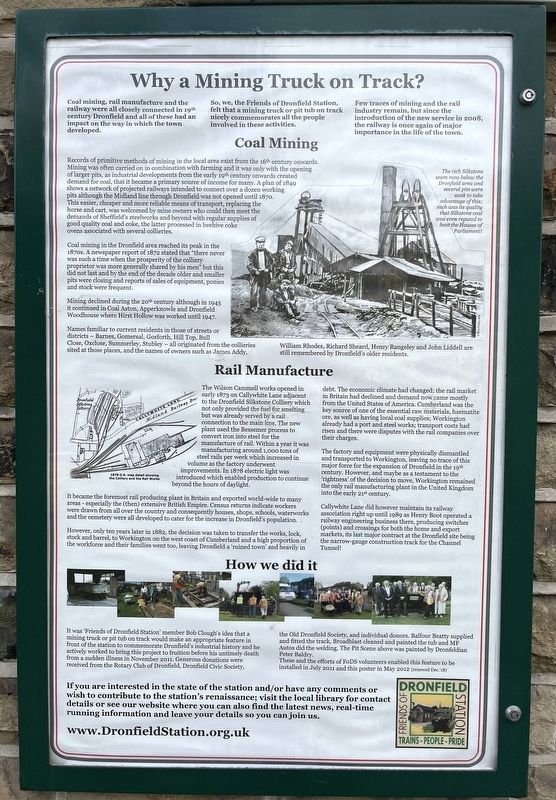
Why a Mining Truck on Track?
Photographed by Ray Gurganus, April 17, 2025
1. Why a Mining Truck on Track? Marker
So, we, the Friends of Dronfield Station, felt that a mining truck or pit tub on track nicely commemorates all the people involved in these activities.
Few traces of mining and the rail industry remain, but since the introduction of the new service in 2008, the railway is once again of major importance in the life of the town.
Coal Mining
Records of primitive methods of mining in the local area exist from the 16 century onwards. Mining was often carried on in combination with farming and it was only with the opening of larger pits, as industrial developments from the early 19th century onwards created demand for coal, that it became a primary source of income for many. A plan of 1849 shows a network of projected railways intended to connect over a dozen working pits although the Midland line through Dronfield was not opened until 1870. This easier, cheaper and more reliable means of transport, replacing the horse and cart, was welcomed by mine
this page online
Coal mining in the Dronfield area reached its peak in the 1870s. A newspaper report of 1872 stated that "there never was such a time when the prosperity of the colliery proprietor was more generally shared by his men" but this did not last and by the end of the decade older and smaller pits were closing and reports of sales of equipment, ponies and stock were frequent.
Mining declined during the 20 century although in 1945 it continued in Coal Aston, Apperknowle and Dronfield Woodhouse where Hirst Hollow was worked until 1947.
Names familiar to current residents in those of streets or districts - Barnes, Gomersal, Gosforth, Hill Top, Ball Close, Oxclose, Summerley, Stubley - all originated from the collieries sited at those places, and the names of owners such as James Addy, William Rhodes, Richard Sheard, Henry Rangeley and John Liddell are still remembered by Dronfield's older residents.
Rail Manufacture
The Wilson
Photographed by Ray Gurganus, April 17, 2025
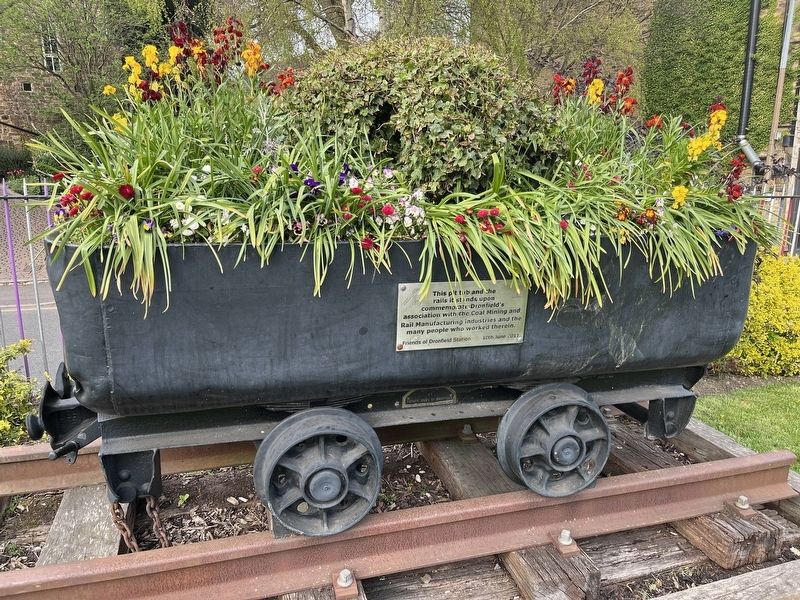
2. Pit Tub and Rails
This pit tub and the rails it stands upon commemorate Dronfield's association with the Coal Mining and Rail Manufacturing industries and the many people who worked therein. Friends of Dronfield Station, 10th June 2011
It became the foremost rail producing plant in Britain and exported world-wide to many areas - especially the (then) extensive British Empire. Census returns indicate workers were drawn from all over the country and consequently houses, shops, schools, waterworks and the cemetery were all developed to cater for the increase in Dronfield's population.
However, only ten years later in 1882, the decision was taken to transfer the works, lock, stock and barrel, to Workington on the west coast of Cumberland and a high proportion of the workforce and their families went too, leaving Dronfield a ruined town and heavily in debt. The economic climate had changed; the rail market in Britain had declined and demand now came mostly from the United States of America. Cumberland was the key source of one of the essential raw materials, haematite ore, as well as having local coal supplies; Workington already had a port and steel works; transport costs had risen and there were disputes with the rail companies over their charges.
The factory and equipment were physically dismantled and transported to Workington, leaving no trace of this major force for the expansion of Dronfield in the 19th century. However, and maybe as a testament to the rightness of the decision to move, Workington remained the only rail manufacturing plant in the United Kingdom into the early 21 century.
Callywhite Lane did however maintain its railway association right up until 1989 as Henry Boot operated a railway engineering business there, producing switches (points) and crossings for both the home and export markets, its last major contract at the Dronfield site being the narrow-gauge construction track for the Channel Tunnel!
How we did it
It was 'Friends of Dronfield Station' member Bob Clough's idea that a mining truck or pit tub on track would make an appropriate feature in front of the station to commemorate Dronfield's industrial history and he actively worked to bring this project to fruition before his untimely death from a sudden illness in November 2011. Generous donations were received from the Rotary Club of Dronfield, Dronfield Civic Society, the Old Dronfield Society, and individual donors. Balfour Beatty supplied and fitted the track, Broadblast cleaned and painted the tub and MF Autos did the welding. The Pit Scene above was painted by Dronfieldian Peter Baldry.
These and the efforts of FoDS volunteers enabled this feature to be installed in July 2011 and this poster in May 2012.
Erected by Friends of Dronfield Station.
Topics. This historical marker is listed in these topic lists: Industry & Commerce • Railroads & Streetcars.
Location. 53° 18.084′ N, 1° 28.137′ W. Marker is in Dronfield, England, in Derbyshire. It can be reached from Chesterfield Road, on the right when traveling east. The marker is on the station lawn, on the north side of the station. Touch for map. Marker is at or near this postal address: 37 Chesterfield Road, Dronfield, England S18 2XA, United Kingdom. Touch for directions.

Regionally, this marker is in the Midlands. Globally, it is on the Atlantic Ocean, in the North Atlantic Region, in Europe, in Atlantic Europe, on one of the British Isles, in the Western World, and in the Anglosphere. Historically, it finds itself in what was once the Roman Empire.
Other nearby markers. At least 8 other markers are within 18 kilometers of this marker, measured as the crow flies: Chesterfield Station (approx. 7.7 kilometers away); Heads or Tails? (approx. 8.7 kilometers away); Tudor Square (approx. 8.8 kilometers away); Leopold Street (approx. 8.9 kilometers away); The Old Market (approx. 16.2 kilometers away); Welcome to Rotherham Minster (approx. 16.2 kilometers away); Rotherham Parish Church (approx. 16.2 kilometers away); Tommy James (approx. 16.3 kilometers away).
Credits. This page was last revised on July 13, 2025. It was originally submitted on July 5, 2025, by Ray Gurganus of Washington, District of Columbia. This page has been viewed 184 times since then and 54 times this year. Last updated on July 13, 2025, by Ray Gurganus of Washington, District of Columbia. Photos: 1, 2. submitted on July 5, 2025, by Ray Gurganus of Washington, District of Columbia. • J. Makali Bruton was the editor who published this page.
