
Perschen in Nabburg in Schwandorf, Bavaria, Germany — Central Europe
Edelmannshof Perschen
⎯⎯⎯
Manor House Perschen
Photographed by James Hulse, June 30, 2025
1. Edelmannshof Perschen / Manor House Perschen Marker

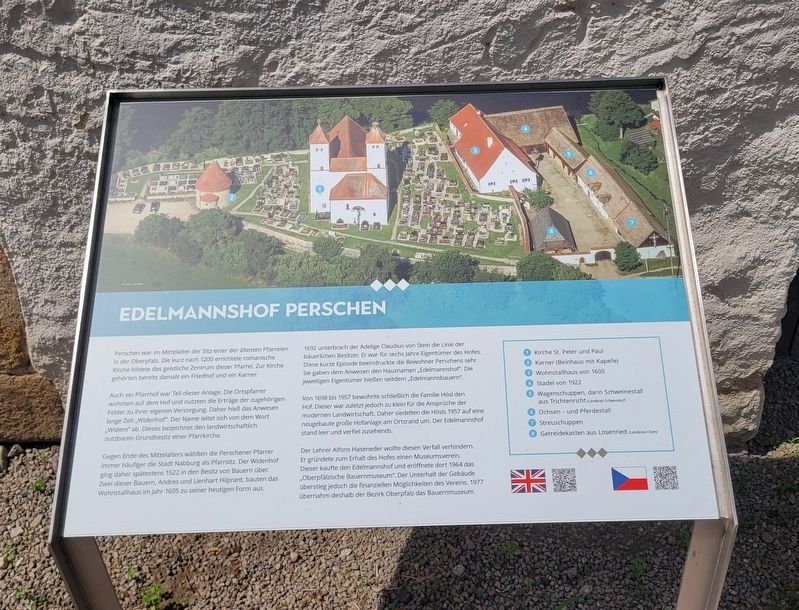
Perschen war im Mittelalter der Sitz einer der ältesten Pfarreien in der Oberpfalz. Die kurz nach 1200 errichtete romanische Kirche bildete das geistliche Zentrum dieser Pfarrei. Zur Kirche gehörten bereits damals ein Friedhof und ein Karner.
Auch ein Pfarrhof war Teil dieser Anlage. Die Ortspfarrer wohnten auf dem Hof und nutzten die Erträge der zugehörigen Felder zu ihrer eigenen Versorgung. Daher hieß das Anwesen lange Zeit „Widenhof". Der Name leitet sich von dem Wort „Widem" ab. Dieses bezeichnet den landwirtschaftlich nutzbaren Grundbesitz einer Pfarrkirche.
Gegen Ende des Mittelalters wählten die Perschener Pfarrer immer häufiger die Stadt Nabburg als Pfarrsitz. Der Widenhof ging daher spätestens 1522 in den Besitz von Bauern über. Zwei dieser Bauern, Andres und Lienhart Hilprant, bauten das Wohnstallhaus im Jahr 1605 zu seiner heutigen Form aus.
1692 unterbrach der Adelige Claudius von Stein die Linie der bäuerlichen Besitzer. Er war für sechs Jahre Eigentümer des Hofes. Diese kurze Episode beeindruckte die Bewohner Perschens sehr. Sie gaben dem Anwesen den Hausnamen „Edelmannshof". Die
this page online
Von 1698 bis 1957 bewohnte schließlich die Familie Hösl den Hof. Dieser war zuletzt jedoch zu klein für die Ansprüche der modernen Landwirtschaft. Daher siedelten die Hösls 1957 auf eine neugebaute große Hofanlage am Ortsrand um. Der Edelmannshof stand leer und verfiel zusehends.
Der Lehrer Alfons Haseneder wollte diesen Verfall verhindern. Er gründete zum Erhalt des Hofes einen Museumsverein. Dieser kaufte den Edelmannshof und eröffnete dort 1964 das „Oberpfälzische Bauernmuseum". Der Unterhalt der Gebäude überstieg jedoch die finanziellen Möglichkeiten des Vereins. 1977 übernahm deshalb der Bezirk Oberpfalz das Bauernmuseum.
(1) Kirche St. Peter und Paul
(2) Karner (Beinhaus mit Kapelle)
(3) Wohnstallhaus von 1605
(4) Stadel von 1922
(5) Wagenschuppen, darin Schweinestall aus Trichtenricht (Landkreis Schwandorf)
(6) Ochsen- und Pferdestall
(7) Streuschuppen
(8) Getreidekasten aus Losenried (Landkreis Cham)
Perschen was in the Middle Ages the seat of one of the oldest parishes in the Upper Palatinate. The Romanesque church, built shortly
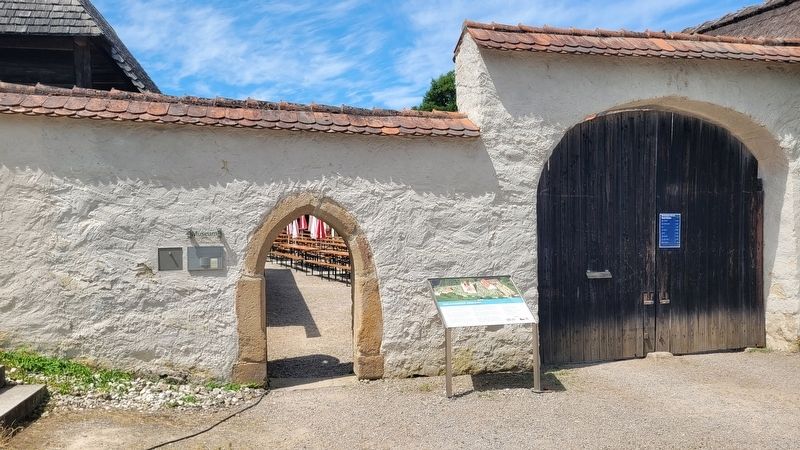
Photographed by James Hulse, June 30, 2025
2. Edelmannshof Perschen / Manor House Perschen Marker
A parsonage was also part of this complex. The local pastors lived on the estate and used the yields of the associated fields for their own sustenance. For this reason, the property was called the "Widenhof" for a long time. The name derives from the word "Widem," which refers to the agricultural landholdings of a parish church.
Towards the end of the Middle Ages, the pastors of Perschen increasingly chose the town of Nabburg as their parish seat. As a result, the Widenhof passed into the hands of farmers by 1522 at the latest. Two of these farmers, Andres and Lienhart Hilprant, expanded the residential and stable house into its present form in 1605.
In 1692, the nobleman Claudius von Stein interrupted the line of peasant owners. He was the owner of the estate for six years. This brief episode made a strong impression on the inhabitants of Perschen, who gave the property the house name "Edelmannshof" (Nobleman’s Court). Since then, the respective owners were called "Edelmannsbauern" (noblemen farmers).
From
Photographed by James Hulse, June 30, 2025
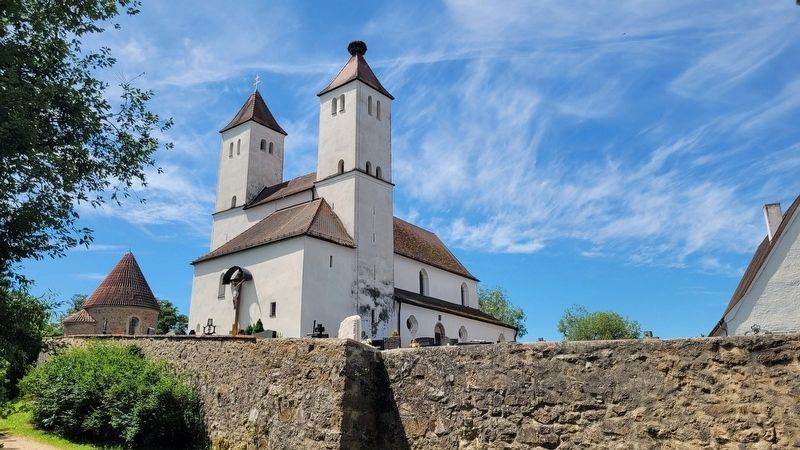
3. St. Peter and Paul Church
The teacher Alfons Haseneder wanted to prevent this decay. He founded a museum association to preserve the estate. This group purchased the Edelmannshof and opened the "Upper Palatinate Farmers’ Museum" there in 1964. However, the maintenance costs of the buildings exceeded the financial means of the association. In 1977, the district of Upper Palatinate therefore took over the farmers’ museum.
(1) Church of St. Peter and Paul
(2) Charnel house (ossuary with chapel)
(3) Residential and stable house from 1605
(4) Barn from 1922
(5) Wagon shed, containing pigsty from Trichtenricht (district of Schwandorf)
(6) Oxen and horse stable
(7) Loose material shed (bedding shed)
(8) Grain store from Losenried (district of Cham)
Topics. This historical marker is listed in this topic list: Notable Buildings. A significant historical year for this entry is 1200.
Location. 49° 28.139′ N,
Photographed by James Hulse, June 30, 2025
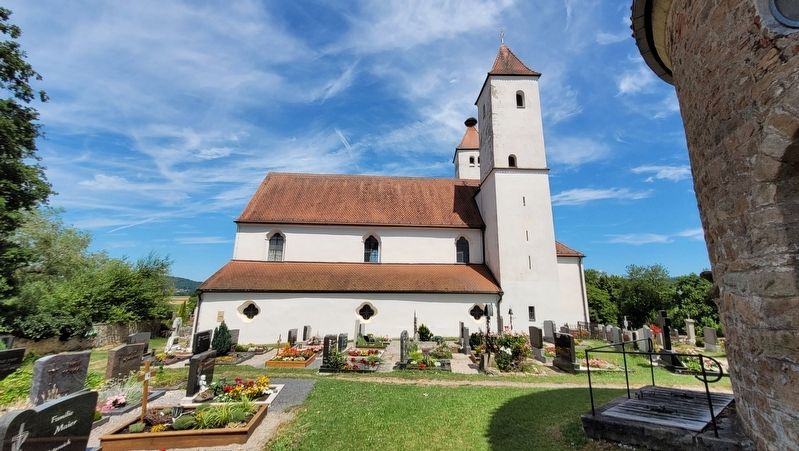
4. The view of the church and cemetery

Regionally, it is in Europe, the European Union, Atlantic Europe, Central Europe, the Schengen Area, Western Europe, and the Western World. Historically, it finds itself in what was once the Holy Roman Empire and also the former West Germany.
Other nearby markers. At least 8 other markers are within 2 kilometers of this marker, measured as the crow flies: Pflegschloss / Governor’s Castle (approx. 1.6 kilometers away); St. Johannes (approx. 1.6 kilometers away); St. Laurentius / St. Lawrence (approx. 1.6 kilometers away); Fronfeste / Town Prison (approx. 1.6 kilometers away); Anton Schreiner's Söhne / Anton Schreiner’s Sons (approx. 1.6 kilometers away); Obertor / Upper Gate (approx. 1.6 kilometers away); Türmer-Haus / Watchman's House (approx. 1.6
Photographed by James Hulse, June 30, 2025
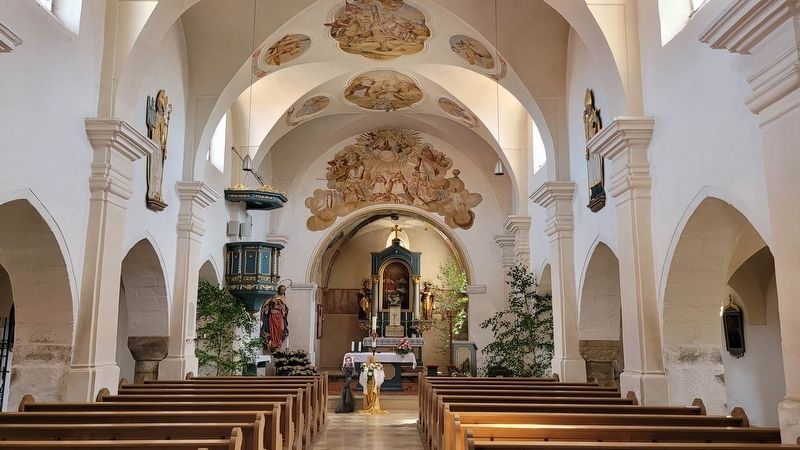
5. The interior view of the St. Peter and Paul Church
Credits. This page was last revised on July 16, 2025. It was originally submitted on July 15, 2025, by James Hulse of Medina, Texas. This page has been viewed 81 times since then and 20 times this year. Photos: 1, 2, 3, 4, 5. submitted on July 16, 2025, by James Hulse of Medina, Texas.
