Kendal in Westmorland and Furness, England, United Kingdom — Northwestern Europe (the British Isles)
Medieval Kendal

Photographed by Ray Gurganus, April 12, 2025
1. Medieval Kendal Marker
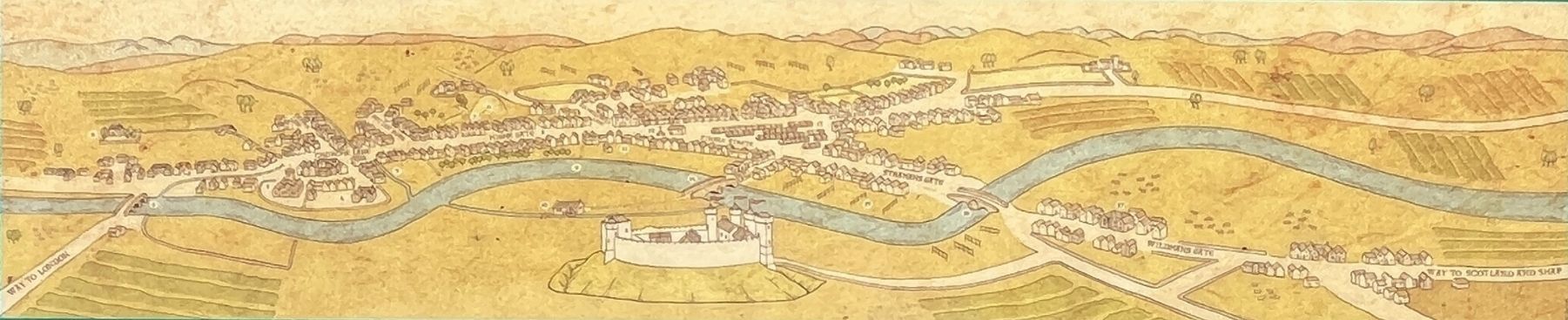
1. Nether Bridge. There was a bridge crossing for the route south to Lancaster and London, from Saxon times. In 1376, it became a toll bridge. It was a busy packhorse bridge. Large wagon carts crossed at the ford, which was very dangerous in wet weather.
2. Anchorite House and Well. By 1450(?) an Anchorite dwelling existed here for a hermit who lived a secluded life of prayer. The well was fed by a stream that was reputed never to run dry and to have healing powers. The current private house was built in 1771.
3. Parish Church of Holy Trinity. Dating from 1232, it is the largest parish church in Cumbria. It was built over an earlier Saxon church. The tomb of Sir William Parr (died 1484), is in the Parr chapel. He was the grandfather of Queen Katherine Parr, Henry VIII's sixth wife.
4. Abbot Hall. The original Abbot Hall stood between the current Abbot Hall Art Gallery and the Museum of Lakeland Life. It belonged to the Abbey of St Mary's,
this page online
5. Blind Beck. Blind Beck marks the boundary between the former church town of Kirkland and the baron's market town of Kendal. It flowed across Kirk Lane where there was a ford and then a narrow bridge. Now, the beck flows under the widened road.
6 Castle Howe. This motte and bailey castle, built in 1082 by the first Baron of Kendal. An obelisk to the Glorious Revolution of 1688 marks the site. Castle Howe was surrounded by cattle pasture and the cattle were slaughtered at Beast Banks.
7. Bowling Fell. The flat area (bailey) accommodated men, animals, and stores. After the new castle was built on Castle Hill, the bailey was levelled and made into a bowling green. It was later used as a tenter-ground for the woollen trade.
8. Kendal's Medieval Yards. The barons granted plots of land to free men. The owner's house faced the street animal sheds, workshops, and gardens stretched behind. As Kendal expanded, the yards were heavily built on. Of the original 120-150 years about 30 remain.
9. River Kent. Weaving was cottage industry. The fulling and dyeing mills, powered
From The Marker, April 12, 2025
2. Map of Kendal
10. Castle Mill. A fulling mill existed near this site by 1246. Castle Mill ground corn and oats for the castle and was powered by water from the River Kent. In 1853 the mills were mechanised for cloth manufacture. The buildings are now small business units.
11. Leaden Hall. On this site stood the White Hall or Leaden Hall, the cloth exchange. It was replaced in 1825 by new assembly rooms which were converted and extended in 1859, to form the current Town Hall.
12. The Market Cross. This stood in the middle of the junction of Stricklandgate and Finkle Street. It was where important proclamations were read. The remnant of its stone base, the Cauld Stone, is embedded in the front wall of the current Town Hall.
13. Market Place. In 1189, Richard I sold the rights of a weekly market to the town, establishing the new market town of Kendal. The marketplace originally covered the whole area between Finkle Street, Market Place and Stricklandgate.
14. Miller Bridge. The simple wooden bridges connecting the Castle Mill with the town were regularly swept away by floods. In 1743, a stone bridge was built. The current bridge dates from 1819, when the canal basin was built, and was widened in 1827.
15. Tenterframes. After dyeing and washing, the cloth was hooked onto tenterframes to keep it tight as it dried. The frames were at Gooseholme, [illegible] and on the Fellside. The expression 'on tenterhooks' meaning to keep in suspense, comes from this activity.
16. Stramongate Bridge. This is a significant medieval crossing point. The original bridge has been encased in subsequent rebuilding. It is believed that a chantry chapel was situated at the eastern end, where prayers were made for the safety of the journey north.
17. Castle Dairy. Dating from the 14th century, it is the oldest continuously used building in Kendal. It was either the [illegible] for the baron's widow or the Castle milk [illegible] and part of a very large farmstead recorded in 1331. It is now a restaurant.
The Lakeland Fells
Castle Hill has a spectacular 360° view over Kendal to the Lakeland fells on the horizon.
Kendal fell was originally known as Dob Frear (Free Land) and used for grazing. The lower slopes were used as tenter grounds.
Most of the distant fells, that you can see, are included in the famous Wainwright guides of the Eastern and Far Eastern Fells. You can find out more about Alfred Wainwright and the Lakeland Fells in Kendal Museum.
Topics. This historical marker is listed in these topic lists: Bridges & Viaducts • Forts and Castles • Industry & Commerce • Religion & Religious Structures.
Location. 54° 19.542′ N, 2° 44.182′ W. Marker is in Kendal, England, in Westmorland and Furness. It can be reached from Sunnyside. On the grounds of Kendal Castle. Touch for map. Marker is at or near this postal address: 5-21 Sunnyside, Kendal, England LA9 7DJ, United Kingdom. Touch for directions.

Regionally, this marker is in North West England. Globally, it is on the Atlantic Ocean, in the North Atlantic Region, in Europe, in Atlantic Europe, on one of the British Isles, in the Western World, and in the Anglosphere. Historically, it finds itself in what was once the Roman Empire.
Other nearby markers. At least 8 other markers are within walking distance of this marker: Kendal Castle (within shouting distance of this marker); a different marker also named Kendal Castle (within shouting distance of this marker); The North-west Tower (within shouting distance of this marker); Castle Hill (approx. 0.4 kilometers away); Explore the history around Wildman Street (approx. 0.6 kilometers away); Castle Dairy (approx. 0.6 kilometers away); 25 Finkle Street (approx. 0.7 kilometers away); The New Shambles (approx. 0.7 kilometers away). Touch for a list and map of all markers in Kendal.
Credits. This page was last revised on July 18, 2025. It was originally submitted on July 18, 2025, by Ray Gurganus of Washington, District of Columbia. This page has been viewed 108 times since then and 24 times this year. Photos: 1, 2. submitted on July 18, 2025, by Ray Gurganus of Washington, District of Columbia. • Andrew Ruppenstein was the editor who published this page.
Editor’s want-list for this marker. photo of the marker within its surroundings • Can you help?
