Vernal in Uintah County, Utah — The American Mountains (Southwest)
"Fort Scared-to-Death"
⎯⎯⎯
"Biggest Little City off the Railroad"/One of the Top 50 Small Cities in US
Photographed by Jeremy Snow, June 27, 2025
1. "Fort Scared-to-Death" side of marker
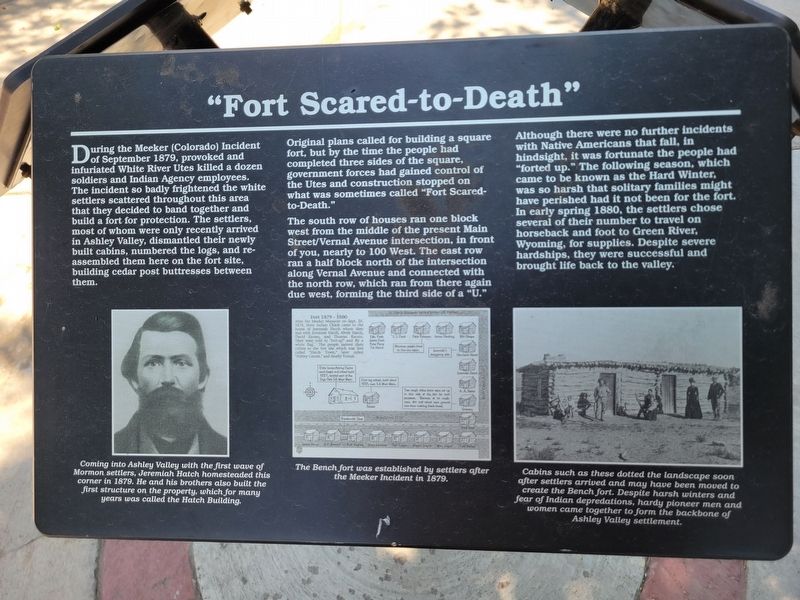
"Fort Scared-to-Death"
During the Meeker (Colorado) Incident of September 1879, provoked and infuriated White River Utes killed a dozen soldiers and Indian Agency employees. The incident so badly frightened the white settlers scattered throughout this area that they decided to band together and build a fort for protection. The settlers, most of whom were only recently arrived in Ashley Valley, dismantled their newly built cabins, numbered the logs, and reassembled them here on the fort site, building cedar post buttresses between them.
Original plans called for building a square fort, but by the time the people had completed three sides of the square, government forces had gained control of the Utes and construction stopped on what was sometimes called "Fort Scared-to-Death."
The south row of houses ran one block west from the middle of the present Main Street/Vernal Avenue intersection, in front of you, nearly to 100 West. The east row ran a half block north of the intersection along Vernal Avenue and connected with the north row, which ran from there again due west, forming the third side of a "U."
Although
this page online
Captions
Coming into Ashley Valley with the first wave of Mormon settlers, Jeremiah Hatch homesteaded this corner in 1879. He and his brothers also built the first structure on the property, which for many years was called the Hatch Building.
The Bench fort was established by settlers after the Meeker Incident in 1879.
Cabins such as these dotted the landscape soon after settlers arrived and may have been moved to create the Bench fort. Despite harsh winters and fear of Indian depredations, hardy pioneer men and women came together to form the backbone of Ashley Valley settlement.
"Biggest Little City off the Railroad"
While the

Photographed by Jeremy Snow, June 27, 2025
2. "Biggest Little City off the Railroad" side of marker
It wasn't too many years before Ashley was nothing more than a ghost town. Led by prominent saloon keeper and mayor S.M. Browne, Vernal had become the "biggest little city off the railroad” and a "model of city government.” In 1902 Missouri's St. Louis Globe gushed: This little burg is governed in such a manner as to make it the envy of all the other cities in the state. The one thing which makes Vernal unique among the cities of the United States, if not the whole world, is that there has never been a dollar of money raised by a city tax since it incorporated.
There are no boodlers [bribe-takers] in Vernal and there never has been a suspicion of scandal since it became a city.
Politics cut no figure in the city elections, and the best men in the place are chosen to fill the offices. To be a member of the city government is considered a high compliment to the business ability of the man, so the offices are sought by the leading businessmen of the place and, when once elected, they gladly served out their terms without pay.
While
Photographed by Jeremy Snow, June 27, 2025
3. One of the Top 50 Small Cities in the U.S. panel
Captions
This castle-like Uintah County Courthouse was erected in 1900 on the same lot as the current county building and library, one block east of here. It served the community until the mid-1950s.
Looking north on Vernal Avenue from about 100 South in the early 1930s.
Vernal's Main Street, once called Uintah Avenue, prior to 1924.
One of the Top 50 Small Cities in the U.S.
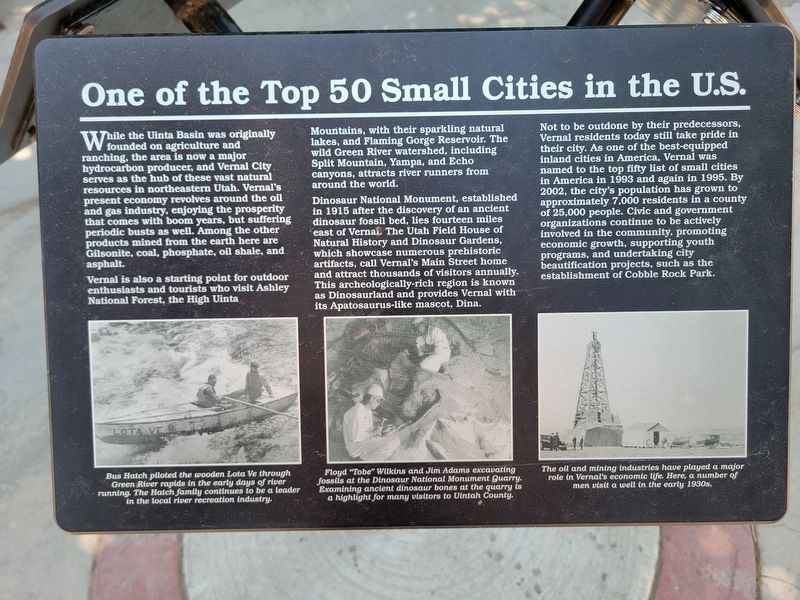
While the Uinta Basin was originally founded on agriculture and ranching, the area is now a major hydrocarbon producer, and Vernal City serves as the hub of these vast natural resources in northeastern Utah. Vernal's present economy revolves around the oil and gas industry, enjoying the prosperity that comes with boom years, but suffering periodic busts as well. Among the other products mined from the earth here are Gilsonite, coal, phosphate, oil shale, and asphalt.
Vernal is also a starting point for outdoor enthusiasts and tourists who visit Ashley National Forest, the High Uinta Mountains, with their sparkling
Photographed by Jeremy Snow, June 27, 2025
4. "Fort Scared-to-Death" / "Biggest Little City off the Railroad" Marker
Dinosaur National Monument, established in 1915 after the discovery of an ancient dinosaur fossil bed, lies fourteen miles east of Vernal. The Utah Field House of Natural History and Dinosaur Gardens, which showcase numerous prehistoric artifacts, call Vernal's Main Street home and attract thousands of visitors annually. This archeologically-rich region is known as Dinosaurland and provides Vernal with its Apatosaurus-like mascot, Dina.
Not to be outdone by their predecessors, Vernal residents today still take pride in their city. As one of the best-equipped inland cities in America, Vernal was named to the top fifty list of small cities in America in 1993 and again in 1995. By 2002, the city's population has grown to approximately 7,000 residents in a county of 25,000 people. Civic and government organizations continue to be actively involved in the community, promoting economic growth, supporting youth programs, and undertaking city beautification projects, such as the establishment of Cobble Rock Park.
Captions
Bus Hatch piloted the wooden Lota Ve through Green River rapids in the early days of river running, The Hatch family continues to be a leader in the local river recreation industry.
Floyd "Tobe" Wilkins and Jim Adams excavating fossils at the Dinosaur National Monument Quarry. Examining ancient dinosaur bones at the quarry is a highlight for many visitors to Uintah County.
The oil and mining industries have played a major role in Vernal's economic life. Here, a number of men visit a well in the early 1930s.
Topics. This historical marker is listed in these topic lists: Forts and Castles • Settlements & Settlers. A significant historical month for this entry is August 1879.
Location. 40° 27.33′ N, 109° 31.681′ W. Marker is in Vernal, Utah, in Uintah County. It can be reached from South Vernal Avenue, on the right when traveling east. Touch for map. Marker is at or near this postal address: 29 S Vernal Ave, Vernal UT 84078, United States of America. Touch for directions.

Regionally, this marker is in Utah’s Uinta Basin. It is also in the American Mountain West and on the Colorado Plateau. Globally, it is in North America, the Rocky Mountains, the Western Hemisphere, the Western World, and the Anglosphere. Historically, it finds itself in what was once New Spain and also Mexico’s Alta California.
Other nearby markers. At least 8 other markers are within walking distance of this marker: Cobble Rock Station / Vernal Auto Company / "A Splendid Specimen of Architecture" (here, next to this marker); If You Were an Outlaw Where Would You Shop? (a few steps from this marker); Where Can You Get an Iron Port, Phosphate, or Suicide? (a few steps from this marker); How Far Would You Carry a Brick for Seven Cents? (within shouting distance of this marker); Now Playing at the Vernal Theater... (within shouting distance of this marker); The Bank of Vernal (within shouting distance of this marker); Parcel Post Bank (within shouting distance of this marker); Do Religion and Money Mix? (within shouting distance of this marker). Touch for a list and map of all markers in Vernal.
Credits. This page was last revised on July 22, 2025. It was originally submitted on July 18, 2025, by Jeremy Snow of Cedar City, Utah. This page has been viewed 132 times since then and 40 times this year. Photos: 1, 2, 3, 4. submitted on July 18, 2025, by Jeremy Snow of Cedar City, Utah. • J. Makali Bruton was the editor who published this page.
