Valley Township in Valley City in Barnes County, North Dakota — The American Midwest (Upper Plains)
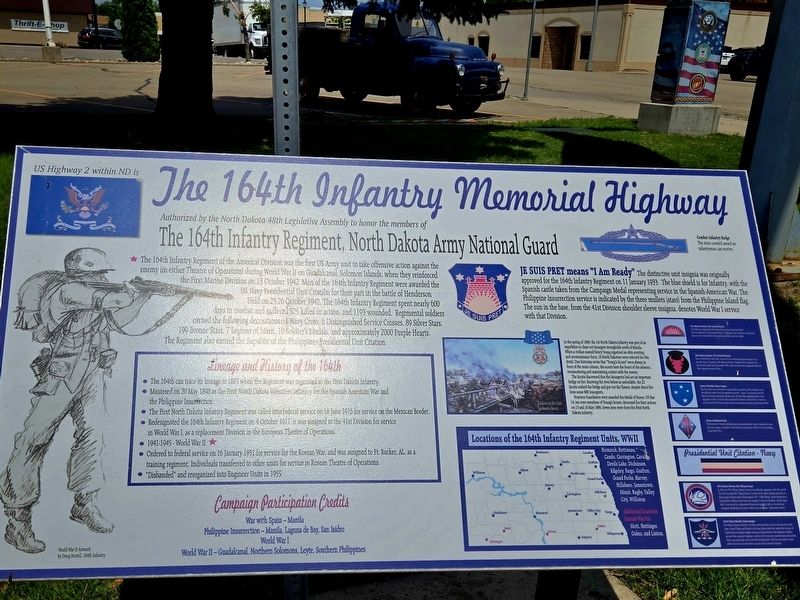
The 164th Infantry Memorial Highway
US Highway 2 within ND
Photographed by Mark Parker, June 27, 2025
1. The 164th Infantry Memorial Highway Marker
The 164th Infantry Regiment, North Dakota Army National Guard
*The 164th Infantry Regiment of the Americal Division was the first US Army unit to take offensive action against the enemy (in either Theatre of Operation) during World War II on Guadalcanal, Solomon Islands, when they reinforced the First Marine Division on 13 October 1942. Men of the 164th Infantry Regiment were awarded the US Navy Presidential Unit Citation for their part in the battle of Henderson Field on 23-26 October 1942. The 164th Infantry Regiment spent nearly 600 days in combat and suffered 325 killed in action, and 1193 wounded. Regimental soldiers earned the following decorations: 1 Navy Cross, 6 Distinguished Service Crosses, 89 Silver Stars, 199 Bronze Stars, 7 Legions of Merit, 10 Soldier's Medals, and approximately 2000 Purple Hearts. The Regiment also earned the Republic of the Philippines Presidential Unit Citation.
• The 164th can trace its lineage to 1885 when the Regiment was organized as the First Dakota Infantry.
•
this page online
• The First North Dakota Infantry Regiment was called into federal service on 18 June 1916 for service on the Mexican Border.
• Redesignated the 164th Infantry Regiment on 4 October 1917, it was assigned to the 41st Division for service in World War I, as a replacement Division in the European Theatre of Operations.
• 1941-1945 — World War II *
• Ordered to federal service on 16 January 1951 for service for the Korean War, and was assigned to Ft. Rucker, AL, as a training regiment. Individuals transferred to other units for service in Korean Theatre of Operations.
• "Disbanded" and reorganized into Engineer Units in 1955.
War with Spain — Manila
Philippine Insurrection — Manila, Laguna de Bay, San Isidro
World War I
World War II — Guadalcanal, Northern Solomons, Leyte, Southern Philippines
Combat Infantry Badge The most covered award and Infantryman can receive.
JE SUIS PRET means "I Am Ready" The distinctive unit insignia was originally approved for the
Photographed by Mark Parker, June 27, 2025
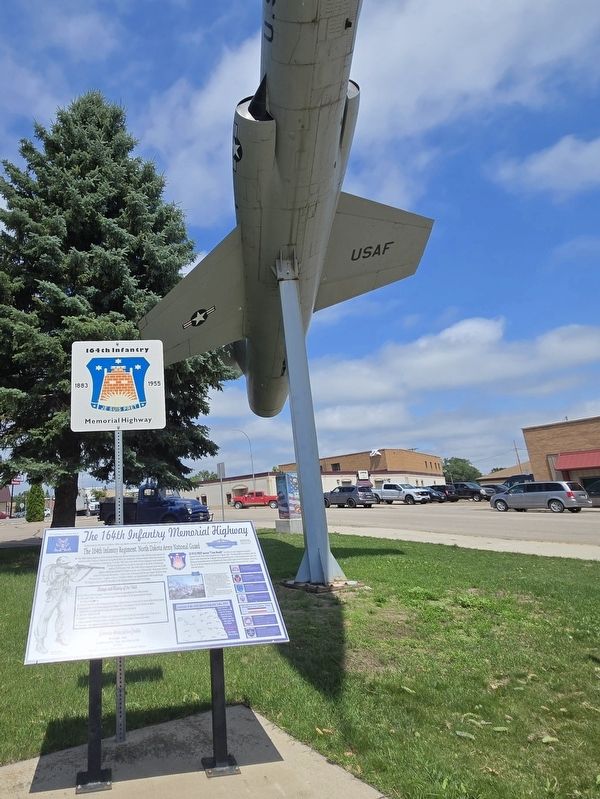
2. The 164th Infantry Memorial Highway Marker next to Highway sign and USAF jet
41st Infantry Division (The Sunset Division)
The 164th was assigned the 41st Division for service during World War I. The 41st deployed to the European Theatre of Operations and served as a replacement division, where individuals were transferred to other units for combat.
34th Infantry Division (The Red Bull Division)
Prior to World War II; the 164th was one of four infantry regiments assigned to the Seventh Service Command, 34th Infantry Division. Members of the regiment wore this shoulder patch until 8 December 1941, when divisions were reorganized with only three regiments instead of four.
Americal Shoulder Sleeve Insignia
The four white stars on the blue Norman shield are symbolic of the Southern Cross constellation
Photographed by Mark Parker, June 27, 2025
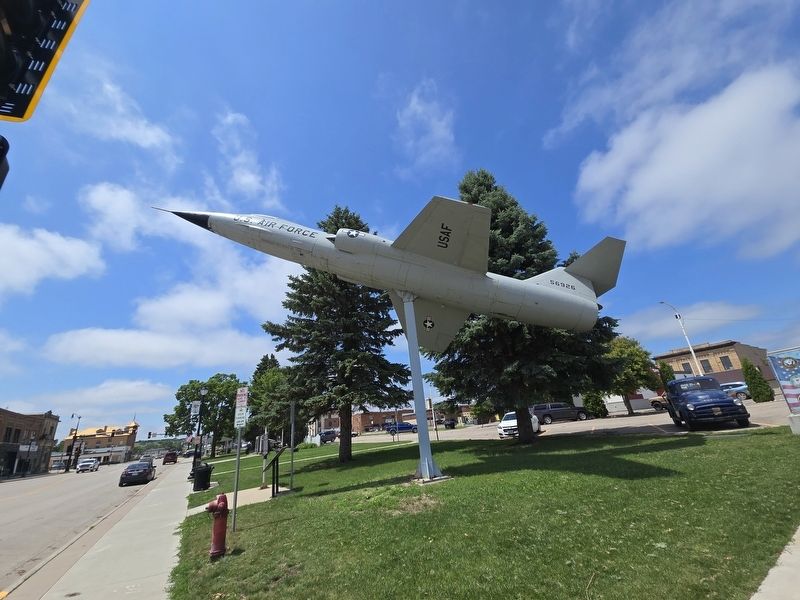
3. Side view of The 164th Infantry Memorial Highway marker looking west on Main Street East
Marine Guadalcanal Patch
The Marines 1st Division shoulder patch was authorized for wear by members of units that were organic or attached to the Division (including the 164th) in its four landings in the Pacific War.
47th Infantry Division (The Viking Division)
In 1946, the 47th "Viking" Infantry Division was officially organized in MN, ND, and WI. The 47th was called the "Viking Division" in honor of the ethnic heritage shared by so many people of those states. By late January 1951, "9,000 Vikings" found themselves at Camp Rucker, Alabama, where they were assigned to train new draftees. Shortly thereafter, it was named as a replacement division and gradually split up. Its men were reassigned individually or by unit to other Army commands. Many went to Korea.
North Dakota Shoulder Sleeve Insignia
The shield is blue for infantry. The three arrows and bow are from the Great Seal of the State of North Dakota and allude to the Sioux Indian tribes that roamed the territory of North Dakota and signify mighty warriors and great hunters. Red represents Artillery, red and white represent Engineers, and the yellow represents Quartermaster and Cavalry which were once major units of the ND National Guard. This blue and yellow wreath reflects the history of the territory as part of the Louisiana Purchase.
(Caption)
In the spring of 1899 the lst North Dakota Infantry was part of an expedition to clean cut Insurgent strongholds north of Manila. When a civilian named Henry Young organized an elite scouting and reconnaissance force, 16 North Dakotans were selected for this detail. One historian wrote that "Young's Scouts" were always in front of the main column, the scouts bore the brunt of the advanced, reconnoitering and maintaining contact with the enemy.
The Scouts discovered that the Insurgents had set an important bridge on fire. Knowing the river below as unfordable, the 22 Scouts rushed the bridge and put out the flames despite direct fire from some 600 Insurgents.
Fourteen Guardsmen were awarded the Medal of Honor. Of that 14, ten were members of Young's Scouts, decorated for their actions on 13 and 16 May 1899. Seven men were from the First North Dakota Infantry.
(Photo credit) Soldiers in the Sun by Donna Neary
Bismarck, Bottineau, Cando, Carrington, Cavalier, Devils Lake, Dickinson, Edgeley, Fargo, Grafton, Grand Forks, Harvey, Hillsboro, Jamestown, Minot, Rugby, Valley City, Williston
Additional Locations Korean War Era
Mott, Hettinger, Oakes, and Linton.
(Credit soldier drawing) World War II Artwork by Doug Burtell, 164th Infantry
Topics. This historical marker is listed in these topic lists: War, Korean • War, Spanish-American • War, World I • War, World II. A significant historical date for this entry is January 11, 1933.
Location. 46° 55.408′ N, 98° 0.111′ W. Marker is in Valley City, North Dakota, in Barnes County. It is in Valley Township. It is at the intersection of Main Street East (U.S. 10) and 2nd Avenue Northeast, on the right when traveling west on Main Street East. Touch for map. Marker is at or near this postal address: 155 Main St E, Valley City ND 58072, United States of America. Touch for directions.

Regionally, this marker is in North Dakota’s Red River Valley. It is also in the American Lewis & Clark Corridor, on the prairies, and on the Northern Plains. Globally, it is in North America, the Western Hemisphere, the Western World, and the Anglosphere. Historically, it finds itself in what was once Rupert’s Land and also the Louisiana Purchase.
Other nearby markers. At least 8 other markers are within walking distance of this marker: Herman Stern (a few steps from this marker); The Honored Dead Barnes County World War II (within shouting distance of this marker); The Honored Dead Barnes County (within shouting distance of this marker); Footbridge to Fun (about 800 feet away, measured in a direct line); Caboose (approx. 0.2 miles away); Rosebud Visitor Center Along the Byway (approx. 0.2 miles away); Valley City Street & Interurban Railroad (approx. 0.2 miles away); Wood Beam (approx. 0.2 miles away). Touch for a list and map of all markers in Valley City.
Credits. This page was last revised on July 22, 2025. It was originally submitted on July 19, 2025, by Mark Parker of Hickory, North Carolina. This page has been viewed 229 times since then and 100 times this year. Photos: 1, 2, 3. submitted on July 19, 2025, by Mark Parker of Hickory, North Carolina. • J. Makali Bruton was the editor who published this page.
