Norman in Cleveland County, Oklahoma — The American South (West South Central)
A Tough Decade
Politicians and Fires
—
1902-1912
—
Photographed by Duane and Tracy Marsteller, June 20, 2025
1. A Tough Decade Marker
Inscription.
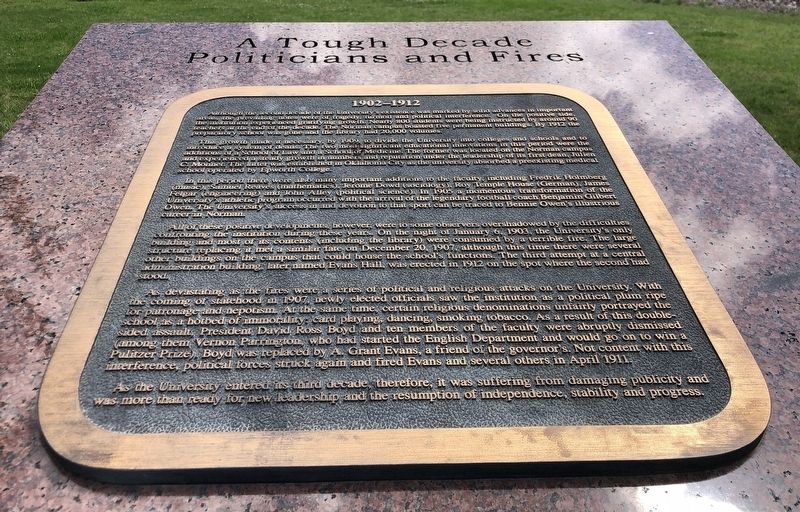
A Tough Decade. Politicians and Fires. Although the second decade of the university's existence was marked by solid advances in important areas, the prevailing notes were of tragedy, turmoil and political interference. On the positive side, the institution experience gratifying growth. Nearly 800 students were being instructed by around 90 teachers at the end of the decade. The Norman campus boasted five permanent buildings. By 1912 the preparatory school was gone and the library had 20,000 volumes. , This growth made it necessary, by 1909, to divide the university into colleges and schools and to introduce a system of deans. The two most significant educational innovations in this period were the additions of a School of Law and a School of Medicine. The former was located on the Norman campus and experienced a steady growth in numbers and reputation under the leadership of its first dean, Julien C. Monnet. The latter was established in Oklahoma City as the university absorbed a preexisting medical school operated by Epworth College. , In this period there were many important additions to the faculty, including Fredrik Holmberg (music), Samuel Reaves (mathematics), Jerome Dowd (sociology), Roy Temple House (German), James Felgar (engineering) and John Alley (political science). In 1905 a momentous transformation of the university's athletics program occurred with the arrival of the legendary football coach Benjamin Gilbert Owen. The university's success in and devotion to that sport can be traced to Bennie Owen's illustrious career in Norman. , All of these positive developments, however, were to some observers overshadowed by the difficulties confronting the institution during these years. On the night of January 6, 1903, the university's only building and most of its contents (including the library) were consumed by a terrible fire. The large structure replacing it met a similar fare on December 20, 1907, although this time there were several other buildings on the campus that could house the school's functions. The third attempt at a central administration building, later named Evans Hall, was erected in 1912 on the spot where the second had stood. , As devastating as the fires were a series of political and religious attacks on the university. With the coming of statehood in 1907, newly elected officials saw the institution as a political plum ripe for patronage and nepotism. At the same time, certain religious denominations unfairly portrayed the school as a hotbed of immorality: card playing, dancing, smoking tobacco. As a result of this double-sided assault, President David Ross Boyd and ten members of the faculty were abruptly dismissed (among them Vernon Parrington, who had started the English Department and would go on to win a Pulitzer Prize). Boyd was replaced by A. Grant Evans, a friend of the governor's. Not content with this interference, political forces struck again and fired Evans and several others in April 1911. , As the university entered its third decade, therefore, it was suffering from damaging publicity and was more than ready for new leadership and the resumption of independence, stability and progress.
Although the second decade of the university's existence was marked by solid advances in important areas, the prevailing notes were of tragedy, turmoil and political interference. On the positive side, the institution experience gratifying growth. Nearly 800 students were being instructed by around 90 teachers at the end of the decade. The Norman campus boasted five permanent buildings. By 1912 the preparatory school was gone and the library had 20,000 volumes.
This growth made it necessary, by 1909, to divide the university into colleges and schools and to introduce a system of deans. The two most significant educational innovations in this period were the additions of a School of Law and a School of Medicine. The former was located on the Norman campus and experienced a steady growth in numbers and reputation under the leadership of its first dean, Julien C. Monnet. The latter was established in Oklahoma City as the university absorbed a preexisting medical school operated by Epworth College.
In this period there were many important additions to the faculty, including Fredrik Holmberg (music), Samuel Reaves (mathematics),
Click or scan to see this page online
Jerome Dowd (sociology), Roy Temple House (German), James Felgar (engineering) and John Alley (political science). In 1905 a momentous transformation of the university's athletics program occurred with the arrival of the legendary football coach Benjamin Gilbert Owen. The university's success in and devotion to that sport can be traced to Bennie Owen's illustrious career in Norman.
All of these positive developments, however, were to some observers overshadowed by the difficulties confronting the institution during these years. On the night of January 6, 1903, the university's only building and most of its contents (including the library) were consumed by a terrible fire. The large structure replacing it met a similar fare on December 20, 1907, although this time there were several other buildings on the campus that could house the school's functions. The third attempt at a central administration building, later named Evans Hall, was erected in 1912 on the spot where the second had stood.
As devastating as the fires were a series of political and religious attacks on the university. With the coming of statehood in 1907, newly
Photographed by Duane and Tracy Marsteller, June 20, 2025
2. A Tough Decade Marker
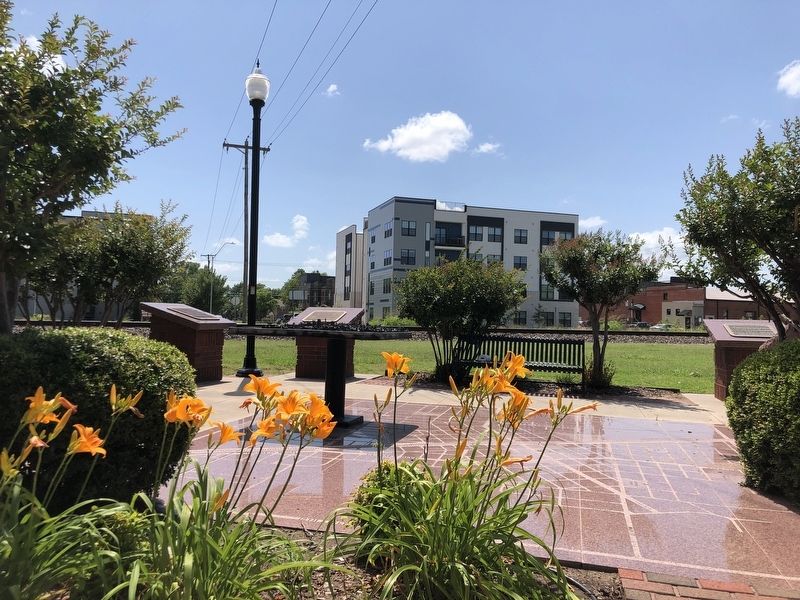
This marker is on the left.
elected officials saw the institution as a political plum ripe for patronage and nepotism. At the same time, certain religious denominations unfairly portrayed the school as a hotbed of immorality: card playing, dancing, smoking tobacco. As a result of this double-sided assault, President David Ross Boyd and ten members of the faculty were abruptly dismissed (among them Vernon Parrington, who had started the English Department and would go on to win a Pulitzer Prize). Boyd was replaced by A. Grant Evans, a friend of the governor's. Not content with this interference, political forces struck again and fired Evans and several others in April 1911.
As the university entered its third decade, therefore, it was suffering from damaging publicity and was more than ready for new leadership and the resumption of independence, stability and progress.
Erected by City of Norman, Oklahoma.
Topics. This historical marker is listed in these topic lists: Disasters • Education • Government & Politics. A significant historical date for this entry is January 6, 1901.
Location. 35° 13.08′ N, 97° 26.499′ W. Marker is in Norman, Oklahoma, in Cleveland County. It can be reached from South Jones Avenue near East Symmes Street, on the right when traveling south. Marker is on the Norman Legacy Trail, which runs parallel and to the west of South Jones Street. Touch for map. Marker is in this post office area: Norman OK 73069, United States of America. Touch for directions.
Regionally, this marker is in Central Oklahoma — Frontier Country and in Greater Oklahoma City. It is also in the American South, specifically on the prairies, and on the Southern Plains. Globally, it is in North America, the Western Hemisphere, the Western World, and the Anglosphere. Historically, it finds itself in what was once the territory of the Mississippian Culture and also the Louisiana Purchase.
Related markers. Click here for a list of markers that are related to this marker.
Credits. This page was last revised on July 21, 2025. It was originally submitted on July 19, 2025, by Duane and Tracy Marsteller of Murfreesboro, Tennessee. This page has been viewed 108 times since then and 17 times this year. Photos:1, 2. submitted on July 19, 2025, by Duane and Tracy Marsteller of Murfreesboro, Tennessee.