Norman in Cleveland County, Oklahoma — The American South (West South Central)
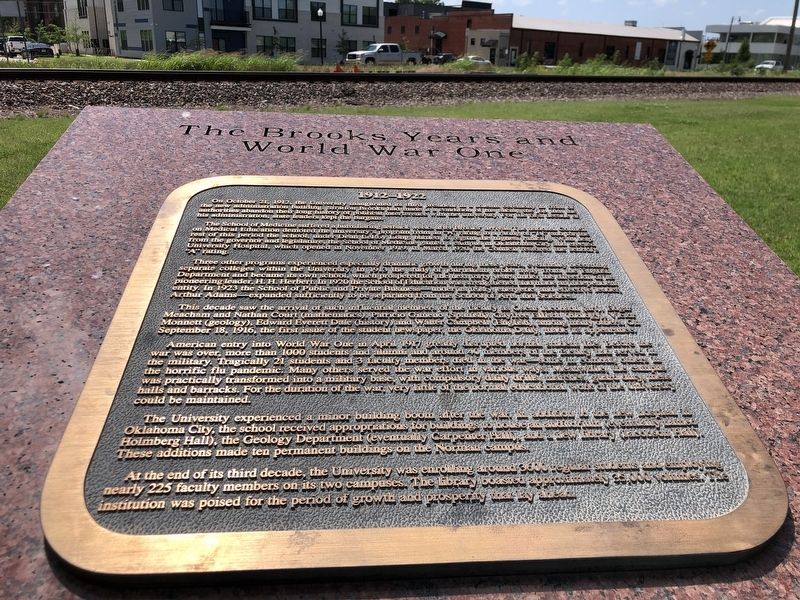
The Brooks Years and World War One
1912-1922
| — | Norman Legacy Trail | — |
Photographed by Duane and Tracy Marsteller, June 20, 2025
1. The Brooks Years and World War One Marker
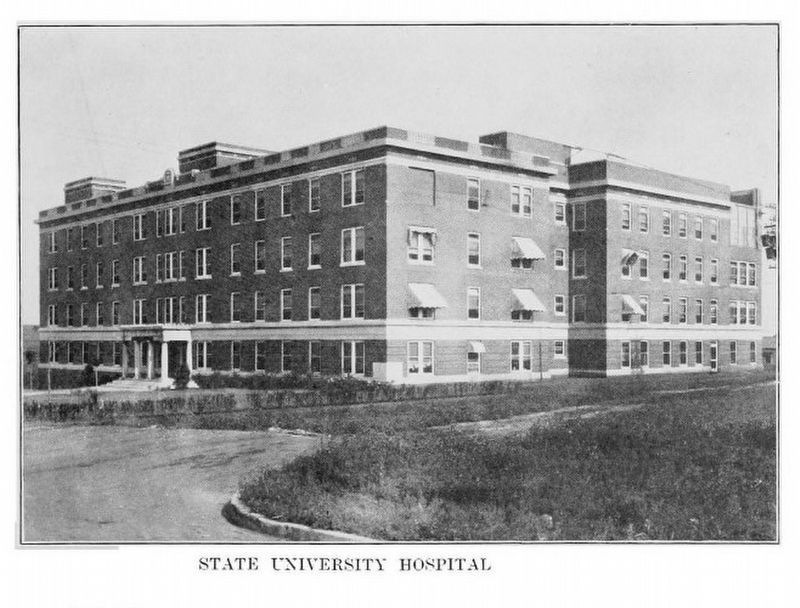
The School of Medicine suffered a humiliating setback weeks after Brooks' arrival. The national Council on Medical Education demoted the university's program from an “A” rating to a rating of “B,” and for the rest of this period the school, under Dean LeRoy Long, battled to regain the higher ranking. With help from the governor and legislature, the School of Medicine gained a campus in Oklahoma City and erected University Hospital, which opened in November 1919. In March 1920 the Council restored the school's “A” rating.
Three other programs experienced especially dramatic growth during these years, eventually becoming separate colleges within the university. In 1913 the study of journalism broke away from the English Department and became
this page online
This decade saw the arrival of such influential members of the faculty as Oscar Jacobson (art), Edgar Meacham and Nathan Court (mathematics), Patricio Gimeno (Spanish), Gayfree Ellison (biology), Victor Monnet (geology), Edward Everett Date (history) and Walter Campbell (English), among many others. On September 18, 1916, the first issue of the student newspaper, the Oklahoma Daily, made its appearance.
American entry into World War One in April 1917 greatly disrupted normal student life. Before the war was over, more than 1000 students and and alumni and around 40 members of the faculty had served in the military. Tragically 21 students and 3 faculty members died in the war – some in combat, other in the horrific flu pandemic. Many others served
Photographed by Duane and Tracy Marsteller, June 20, 2025
2. The Brooks Years and World War One Marker
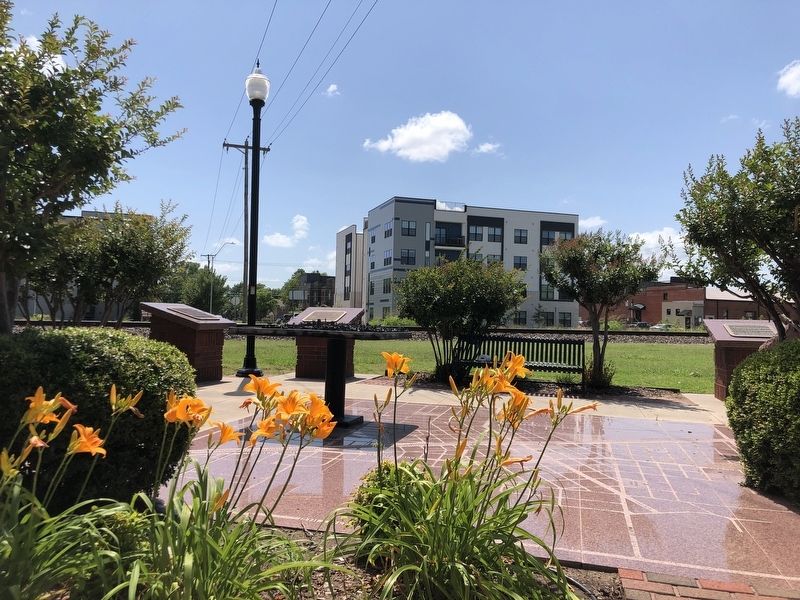
This marker is the second one from the left.
The university experienced a minor building boom after the war. In addition to the new hospital in Oklahoma City, the school received appropriation for buildings to house an auditorium (eventually named Holmberg Hall), the Geology Department (eventually Carpenter Hall), and a new library (Jacobson Hall). These additions made ten permanent buildings on the Norman campus.
At the end of its third decade, the University was enrolling around 3600 regular students and employing nearly 225 faculty members on its two campuses. The library boasted approximately 35,000 volumes. The institution was poised for the period of growth and prosperity that lay ahead.
Topics. This historical marker is listed in this topic list: Education. A significant historical date for this entry is September 18, 1916.
Location. 35° 13.081′ N, 97° 26.5′ W. Marker is in Norman, Oklahoma, in
The Story of Oklahoma City, Oklahoma, W.F. Kerr & Ina Gainer (1922) via Google Books (Public Domain), circa 1920
3. University Hospital
The 176-bed, fireproof teaching hospital cost $300,000 (nearly $4.8 million in 2024 dollars) to build.

Regionally, this marker is in Central Oklahoma—Frontier Country and in Greater Oklahoma City. It is also in the American South, specifically on the prairies, and on the Southern Plains. Globally, it is in North America, the Western Hemisphere, the Western World, and the Anglosphere. Historically, it finds itself in what was once the territory of the Mississippian Culture and also the Louisiana Purchase.
Other nearby markers. At least 8 other markers are within walking distance of this marker: A Tough Decade (here, next to this marker); The Roaring Twenties and Early Bizzell Years (here, next to this marker); Norman the University City (here, next to this marker); University on the Prairie (here, next to this marker); Surviving the Depression and Becoming Fifty Years Old (a few steps from this marker); War Years in Norman (about 300 feet away, measured in a direct line); U.S. Naval Air Station (about 300 feet away); Norman Public Library (about 600 feet away). Touch for a list and map of all markers in Norman.
Related markers. Click here for a list of markers that are related to this marker.
Credits. This page was last revised on July 30, 2025. It was originally submitted on July 19, 2025, by Duane and Tracy Marsteller of Murfreesboro, Tennessee. This page has been viewed 119 times since then and 21 times this year. Photos: 1, 2. submitted on July 19, 2025, by Duane and Tracy Marsteller of Murfreesboro, Tennessee. 3. submitted on July 29, 2025, by Duane and Tracy Marsteller of Murfreesboro, Tennessee.
