Fort Payne in DeKalb County, Alabama — The American South (East South Central)
Fort Payne Residential Historic District
Photographed by Deborah Spencer
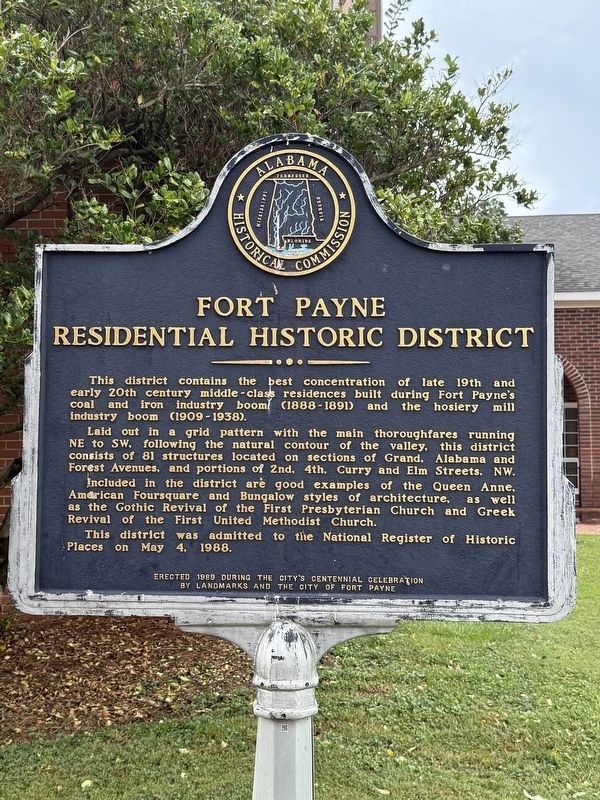
1. Fort Payne Residential Historic District Marker
Laid out in a grid pattern with the main thoroughfares running NE to SW, following the natural contour of the valley, this district consists of 81 structures located on sections of Grand, Alabama and Forest Avenues, and portions of 2nd, 4th, Curry and Elm Streets, NW.
Included in the district are good examples of the Queen Anne, American Foursquare and Bungalow styles of architecture, as well as the Gothic Revival of the First Presbyterian Church and Greek Revival of the First United Methodist Church.
This district was admitted to the National Register of Historic Places on May 4, 1988.
Erected 1989 during the City's Centennial Celebration by Landmarks and the City of Fort Payne
Erected 1989 by City of Fort Payne.
Topics. This historical marker is listed in this topic list: Settlements & Settlers.
Location. 34° 26.573′ N, 85° 43.34′ W.
this page online

Regionally, this marker is in North Alabama. It is also in the American South, specifically in the Deep South, in Appalachia, and specifically in Southern Appalachia. Globally, it is in North America, a Gulf of Mexico state, the Western Hemisphere, the Western World, and the Anglosphere. Historically, it finds itself in what was once the original Cherokee Nation, the territory of the Mississippian Culture, one of the Confederate States of America, and the Antebellum South.
Other nearby markers. At least 8 other markers are within walking distance of this marker: Alabama (about 600 feet away, measured in a direct line); Whittler's Corner (about 700 feet away);
Photographed by Deborah Spencer
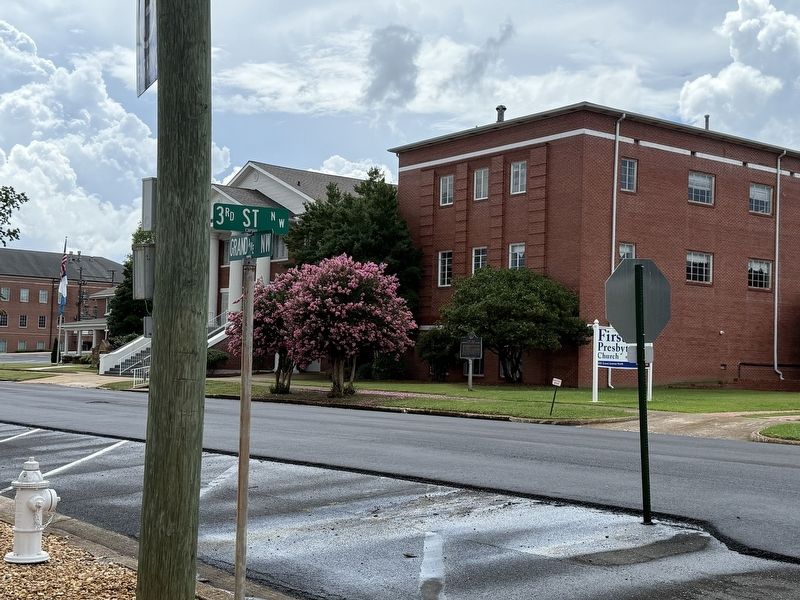
2. Fort Payne Residential Historic District Marker
Other markers no longer nearby. Sequoyah (was about 800 feet away but has been confirmed missing); Wills Town Mission (was about 800 feet away but has been confirmed missing); Fort Payne’s Fort (was about 800 feet away but has been confirmed missing); Boom Town Historic District (was approx. 0.2 miles away but has been confirmed missing).
Credits. This page was last revised on July 20, 2025. It was originally submitted on July 19, 2025, by Deborah Spencer of Huntsville, Alabama. This page has been viewed 193 times since then and 38 times this year. Photos: 1, 2. submitted on July 19, 2025, by Deborah Spencer of Huntsville, Alabama. • James Hulse was the editor who published this page.
