
Cheb, Karlovy Vary, Czechia — Central Europe (Bohemia)
Špalíček
Photographed by James Hulse, June 17, 2025
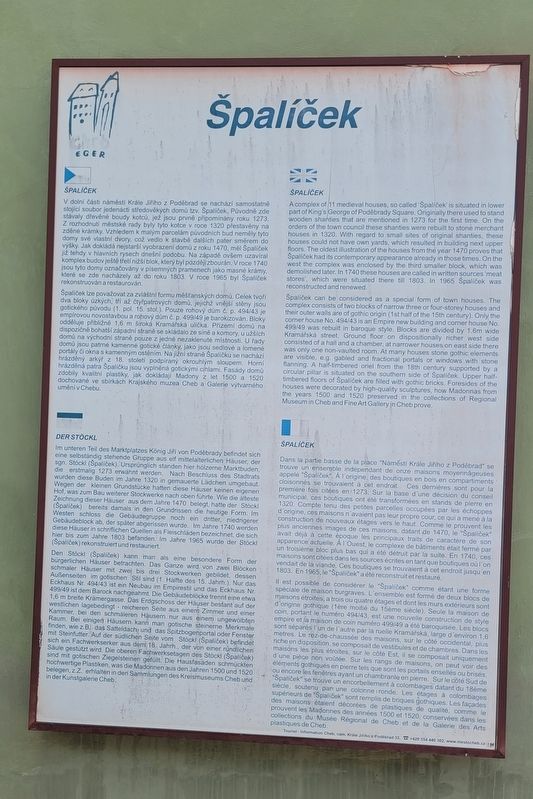
1. Špalíček Marker

Špalíček
V dolní části náměstí Krále Jiřího z Poděbrad se nachází samostatně stojící soubor jedenácti středověkých domů tzv. Špalíček. Původně zde stávaly dřevěné boudy kotců, jež jsou prvně připomínány roku 1273. Z rozhodnutí městské rady byly tyto kotce v roce 1320 přestavěny na zděné krámky. Vzhledem k malým parcelám původních bud neměly tyto domy své vlastní dvory, což vedlo k stavbě dalších pater směrem do výšky. Jak dokládá nejstarší vyobrazení domů z roku 1470, měl Špalíček již tehdy v hlavních rysech dnešní podobu. Na západě ovšem uzavíral komplex budov ještě třetí nižší blok, který byl později zbourán. V roce 1740 jsou tyto domy označovány v písemných pramenech jako masné krámy, které se zde nacházely až do roku 1803. V roce 1965 byl Špalíček rekonstruován a restaurován.
Špalíček lze považovat za zvláštní formu měšťanských domů. Celek tvoří dva bloky úzkých, tří až čtyřpatrových domů, jejichž vnější stěny jsou gotického původu (1. pol. 15. stol.). Pouze rohový dům č. p. 494/43 je empírovou novostavbou a rohový dům č. p. 499/49 je barokizován. Bloky odděluje přibližně 1,6 m široká Kramářská ulička. Přízemí domů na dispozičně bohatší západní straně se skládalo ze síně a komory, u užších domů na východní straně pouze z jedné nezaklenuté místnosti. U řady domů jsou patrné kamenné gotické články, jako jsou sedlové a lomené portály či okna s kamenným ostěním. Na jižní straně Špalíčku se nachází hrázděný arkýř z 18. století podpíraný okrouhlým sloupem. Horní hrázděná patra Špalíčku jsou vyplněná gotickými cihlami. Fasády domů zdobily kvalitní plastiky, jak dokládají Madony z let 1500 a 1520 dochované ve sbírkách Krajského muzea Cheb a Galerie výtvarného umění v Chebu.
Der Stöckl
Im unteren Teil des Marktplatzes König Jiří von Poděbrady befindet sich eine selbständig stehende Gruppe aus elf mittelalterlichen Häuser, der sgn. Stöckl (Špalíček). Ursprünglich standen hier hölzerne Marktbuden, die erstmalig 1273 erwähnt werden. Nach Beschluss des Stadtrats wurden diese Buden im Jahre 1320 in gemauerte Lädchen umgebaut. Wegen der kleinen Grundstücke hatten diese Häuser keinen eigenen Hof, was zum Bau weiterer Stockwerke nach oben führte. Wie die älteste Zeichnung dieser Häuser aus dem Jahre 1470 belegt, hatte der Stöckl (Špalíček) bereits damals in den Grundrissen die heutige Form. Im Westen schloss die Gebäudegruppe noch ein dritter, niedrigerer Gebäudeblock ab, der später abgerissen wurde. Im Jahre 1740 werden diese Häuser in schriflichen Quellen als Fleischläden bezeichnet, die sich hier bis zum Jahre 1803 befanden. Im Jahre 1965 wurde der Stöckl (Špalíček) rekonstruiert und restauriert.
Den Stöckl (Špalíček) kann man als eine besondere Form der bürgerlichen Häuser betrachten. Das Ganze wird von zwei Blöcken schmaler Häuser mit zwei bis drei Stockwerken gebildet, dessen Außenseiten im gotischen Stil sind (1. Hälfte des 15. Jahrh.). Nur das Eckhaus Nr. 494/43 ist ein Neubau im Empirestil und das Eckhaus Nr. 499/49 ist dem Barock nachgeahmt. Die Gebäudeblöcke trennt eine etwa 1,6 m breite Krämergasse. Das Erdgschoss der Häuser bestant auf der westlichen lagebedingt - reicheren Seite aus einem Zimmer und einer Kammer, bei den schmäleren Häusern nur aus einem ungewölbten Raum. Bei einigen Häusern kann man gotische steinerne Merkmale finden, wie z. B. das Satteldach und das Spitzbogenportal oder Fenster mit Steinfutter. Auf der südlichen Seite vom Stöckl (Špalíček) befindet sich ein Fachwerkserker aus dem 18. Jahrh., der von einer ründlichen Säule gestützt wird. Die oberen Fachwerksetagen des Stöckl (Špalíček) sind mit gotischen Ziegelsteinen gefüllt. Die Hausfasaden schmückten hochwertige Plastiken, was die Madonnen aus den Jahren 1500 und 1520 belegen, z.Z. erhlalten in den Sammlungen des Kreismuseums Cheb und in der Kunstgalerie Cheb.
Špalíček
A complex of 11 medieval houses, so called 'Špalíček' is situated in lower part of King's George of Poděbrady Square. Originally there used to stand wooden shanties that are mentioned in 1273 for the first time. On the orders of the town council these shanties were rebuilt to stone merchant houses in 1320. With regard to small sites of original shanties, these houses could not have own yards, which resulted in building next upper floors. The oldest illustration of the houses from the year 1470 proves that Špalíček had its contemporary appearance already in those times. On the west the complex was enclosed by the third smaller block, which was demolished later. In 1740 these houses are called in written sources 'meat stores', which were situated there till 1803. In 1965 Špalíček was reconstructed and renewed.
Špalíček can be considered as a special form of town houses. The complex consists of two blocks of narrow three or four-storey houses and their outer walls are of gothic origin (1st half of the 15th century). Only the corner house No. 494/43 is an Empire new building and corner house No. 499/49 was rebuilt in baroque style. Blocks are divided by 1.6m wide Kramářská street. Ground floor on dispositionally richer west side consisted of a hall and a chamber, at narrower houses on east side there was only one non-vaulted room. At many houses stone gothic elements are visible, e.g. gabled and fractional portals or windows with stone flanning. A half-timbered oriel from the 18th century supported by a circular pillar is situated on the southern side of Špalíček. Upper half-timbered floors of Špalíček are filled with gothic bricks. Foresides of the houses were decorated by high-quality sculptures, how Madonnas from the years 1500 and 1520 preserved in the collections of Regional Museum in Cheb and Fine Art Gallery in Cheb prove.
Špalíček
Dans la partie basse de la place "Náměstí Krále Jiřího z Poděbrad" se trouve un ensemble indépendant de onze maisons moyennâgeuses appelé "Špalíček". À l'origine, des boutiques en bois en compartiments cloisonnés se trouvaient à cet endroit. Ces dernières sont pour la première fois citées en 1273. Sur la base d'une décision du conseil municipal, ces boutiques ont été transformées en stands de pierre en 1320. Compte tenu des petites parcelles occupées par les échoppes d'origine, ces maisons n'avaient pas leur propre cour, ce qui a mené à la construction de nouveaux étages vers le haut. Comme le prouvent les plus anciennes images de ces maisons, datant de 1470, le "Špalíček" avait déjà à cette époque les principaux traits de caractère de son apparence actuelle. À l'Ouest, le complexe de bâtiments était fermé par un troisième bloc plus bas qui a été détruit par la suite. En 1740, ces maisons sont citées dans les sources écrites en tant que boutiques où l'on vendait de la viande. Ces boutiques se trouvaient à cet endroit jusqu'en 1803. En 1965, le "Špalíček" a été reconstruit et restauré.
Il est possible de considérer le "Špalíček" comme étant une forme spéciale de maison burgraves. L'ensemble est formé de deux blocs de maisons étroites, a trois ou quatre étages et dont les murs extérieurs sont d'origine gothique (1ère moitié du 15ème siècle). Seule la maison de coin, portant le numéro 494/43, est une nouvelle construction de style empire et la maison de coin numéro 499/49 a été baroquisée. Les blocs sont séparés l'un de l'autre par la ruelle Kramářská, large d'environ 1,6 metres. Le rez-de-chaussée des maisons, sur le côté occidental, plus riche en disposition, se composait de vestibules et de chambres. Dans les maisons les plus étroites, sur le côté Est, il se composait uniquement d'une pièce non voûtée. Sur les rangs de maisons, on peut voir des éléments gothiques en pierre tels que sont les portails ensellés ou brisés, ou encore les fenêtres ayant un chambranle en pierre. Sur le côté Sud de "Špalíček" se trouve un encorbellement à colombages datant du 18ème siècle, soutenu par une colonne ronde. Les étages à colombages supérieurs de "Špalíček" sont remplis de briques gothiques. Les façades des maisons étaient décorées de plastiques de qualité, comme le prouvent les Madonnes des années 1500 et 1520, conservées dans les collections du Musée Régional de Cheb et de la Galerie des Arts plastiques de Cheb.
Tourist - Information Cheb, nám. Krále Jiřího z Poděbrad 33, +420 354 440 302, www.mestocheb.cz 04
Topics.
this page online
Location. 50° 4.776′ N, 12° 22.198′ E. Marker is in Cheb, Karlovarský kraj ( Karlovy Vary). It is on námestí Krále Jirího z Podebrad just south of Židovská, on the right when traveling north. The marker is located on the southwest corner of the building. Touch for map. Marker is at or near this postal address: nám Krále Jirího z Podebrad 1, Cheb, Karlovarský kraj 350 02, Czechia. Touch for directions.

Regionally, it is in Europe, the European Union, the Carpathian States, Central Europe, Eastern Europe, the Schengen Area, and the Western World. Historically, it finds itself in what was once the Holy Roman Empire.
Other nearby markers. At least 8 other markers are within walking distance of this marker: Kramařská ulička / Shopkeeper Lane (a few steps from this marker); Spalíček / Cluster of Houses (a few steps from this marker); Schlickův dům č. p. 481 / The Schlick house no. 481 (within shouting
Photographed by James Hulse, June 17, 2025
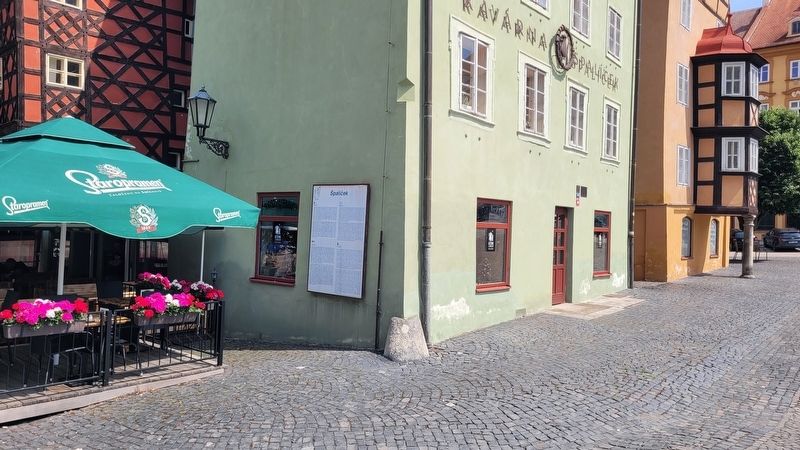
2. The view of the Špalíček Marker along the corner of the building
Photographed by James Hulse, June 17, 2025
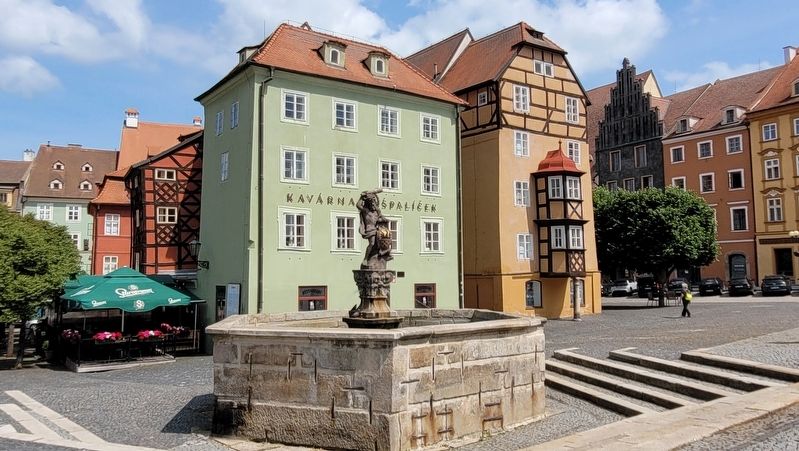
3. The view of the Špalíček and Marker from the plaza
Photographed by James Hulse, June 17, 2025
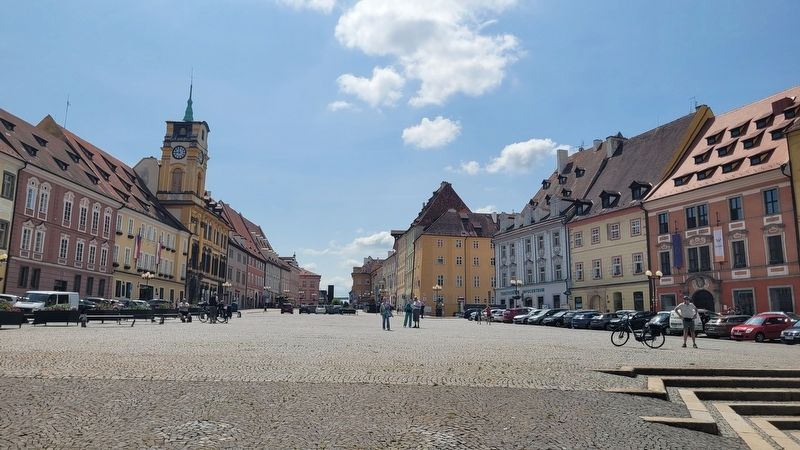
4. The view of the plaza from the Špalíček
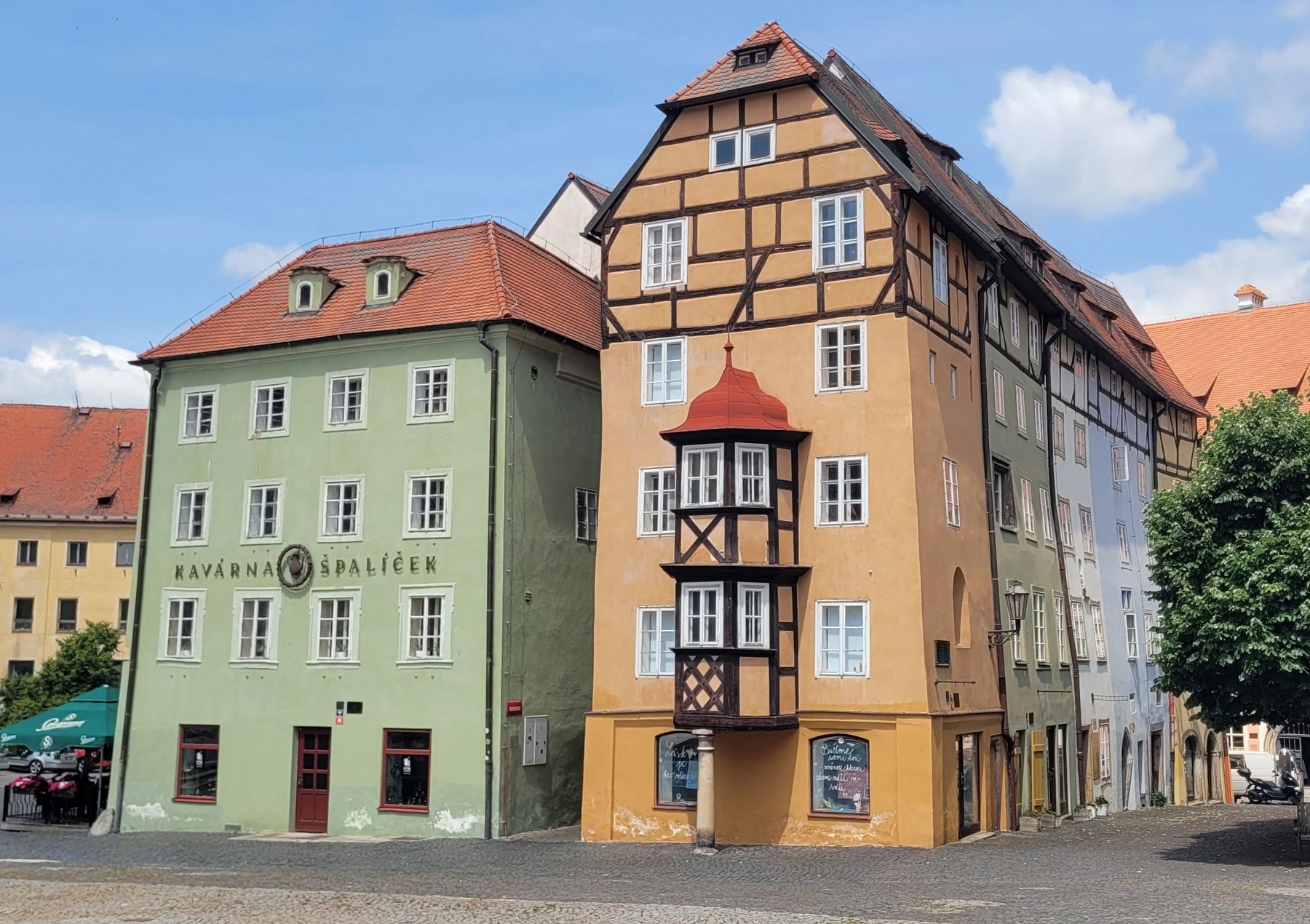
Photographed by James Hulse, June 17, 2025
5. Špalíček
Credits. This page was last revised on October 26, 2025. It was originally submitted on July 19, 2025, by James Hulse of Medina, Texas. This page has been viewed 69 times since then and 11 times this year. Photos: 1, 2, 3, 4, 5. submitted on July 22, 2025, by James Hulse of Medina, Texas.
