
Southampton City Centre , England, United Kingdom — Northwestern Europe (the British Isles)
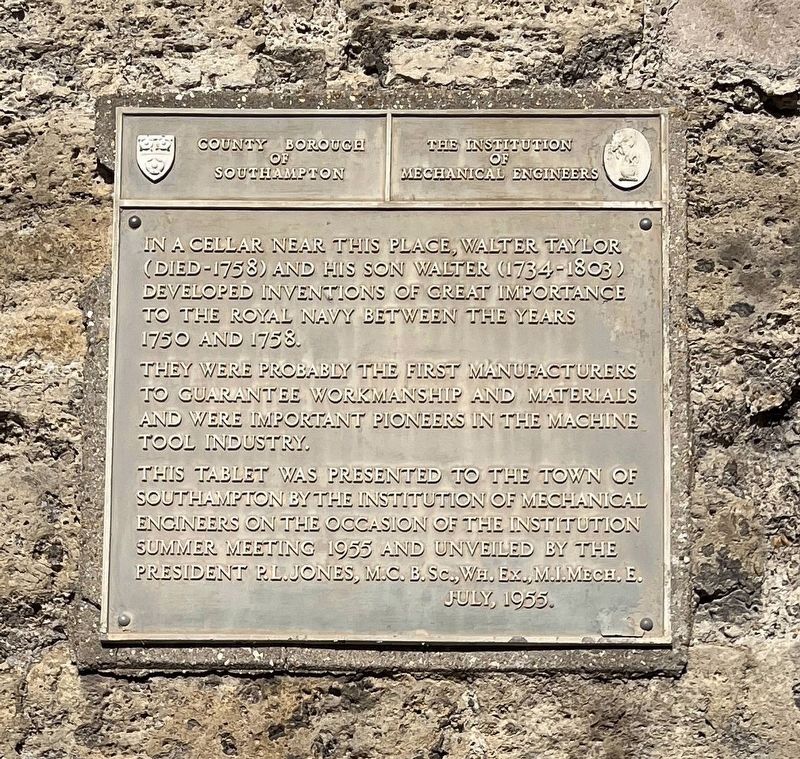
Walter Taylor
Photographed by Ray Gurganus, April 1, 2025
1. Walter Taylor (1734-1803) Marker
They were probably the first manufacturers to guarantee workmanship and materials and were important pioneers in the machine tool industry.
This tablet was presented to the town of Southampton by the Institution of Mechanical Engineers on the occasion of the institution summer meeting 1955 and unveiled by the president P.L. Jones, M.C. B.Sc., Wh. Ex., M.I.Mech. E., July, 1955.
Erected by County Borough of Southampton.
Topics. This historical marker is listed in this topic list: Industry & Commerce. A significant historical year for this entry is 1750.
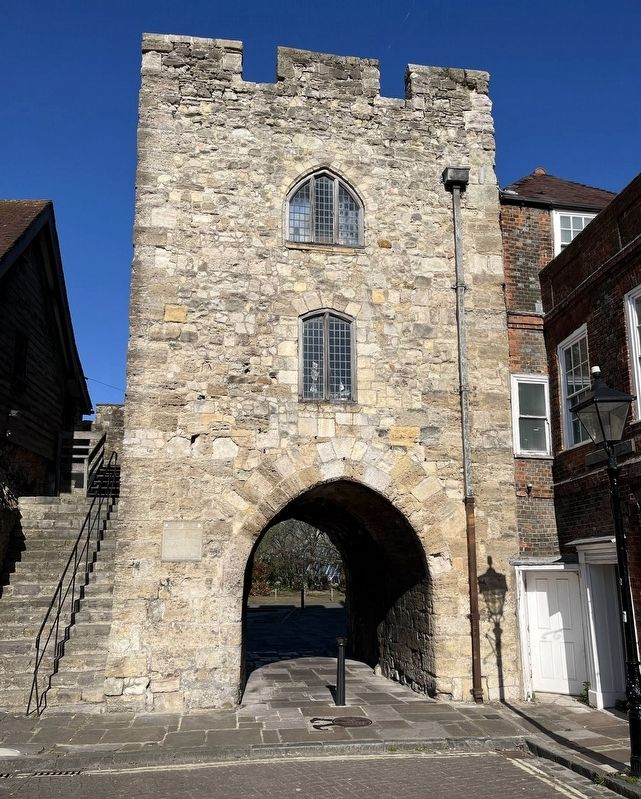
Location. 50° 53.934′ N, 1° 24.413′ W. Marker is in Southampton, England. It is in Southampton City Centre. It is on Westgate Street, on the left when traveling west. Touch for map. Marker is at or near this postal address: 10 Westgate Street, Southampton, England SO14 2AY, United Kingdom. Touch for directions.

Regionally, this marker is in England’s Hampshire Ports. Globally,
this page online
Other nearby markers. At least 8 other markers are within walking distance of this marker: Westgate (a few steps from this marker); a different marker also named Westgate (within shouting distance of this marker); Southampton's Medieval West Quay c.1450 (within shouting distance of this marker); Replica of a 14th Century Cargo Ship (within shouting distance of this marker); Cuckoo Lane (within shouting distance of this marker); Blue Anchor Lane (about 90 meters away, measured in a direct line); Mayflower Memorial (about 120 meters away); Mayflower Pilgrims Memorial (about 120 meters away). Touch for a list and map of all markers in Southampton.
Also see . . . Walter Taylor (engineer) (Wikipedia). Overview:
Walter Taylor (1734–1803) of Southampton, supplied wooden rigging blocks and ship's pumps to the Royal Navy, greatly improving their quality and reliability via technological innovations(Submitted on July 20, 2025.)which were a significant step forward in the Industrial Revolution.Photographed by Ray Gurganus, April 1, 20252. Walter Taylor Marker
Credits. This page was last revised on July 20, 2025. It was originally submitted on July 20, 2025, by Ray Gurganus of Washington, District of Columbia. This page has been viewed 87 times since then and 17 times this year. Photos: 1, 2. submitted on July 20, 2025, by Ray Gurganus of Washington, District of Columbia. • Andrew Ruppenstein was the editor who published this page.
