Griffin in Spalding County, Georgia — The American South (South Atlantic)
The Griffin School
⎯⎯⎯
Rosenwald Schools
Photographed by Dorothy Canter, 2025
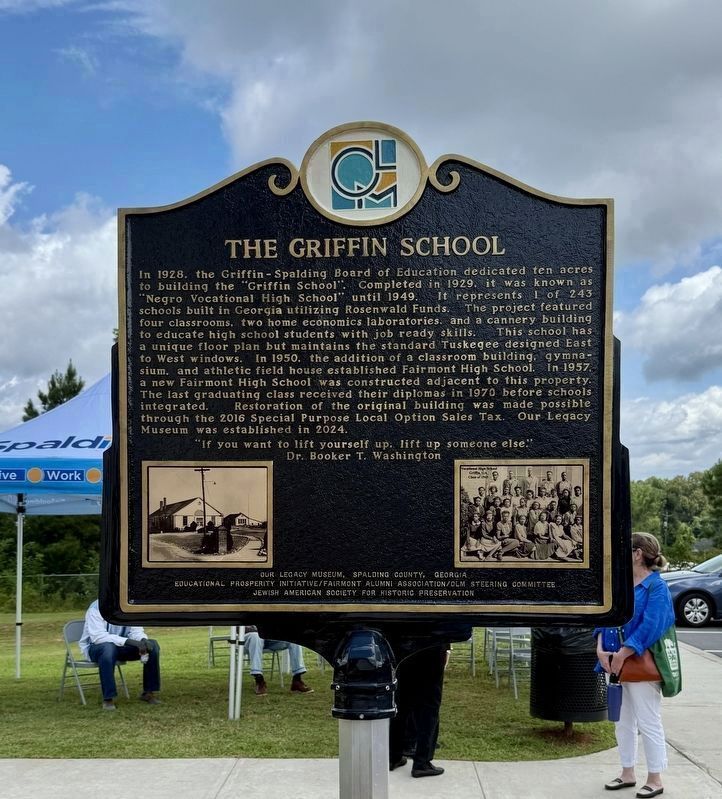
1. The Griffin School Marker
The Griffin School
In 1928, the Griffin-Spalding Board of Education dedicated ten acres to building the “Griffin School”. Completed in 1929, it was known as “Negro Vocational High School” until 1949. It represents 1 of 243 schools built in Georgia utilizing Rosenwald Funds. The project featured four classrooms, two home economics laboratories, and a cannery building to educate high school students with job ready skills. This school has a unique floor plan but maintains the standard Tuskegee designed East to West windows. In 1950, the addition of a classroom building, gymnasium, and athletic field house established Fairmont High School. In 1957, a new Fairmont High School was constructed adjacent to this property. The last graduating class received their diplomas in 1972 before schools integrated. Restoration of the original building was made possible through the 2016 Special Purpose Local Option Sales Tax. Our Legacy Museum was established in 2024.
“If you want to lift yourself up, lift up someone else.”
Dr. Booker T. Washington
Rosenwald Schools
In 1911, Booker T. Washington, head of Tuskegee Institute in Alabama,
this page online
When the Rosenwald Fund closed in 1948, it had facilitated the construction of over 4,977 schools, 217 teachers' homes, and 163 shop buildings in 883 counties in 15 southern states. 1/3 of all Black children attended a Rosenwald School.
Erected 2025 by Jewish American Society for Historic Preservation, Our Legacy Museum, Spalding County, Georgia Educational Prosperity Initiative / Fairmont Alumni Association / OLM Steering Committee.
Topics and series. This historical marker is listed in these topic

Photographed by Dorothy Canter, July 19, 2025
2. Rosenwald Schools side
Location. 33° 15.421′ N, 84° 15.478′ W. Marker is in Griffin, Georgia, in Spalding County. It can be reached from North 3rd Street north of Jefferson Street, on the right when traveling south. Touch for map. Marker is at or near this postal address: 547 North 3rd Street, Griffin GA 30223, United States of America. Touch for directions.

Regionally, this marker is in the Piedmont and in Metro Atlanta. It is also in the American South and specifically in the Deep South. Globally, it is in North America, the Western Hemisphere, the Western World, and the Anglosphere. Historically, it finds itself in what was once the territory of the Mississippian Culture, one of the original Thirteen Colonies, one of the Confederate States of America, and the Antebellum South.
Other nearby markers. At least 8 other markers are within walking distance of this marker: Presbyterian Church (approx. half a mile away); PFC. Harry E. Tate

Photographed by Dorothy Canter, July 19, 2025
3. The Griffin School Marker
Descendant community members whose families attended the Griffin School.
Also see . . .
1. Inside the Rosenwald Schools.
Between 1917 and 1932, nearly 5,000 rural schoolhouses, modest one-, two-, and three-teacher buildings known as Rosenwald Schools, came to exclusively serve more than 700,000 black children over four decades. It was through the shared ideals and a partnership between Booker T. Washington, an educator, intellectual and prominent African American thought leader, and Julius Rosenwald, a German-Jewish immigrant who accumulated his wealth as head of the behemoth retailer, Sears, Roebuck & Company, that Rosenwald Schools would come to comprise more than one in five Black schools operating throughout the South by 1928.(Submitted on July 20, 2025, by Jerry Klinger of Boynton Beach, Florida.)
2. Remembering the Rosenwald Schools.
A former slave who donated his life savings, $38, towards building his community’s Rosenwald school said he did so because he wanted “to see the children of my grandchildren have a chance.”(Submitted on July 20, 2025, by Jerry Klinger of Boynton Beach, Florida.)
3. Rosenwald Schools.
Julius Rosenwald, a wealthy Jewish philanthropist and businessman from Illinois whose charitable interests ranged from health care to colleges and museums, concentrated his efforts in the early twentieth century on improving opportunities for African Americans in the rural South. Inspired by Booker T. Washington, Rosenwald became a trustee of Tuskegee Institute in Alabama, where Washington’s philosophy of self-reliance was stressed through a program of industrial education.(Submitted on July 20, 2025, by Jerry Klinger of Boynton Beach, Florida.)
Credits. This page was last revised on August 5, 2025. It was originally submitted on July 20, 2025, by Jerry Klinger of Boynton Beach, Florida. This page has been viewed 468 times since then and 141 times this year. Photos: 1, 2, 3. submitted on July 20, 2025, by Jerry Klinger of Boynton Beach, Florida. • Andrew Ruppenstein was the editor who published this page.
