
Cheb, Karlovy Vary, Czechia — Central Europe (Bohemia)
Kramařská ulička
⎯⎯⎯
Shopkeeper Lane
Photographed by James Hulse, June 17, 2025
1. Kramařská ulička / Shopkeeper Lane Marker

Kramařská ulička
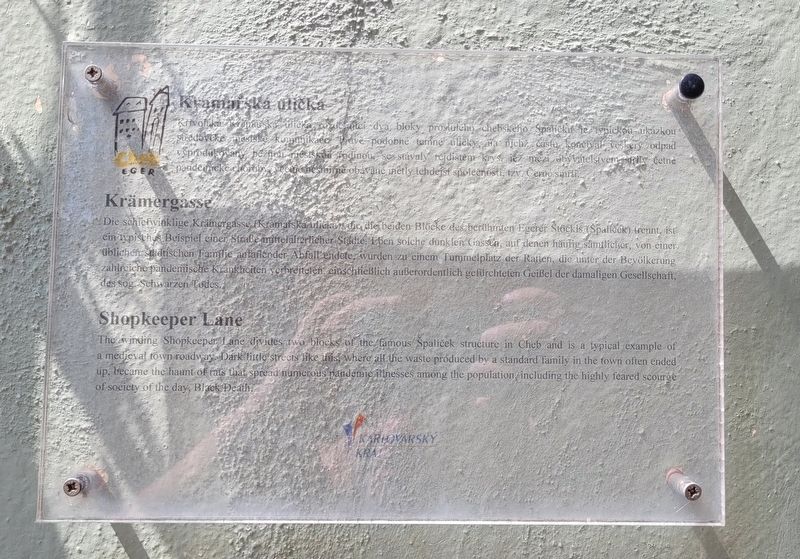
Křivolaká Kramářská ulička, rozdělující dva bloky proslulého chebského Špalíčku, je typickou ukázkou středověké městské komunikace. Právě podobné temné uličky, na nichž často končíval veškerý odpad vyprodulovany běžnou městskou rodinou, se stávaly rejdištěm krys, jež mezi obyvatelstvem šířily četné pandemické choroby, včetně nesmírně obávané metly tehdejší společnosti, tzv. Černé smrti.
Krämergasse
Die schiefwinklige Krämergasse (Kramářská Ulička), die die beiden Blöcke des berühmten Egerer Stöckls (Špalíček) trennt, ist ein typisches Beispiel einer Straße mittelalterlicher Städte. Eben solche dunklen Gassen, auf denen häufig sämtlicher, von einer üblichen städtischen Familie anfallender Abfall endete, wurden zu einem Tummelplatz der Ratten, die unter der Bevölkerung zahlreiche pandemische Krankheiten verbreiteten, einschließlich außerordentlich gefürchteten Geißel der damaligen Gesellschaft, des sog. Schwarzen Todes.
Shopkeeper Lane
The winding Shopkeeper Lane divides two blocks of the famous Spaliček structure in Cheb and is a typical example of a medieval town roadway. Dark little streets like this, where all the waste produced by a standard family in the town often ended up, became the haunt of rats that spread numerous pandemic illnesses among the population including the highly feared scourge of society of the day, Black Death.
Erected by Cheb
this page online
Topics. This historical marker is listed in these topic lists: Architecture • Industry & Commerce.
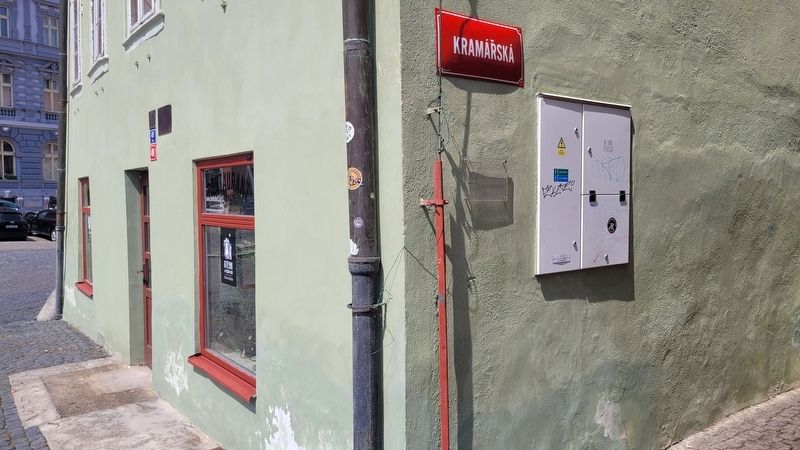
Location. 50° 4.778′ N, 12° 22.207′ E. Marker is in Cheb, Karlovarský kraj ( Karlovy Vary). It is on námestí Krále Jirího z Podebrad just south of nám. Krále Jiřího z Poděbrad. The marker is located on the southeast corner of the building. Touch for map. Marker is at or near this postal address: nám Krále Jirího z Podebrad 1, Cheb, Karlovarský kraj 350 02, Czechia. Touch for directions.

Regionally, it is in Europe, the European Union, the Carpathian States, Central Europe, Eastern Europe, the Schengen Area, and the Western World. Historically, it finds itself in what was once the Holy Roman Empire.
Other nearby markers. At least 8 other markers are within walking distance of this marker: Špalíček (a few steps from this marker); Spalíček / Cluster of Houses (a few steps from this marker); Kramářská ulička / Shopkeeper Lane (within shouting distance of this marker); Dům Ecků č. p. 510 / The Eck building no. 510
Photographed by James Hulse, June 17, 2025
2. Kramařská ulička / Shopkeeper Lane Marker
Also see . . . Black Death. Wikipedia
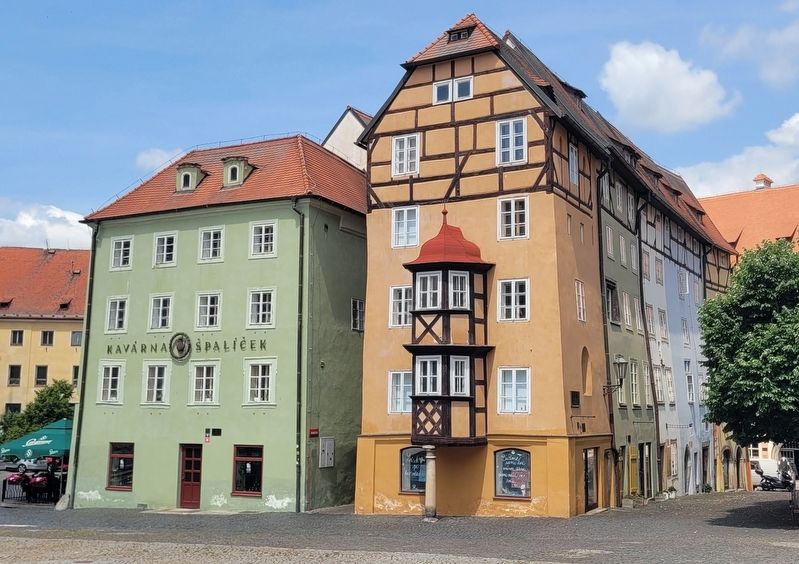
The Black Death was a bubonic plague pandemic that occurred in Europe from 1346 to 1353. It was one of the most fatal pandemics in human history; as many as 50 million people perished, perhaps 50% of Europe's 14th century population. The disease is caused by the bacterium Yersinia pestis and spread by fleas and through the air. One of the most significant events in European history, the Black Death had far-reaching population, economic, and cultural impacts. It was the beginning of the second plague pandemic. The plague created religious, social and economic upheavals, with profound effects on the(Submitted on July 21, 2025, by James Hulse of Medina, Texas.)course of European history.Photographed by James Hulse, June 17, 20253. Kramařská ulička / Shopkeeper Lane MarkerThe marker is located in the middle of the buildings on the corner of the green building
Credits. This page was last revised on October 26, 2025. It was originally submitted on July 20, 2025, by James Hulse of Medina, Texas. This page has been viewed 81 times since then and 12 times this year. Photos: 1, 2, 3. submitted on July 21, 2025, by James Hulse of Medina, Texas.
