Chichester in West Sussex, England, United Kingdom — Northwestern Europe (the British Isles)
The Council House and Assembly Room
Photographed by Ray Gurganus, April 4, 2025
1. The Council House and Assembly Room Marker
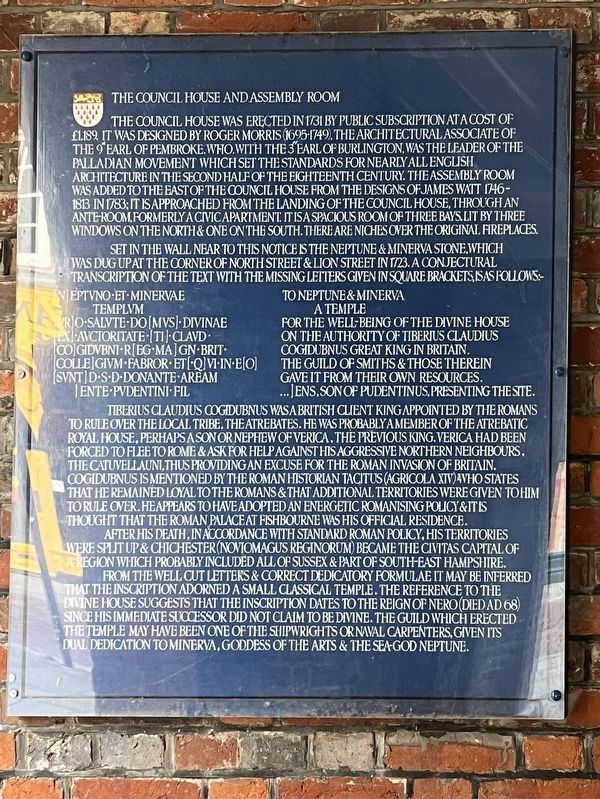
Set in the wall near to this notice is the Neptune & Minerva stone, which was dug up at the corner of North Street & Lion Street in 1723. A conjectural transcription of the text with the missing letters given in square brackets, is as follows:
To Neptune & Minerva
A temple
for the well-being of the divine house
on the authority of Tiberius Claudius
Cogidubnus Great King in Britain.
The guild of smiths
this page online
gave it from their own resources.
...jens, son of pudentinus, presenting the site.
(latin text not transcribed) Tiberius Claudius Cogidubnus was a British client king appointed by the Romans to rule over the local tribe, Theatrebates. He was probably a member of the Atrebatic royal house, perhaps a son or nephew of Verica, the previous king. Verica had been forced to flee to Rome & ask for help against his aggressive northern neighbours, the Catuvellauni, thus providing an excuse for the Roman invasion of Britain. Cogidubnus is mentioned by the roman historian Tacitus (Agricola XIV) who states that he remained loyal to the Romans & that additional territories were given to him to rule over. He appears to have adopted an energetic romanising policy & it is thought that the Roman palace at Fishbourne was his official residence.
After his death, in accordance with standard roman policy, his territories were split up & Chichester (Noviomagus Reginorum) became the civitas capital of a region which probably included all of Sussex & part of south-east Hampshire.
From the well cut letters & correct dedicatory formulae
Photographed by Ray Gurganus, April 4, 2025
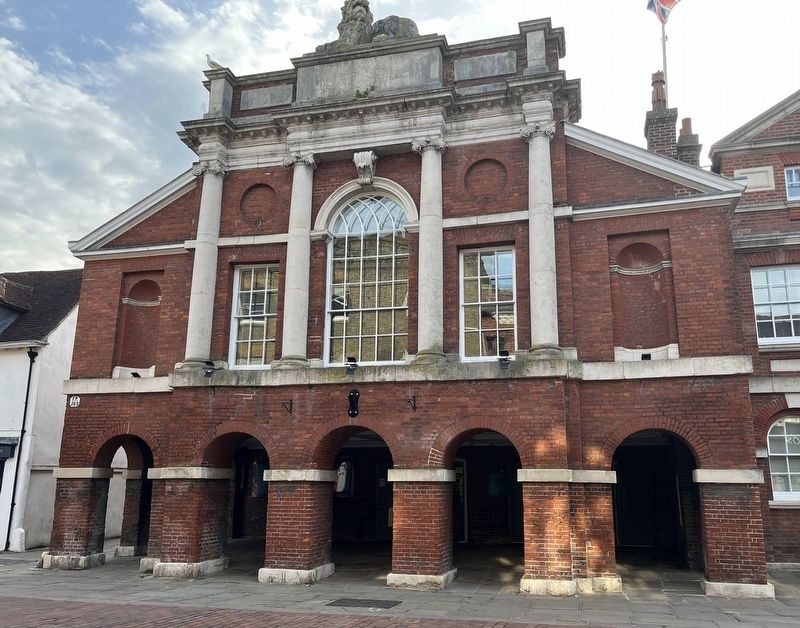
2. The Council House and Assembly Room Marker
(through the arches, on the left)
Topics. This historical marker is listed in these topic lists: Architecture • Government & Politics. A significant historical year for this entry is 1731.
Location. 50° 50.264′ N, 0° 46.719′ W. Marker is in Chichester, England, in West Sussex. It is on North Street, on the left when traveling south. Touch for map. Marker is at or near this postal address: 22 North Street, Chichester, England PO19 1LP, United Kingdom. Touch for directions.

Regionally, this marker is in the Greater South East. Globally, it is on the Atlantic Ocean, in the North Atlantic Region, in Europe, in Atlantic Europe, on one of the British Isles, in the Western World, and in the Anglosphere. Historically, it finds itself in what was once the Roman Empire.
Other nearby markers. At least 8 other markers are within walking distance of this marker: Admirals Lord Horatio Nelson and Sir George Murray (a few steps from this marker); Ethel Margaret 'Madge' Turner (about 90 meters away, measured in a direct line); The Guildhall (about 210 meters away); Priory Park Orchard (approx. 0.2 kilometers away); Leslie Evershed-Martin CBE (approx. 0.3 kilometers away); 1800s - A new use for the walls (approx. 0.3 kilometers away); AD 280 - The Emperor's seal of approval (approx. 0.4 kilometers away); 1100 - Creation of a city (approx. 0.4 kilometers away). Touch for a list and map of all markers in Chichester.
Credits. This page was last revised on July 21, 2025. It was originally submitted on July 20, 2025, by Ray Gurganus of Washington, District of Columbia. This page has been viewed 83 times since then and 16 times this year. Photos: 1, 2. submitted on July 20, 2025, by Ray Gurganus of Washington, District of Columbia. • Andrew Ruppenstein was the editor who published this page.
