Workington in Cumberland, England, United Kingdom — Northwestern Europe (the British Isles)
The Steel Making Process

Photographed by Ray Gurganus, April 11, 2025
1. The Steel Making Process Marker
Locally mined coal and iron ore together with limestone from local quarries fuelled the early industry later supplemented by coke from the North East and iron ore from overseas (Spain, Sweden and Canada).
Some coal is used to raise steam for power but most is converted to coke, to fuel ironmaking in the blast furnaces. Coke is almost pure carbon and has the right structural properties for ironmaking.
Iron ore is crushed & blended in the inter plant then smelted together with crushed coke & limestone to create "sinter".
Iron ore,coke and limestone were charged in to the blast furnace. Periodically the furnace was tapped. First the slag run off through the (higher) slag notch and then the iron. The molten iron was either cast (allowed to cool) as pigs or transported to the Bessemer shop.
Molten iron for steelmaking was stored in the mixer, a refractory
this page online
A powerful blast of air was blown through tuyeres at the bottom, and then the vessel turned to vertical which produced a huge shower of sparks. As the carbon and impurities burnt out, the shower of sparks turned into an intense white flame. Outside, clouds of rusty red smoke drifted across the sky. 25 tons of iron would be converted to steel in about 20 minutes, each cycle was called a "Heat".
The 'blower' was a very experienced man who controlled the blast of air through the converter. He could judge when the blow had finished by the changing appearance of the flame from the converter. The timing at the end of the blow was critical, in order to achieve the precise required metallurgic specification.
Steel was poured from the inverted vessel into special refractory lined ladies. The steel was poured into rail mounted ingot moulds, a process called teeming. The steel would cool and solidify until they were sufficiently solid to allow the ingot mould to be stripped The steel ingots
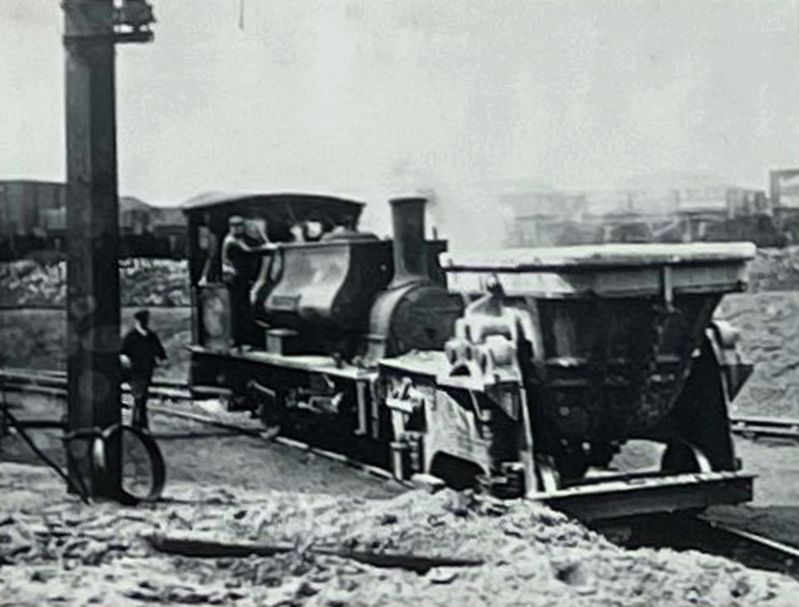
From The Marker
2. The Steel Making Process Marker
"Derwent Howe" the landscaped hill on the shoreline overlooking the town, is primarily slag accumulated over decades of iron and steelmaking Additional slag deposits can be found to the south at Salterbeck and to the north of the river at Oldside. A proportion has been recovered for use in road building and for manufacturing building products.
Erected by Cumbria County Council.
Topics. This historical marker is listed in this topic list: Industry & Commerce.
Location. 54° 38.685′ N, 3° 33.557′ W. Marker is in Workington, England, in Cumberland. It can be reached from Findlay Place. On the Workington train station platform. Touch for map. Marker is at or near this postal address: 1 Findlay Place, Workington, England CA14 2XF, United Kingdom. Touch for directions.

Regionally, this marker is in North West England. Globally, it is on the Atlantic Ocean, in the North Atlantic Region, in Europe, in Atlantic Europe, on one of the British Isles, in the Western World, and in the Anglosphere. Historically, it finds itself in what was once the Roman Empire.
Other nearby markers. At least 8 other markers are within walking distance of this marker: The Rail Making Process (here, next to this marker); Decline of the Local Coal Industry (here, next to this marker); A Local History of Coal Mining (a few steps from this marker); Workington Iron and Steel (a few steps from this marker); Life in the Coal Mines (a few steps from this marker); The Bessemer Impact (a few steps from this marker); Workington Station Timeline (a few steps from this marker); Memories of the Bessemer (a few steps from this marker). Touch for a list and map of all markers in Workington.
Credits. This page was last revised on July 23, 2025. It was originally submitted on July 21, 2025, by Ray Gurganus of Washington, District of Columbia. This page has been viewed 129 times since then and 22 times this year. Photos: 1, 2. submitted on July 21, 2025, by Ray Gurganus of Washington, District of Columbia. • Andrew Ruppenstein was the editor who published this page.
