
Workington in Cumberland, England, United Kingdom — Northwestern Europe (the British Isles)
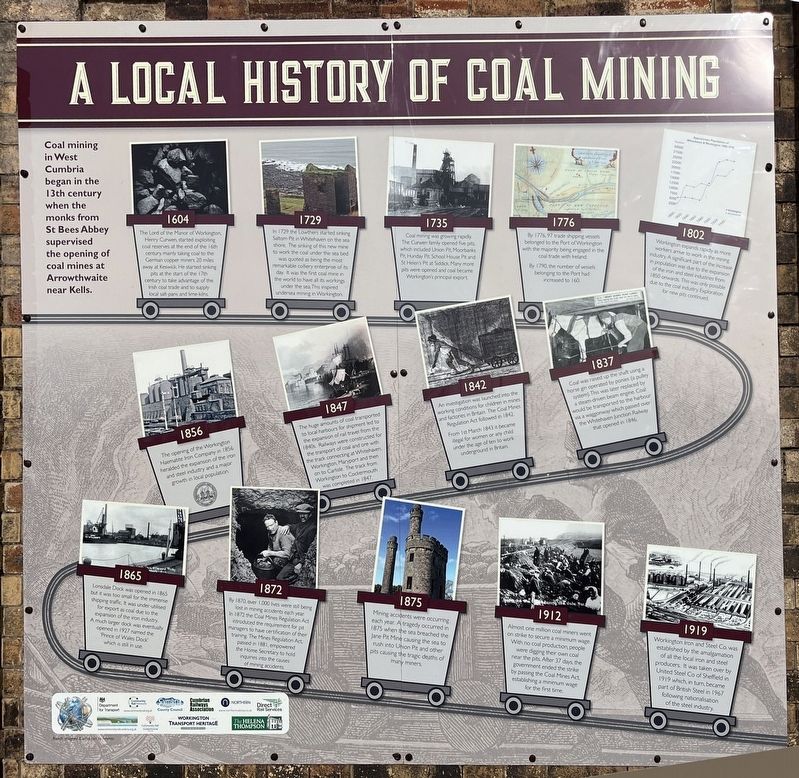
A Local History of Coal Mining
Photographed by Ray Gurganus, April 11, 2025
1. A Local History of Coal Mining Marker
1604
The Lord of the Manor of Workington, Henry Curwen, started exploiting coal reserves at the end of the 16th century, mainly taking coal to the German copper miners 20 miles way at Keswick. He started sinking pits at the start of the 17th century to take advantage of the Irish coal trade and to supply local salt-pans and lime-kilns.
1729
In 1729 the Lowthers started sinking Saltom Pit in Whitehaven on the sea shore. The sinking of this new mine to work the coal under the sea bed was quoted as being the most remarkable colliery enterprise of its day. It was the first coal mine in the world to have all its workings under the sea. This inspired undersea mining in Workington.
1735
Coal mining was growing rapidly. The Curwen family opened five pits, which included Union Pit, Moorbanks Pit, Hunday Pit, School House Pit and St Helen's Pit at Siddick. Many more pits were opened and coal became Workington's principal export.
1776
By 1776, 97 trade shipping vessels
this page online
1802
Workington expands rapidly as more workers arrive to work in the mining industry. A significant part of the increase in population was due to the expansion of the iron and steel industries from 1850 onwards. This was only possible due to the coal industry. Exploration for new pits continued.
1837
Coal was raised up the shaft using a horse gin operated by ponies (a pulley system). This was later replaced by a steam-driven beam engine. Coal would be transported to the harbour via a waggonway which passed over the Whitehaven Junction Railway that opened in 1846.
1842
An investigation was launched Into the working conditions for children in mines and factories Britain. The Coal Mines Regulation Act followed in 1842. From 1st March 1843 it became illegal for women or any child under the age of ten to work underground in Britain.
1847
The huge amounts of coal transported to local harbours for shipment led to the expansion of rail travel from the 1840s. Railways were constructed for the transport of coal and ore with the track connecting at Whitehaven and then on to Carlisle. The track from Workington to Cockermouth was completed in 1847.
1856
The opening of the Workington Haematite Iron Company in 1856 heralded the expansion of the iron and steel industry and a major growth in local population.
1865
Lonsdale Dock was opened in 1865 but it was too small for the immense shipping traffic. It was under-utilised for export as coal due to the expansion of the iron industry. A much larger dock was eventually opened in 1927 named the 'Prince of Wales Dock' which is still in use.
1872
By 1870, Over 1,000 lives were still being lost in mining accidents each year. In 1872 the Coal Mines Regulation Act introduced the requirement for pit managers to have certification of their training. The Mines Regulation Act, passed in 1881, empowered the Home Secretary to hold inquiries into the causes of mining accidents.
1875
Mining accidents were occurring each year. A tragedy occurred in 1875 when the sea breached the Jane Pit Mine causing the sea to rush into Union Pit and other pits causing the tragic deaths of many miners.
1912
Almost one million coal miners went on strike to secure a minimum wage. With no coal production, people were digging their own coal near the pits. After 37 days, the government ended the strike by passing the Coal Mines Act, establishing a minimum wage for the first time.
1919
Workington Iron and Steel Co. was established by the amalgamation of all the local iron and steel producers. It was taken over by United Steel Co of Sheffield in 1919 which, in turn, became part of British Steel in 1967 following nationalisation of the steel industry.
Erected by Cumbria County Council.
Topics. This historical marker is listed in this topic list: Industry & Commerce. A significant historical year for this entry is 1604.
Location. 54° 38.682′ N, 3° 33.562′ W. Marker is in Workington, England, in Cumberland. It can be reached from Findlay Place. On the Workington train station platform. Touch for map. Marker is at or near this postal address: 1 Findlay Place, Workington, England CA14 2XF, United Kingdom. Touch for directions.

Regionally, this marker is in North West England. Globally, it is on the Atlantic Ocean, in the North Atlantic Region, in Europe, in Atlantic Europe, on one of the British Isles, in the Western World, and in the Anglosphere. Historically, it finds itself in what was once the Roman Empire.
Other nearby markers. At least 8 other markers are within walking distance of this marker: Life in the Coal Mines (here, next to this marker); Decline of the Local Coal Industry (here, next to this marker); Workington Station Timeline (here, next to this marker); The Rail Making Process (here, next to this marker); The Steel Making Process (a few steps from this marker); Lost Railways of West Cumbria (a few steps from this marker); Workington Iron and Steel (a few steps from this marker); The Bessemer Impact (a few steps from this marker). Touch for a list and map of all markers in Workington.
Credits. This page was last revised on July 21, 2025. It was originally submitted on July 21, 2025, by Ray Gurganus of Washington, District of Columbia. This page has been viewed 102 times since then and 12 times this year. Photo 1. submitted on July 21, 2025, by Ray Gurganus of Washington, District of Columbia. • Andrew Ruppenstein was the editor who published this page.
Editor’s want-list for this marker. photo of the marker within its surroundings • Can you help?
