Norman in Cleveland County, Oklahoma — The American South (West South Central)
U.S. Naval Air Station
North Base

Photographed by Duane and Tracy Marsteller, June 20, 2025
1. U.S. Naval Air Station Marker, Side One
Norman, Oklahoma
Commissioned on July 28, 1942
De-commissioned on March 4, 1946
On March 20, 1942, the U.S. Navy announced that an aviation base to train Navy pilots would be constructed in Norman located on the site of the University of Oklahoma Max Westheimer Flying Field. The projected cost of the base was $7,000,000 and would occupy approximately 1550 acres for approach zones, landing runways and an estimated 91 buildings. Construction of the base began on April 22, and by the end of the first week 200 men were at work and by late June there were approximately 2000 men employed. The base was officially commissioned on July 28, 1942, three months and two days after breaking ground.
The City of Norman was greatly impacted by the Navy's announcement to locate the air station in Norman, but the community warmly welcomed the base. Housing was necessary for both workers constructing the base and for Navy personnel who were expected to arrive with their families. On April 19, the mayor of Norman, Sylvester Crim, issued the following proclamation: “The period from April 20 to May 30 be and
this page online
Although construction work on the base was only approximately fifty percent complete, the first group of cadets arrived for primary flight training in early September, 1942 and soon here would be approximately 800 cadets in training. The plane used by the Navy for primary training was the reliable biplane Stearman Kaydet. The Stearman was nicknamed the “Yellow Peril” thanks to its somewhat tricky ground handling characteristics due in large part to the sight-angle the pilot had to endure on the ground while taxiing on the tarmac. The Stearman Kaydet was the only American aircraft used during World War II that was standardized for both Army and Navy use. After the war, the Stearman has enjoyed a long and continued career as a trainer and more notably as a crop duster and a show performer.
Beginning April 1, 1943 the base was selected from twenty-one other primary training bases across the country

Photographed by Duane and Tracy Marsteller, June 20, 2025
2. U.S. Naval Air Station Marker, Side Two
Following the end of World War II, the Navy formally de-commissioned the base on March 1, 1946. Immediately the University begin plans to use some of the barracks for housing for returning veterans and other buildings for classrooms. By the end of 1948, all of the land and facilities including responsibility for operation o the airport had been transferred to the University of Oklahoma.
–
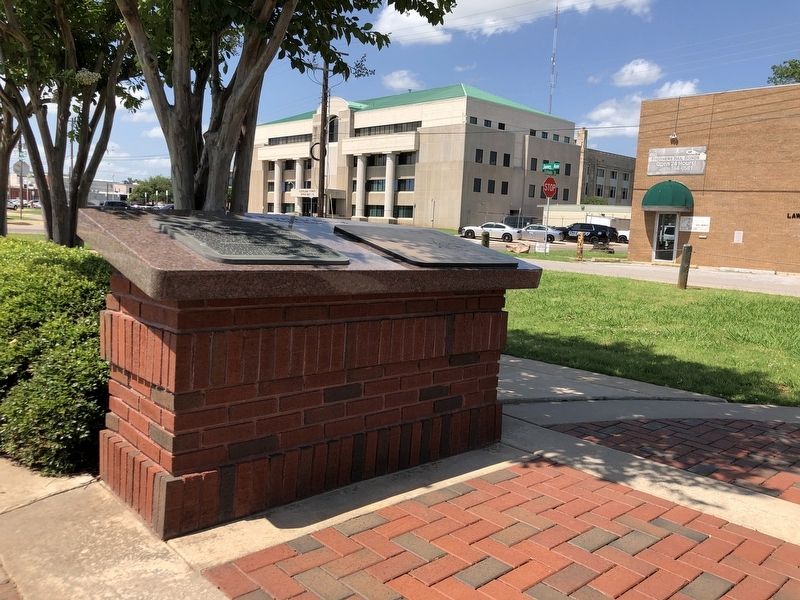
Photographed by Duane and Tracy Marsteller, June 20, 2025
3. U.S. Naval Air Station Marker
Topics. This historical marker is listed in these topic lists: Air & Space • War, World II. A significant historical date for this entry is July 28, 1942.
Location. 35° 13.129′ N, 97° 26.527′ W. Marker is in Norman, Oklahoma, in Cleveland County. It can be reached from South Jones Avenue south of West Eufaula Street, on the right when traveling south. Marker is on the Norman Legacy Trail, which runs parallel and to the west of South Jones Street. Touch for map. Marker is at or near this postal address: 102 S Jones Ave, Norman OK 73069, United States of America. Touch for directions.

Regionally, this marker is in Central Oklahoma—Frontier Country and in Greater Oklahoma City. It is also in the American South, specifically on the prairies, and on the Southern Plains. Globally, it is in North America, the Western Hemisphere, the Western World, and the Anglosphere. Historically, it finds itself in what was once the territory of the Mississippian Culture and also the Louisiana Purchase.
Other nearby markers. At least 8 other markers are within walking distance of this marker: War Years in Norman (here, next

Courtesy of Cleveland County Historical Society (Public Domain), circa 1944
4. Training Planes at Naval Air Station, Norman
Stearman Aircraft, which became a Boeing subsidiary in 1934, produced at least 10,636 of its Model 75 biplane in the 1930s and 1940s.
Also see . . . About Us | History of the Westheimer Airport. Our hope is to share some of the stories, memories and contributions that Norman, Oklahoma made during World War II. At the beginning of 1942, Norman was a small college town when it was announced that the United States Navy would be constructing training bases. (Norman World War II Museum) (Submitted on July 23, 2025, by Duane and Tracy Marsteller of Murfreesboro, Tennessee.)
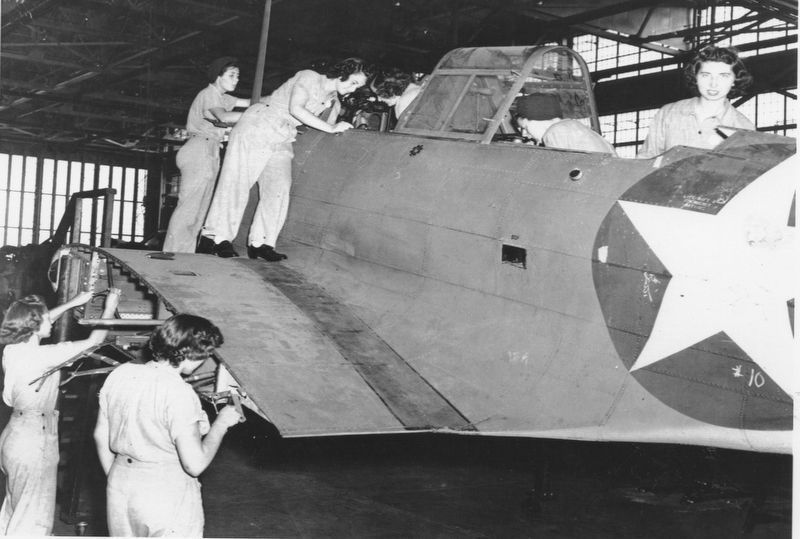
Courtesy of Cleveland County Historical Society (Public Domain)
5. WAVES in machinist training
The WAVES (Women Accepted for Volunteer Emergency Service) program was established on July 30, 1942, as the U.S. Navy’s female corps. It remained a separate unit until 1978, when it was integrated into the main Navy.
Credits. This page was last revised on July 31, 2025. It was originally submitted on July 22, 2025, by Duane and Tracy Marsteller of Murfreesboro, Tennessee. This page has been viewed 290 times since then and 134 times this year. Photos: 1, 2. submitted on July 22, 2025, by Duane and Tracy Marsteller of Murfreesboro, Tennessee. 3, 4, 5. submitted on July 23, 2025, by Duane and Tracy Marsteller of Murfreesboro, Tennessee.
