Workington in Cumberland, England, United Kingdom — Northwestern Europe (the British Isles)
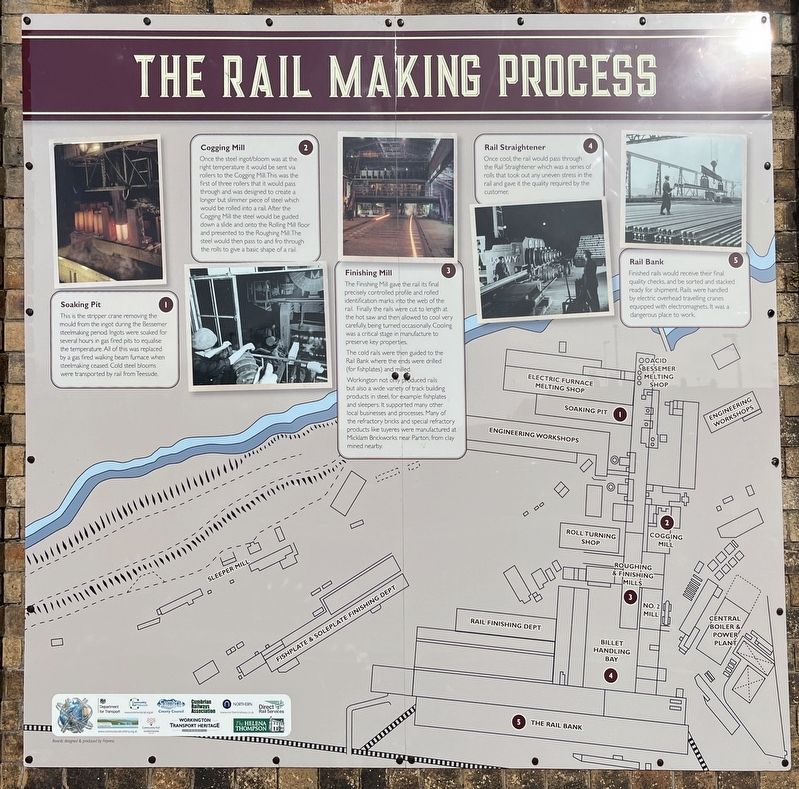
The Rail Making Process
Photographed by Ray Gurganus, April 11, 2025
1. The Rail Making Process Marker
This is the stripper crane removing the mould from the ingot during the Bessemer steelmaking period. Ingots were soaked for several hours in gas feed pits to equalise the temperature. All of this was replaced by a gas fired waking beam furnace when steelmaking ceased. Cold steel blooms were transported by rail from Teesside.
Cogging Mill
Once the steel ingot bloom was at the right temperature it would be sent via rollers to the Cogging Mill. This was the first of three rollers that it would pass through and was designed to create a longer but slimmer piece of steel which would be rolled into a rail. After the Cogging Mill the steel would be guided down a side and onto the Rolling Mill floor and presented to the Roughing Mill. The steel would then pass to and fro through the rolls to give a basic shape of a rail.
Finishing Mill
The finishing Mil gave the rail full precisely controlled profile and rolled identification marks into the web of the rail. Finally the rails were cut to length at the hot saw and then allowed to cool very carefully being turned occasionally. Cooling was a critical stage in manufacture
this page online
The cold rails were then guided to the Rail Bank where the ends were drilled (for fishplates) and milled.
Workington not only produced rails but also a wide variety of track building products in steel, for example plates and sleepers. It supported many other local businesses and processes. Many of the refractory bricks and special refractory products like tuyeres were manufactured at Micklam Brickworks near Parton, from clay mined nearby.
Rail Straightener
Once cool, the rail would pass through the Rail Straightener which was a series of rolls that took out any uneven stress in the rail and gave it the quality required by the customer.
Rail Bank
Finished rails would receive their final quality checks, and be sorted and stacked ready for shipment. Rails were handed by electric overhead travelling cranes equipped with electromagnets. It was a dangerous place to work.
Erected by Cumbria County Council.
Topics. This historical marker is listed in this topic list: Industry & Commerce.
Location. 54° 38.684′ N, 3° 33.558′ W. Marker is in Workington, England, in Cumberland. It can be reached from Findlay Place. On the Workington train station platform. Touch for map. Marker is at or near this postal address: 1 Findlay Place, Workington, England CA14 2XF, United Kingdom. Touch for directions.

Regionally, this marker is in North West England. Globally, it is on the Atlantic Ocean, in the North Atlantic Region, in Europe, in Atlantic Europe, on one of the British Isles, in the Western World, and in the Anglosphere. Historically, it finds itself in what was once the Roman Empire.
Other nearby markers. At least 8 other markers are within walking distance of this marker: The Steel Making Process (here, next to this marker); Decline of the Local Coal Industry (here, next to this marker); A Local History of Coal Mining (here, next to this marker); Life in the Coal Mines (a few steps from this marker); Workington Station Timeline (a few steps from this marker); Workington Iron and Steel (a few steps from this marker); The Bessemer Impact (a few steps from this marker); Lost Railways of West Cumbria (a few steps from this marker). Touch for a list and map of all markers in Workington.
Credits. This page was last revised on July 30, 2025. It was originally submitted on July 23, 2025, by Ray Gurganus of Washington, District of Columbia. This page has been viewed 77 times since then and 17 times this year. Photo 1. submitted on July 23, 2025, by Ray Gurganus of Washington, District of Columbia. • Andrew Ruppenstein was the editor who published this page.
