NoMa/Sursum Corda in Northwest Washington in Washington, District of Columbia — The American Northeast (Mid-Atlantic)
One Big Family
⎯⎯⎯
We Mean Business!
Lift Up Your Hearts!
| — | Sursum Corda | — |
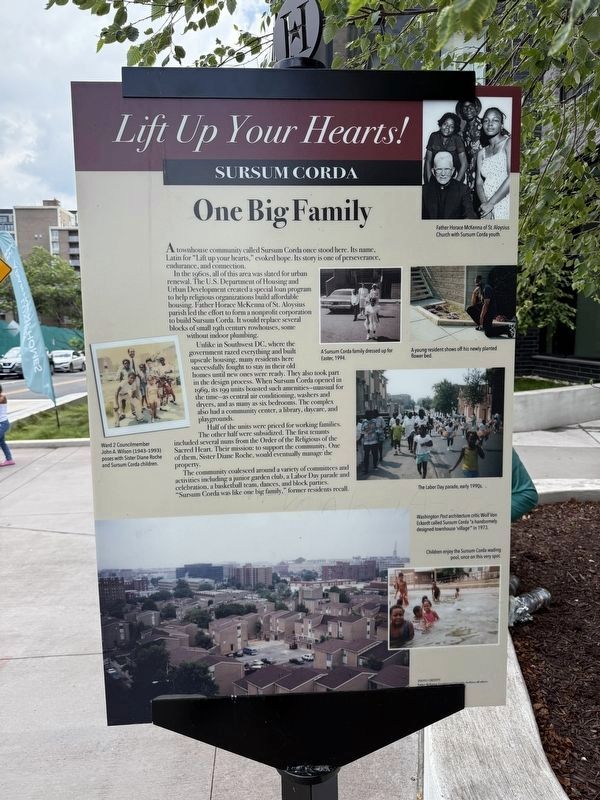
One Big Family
A townhouse community called Sursum Corda once stood here. Its name, Latin for "Lift up your hearts," evoked hope. Its story is one of perseverance, endurance, and connection.
In the 1960s, all of this area was slated for urban renewal. The U.S. Department of Housing and Urban Development created a special loan program to help religious organizations build affordable housing. Father Horace McKenna of St. Aloysius parish led the effort to form a nonprofit corporation to build Sursum Corda. It would replace several blocks of small 19th century rowhouses, some without indoor plumbing.
Unlike in Southwest DC, where the government razed everything and built upscale housing, many residents here successfully fought to stay in their old homes until new ones were ready. They also took part in the design process. When Sursum Corda opened in 1969, its 199 units boasted some amenities—unusual for the time—as central air conditioning, washers and dryers, and as many as six bedrooms. The complex also had a community center, a library, daycare, and playgrounds.
Half of the units were priced for working families.
this page online
,br> The community coalesced around a variety of committees and activities including a junior garden club, a Labor Day parade and celebration, a basketball team, dances, and block parties. "Sursum Corda was like one big family," former residents recall.
We Mean Business!
Not long after Sursum Corda opened in 1969, reality set in. With five large housing projects, this area had too few schools, businesses, and services. Sursum Corda's low rents didn't cover operating costs, which proved higher than expected. Growing inflation worsened the situation. Rather than raise rents, the nonprofit owner partnered with a for-profit company, which poured in money in exchange for tax breaks. But the fix was only temporary.
As in other DC neighborhoods, drug dealing and gang activity plagued this community. One management company after another failed to keep up the complex, which suffered from broken pipes,

"Let's show everyone that we mean business and that we intend to survive, in spite of!!!!!" exhorted the Sursum Corda newsletter. The purchase process took years, but finally, in late 1992, Sursum Corda Cooperative was born.
By about 2005, though, the city had decided to redevelop this area again. Due to low-density zoning, the Cooperative had trouble finding a buyer who would pay an acceptable price. The city threatened to take the property by eminent domain, while the U.S. Department of Housing and Urban Development (HUD) threatened to foreclose.
Increasingly concerned about losing their property and being displaced, Cooperative members switched course in 2008 and chose a new Board of Directors. Lonnie Duren, a lifelong resident of Sursum Corda, was elected Chairman. Under his leadership, the Board engaged a financial consultant, attorney,

Sursum Corda was sold and razed by 2019, and a new apartment community called Banner Lane opened here in 2023. Former Sursum Corda residents were guaranteed the right to return, and about 60 families planned to do so, eager to "get back to the community we had, the love we had for each other," according to one former resident.
Erected by TBSC Owner I LLC.
Topics. This historical marker is listed in these topic lists: Industry & Commerce • Religion & Religious Structures • Settlements & Settlers. A significant historical month for this entry is June 1983.
Location. 38° 54.278′ N,


Regionally, this marker is in the Washington Metropolitan Area. It is also in the American Northeast, in the Upper South, in the Mid-Atlantic, in the Tidewater, and in the Chesapeake Bay Region. Globally, it is in North America, the Western Hemisphere, the Western World, and the Anglosphere.
Other nearby markers. At least 8 other markers are within walking distance of this marker: Votes for Women (about 700 feet away, measured in a direct line); Bishop Smallwood Edmond Williams, D.D. (approx. 0.2 miles away); The Chicken and the Egg (approx. ¼ mile away); Saint Aloysius Church (approx. ¼ mile away); Gonzaga College High School (approx. ¼ mile away); On the Path (approx. ¼ mile away); Zero Hunger (approx. 0.3 miles away); History in a House (approx. 0.3 miles away). Touch for a list and map of all markers in Northwest Washington.
Credits. This page was last revised on July 23, 2025. It was originally submitted on July 23, 2025, by Devry Becker Jones of Washington, District of Columbia. This page has been viewed 113 times since then and 25 times this year. Photos: 1, 2, 3, 4. submitted on July 23, 2025, by Devry Becker Jones of Washington, District of Columbia.
