Old Silk Stocking in Norman in Cleveland County, Oklahoma — The American South (West South Central)
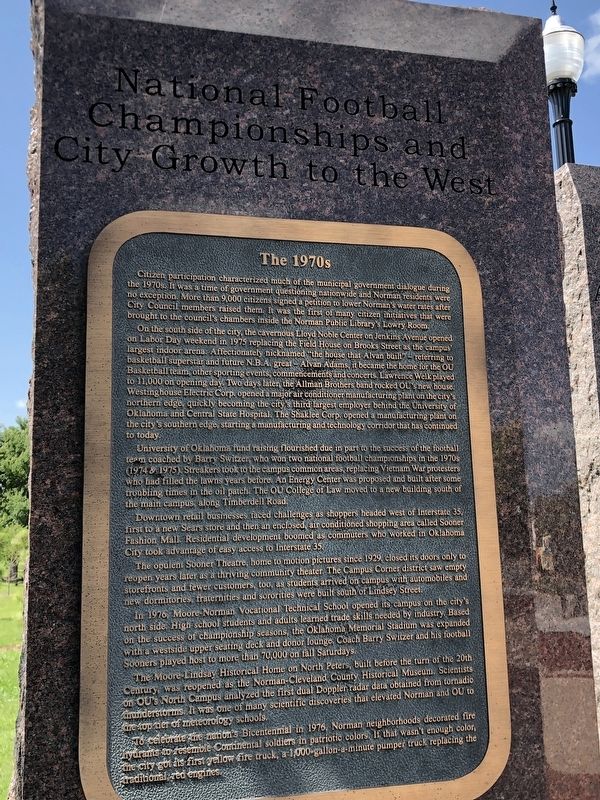
National Football Championships and City Growth to the West
The 1970s
| — | Norman Legacy Trail | — |
Photographed by Duane and Tracy Marsteller, June 20, 2025
1. National Football Championships and City Growth to the West Marker
On the south side of the city, the cavernous Lloyd Noble Center on Jenkins Avenue opened on Labor Day weekend in 1975 replacing the Field House on Brooks Street as the campus' largest indoor arena. Affectionately nicknamed “the house that Alvan built” – referring to basketball superstar and future N.B.A great Alvan Adams – it became the home for the OU basketball team, other sporting events, commencements and concerts. Lawrence Welk played to 11,000 on opening day. Two days later the Allman Brothers band rocked OU's new house. Westinghouse Electric Corp, opened a major air conditioner manufacturing plant on the city's northern edge, quickly becoming the city's third-largest employer behind
this page online
University of Oklahoma fund raising flourished due in part to the success of the football team coached by Barry Switzer, who won two national football championships in the 1970s (1974 & 1975). Streakers took to the campus common areas, replacing Vietnam War protesters who had filled the lawns years before. An Energy Center was proposed and built after some troubling times in the oil patch. The OU College of Law moved to a new building south of the main campus, along Timberdell Road.
Downtown retail businesses faced challenges as shoppers headed west of Interstate 35, first to a new Sears store and then an enclosed, air-conditioned shopping area called Sooner Fashion Mall. Residential development boomed as commuters who worked in Oklahoma City took advantage of easy access to Interstate 35.
The opulent Sooner Theatre, home to motion pictures since 1929, closed its doors only to reopen years later as a thriving community
Photographed by Duane and Tracy Marsteller, June 20, 2025
2. National Football Championships and City Growth to the West Marker
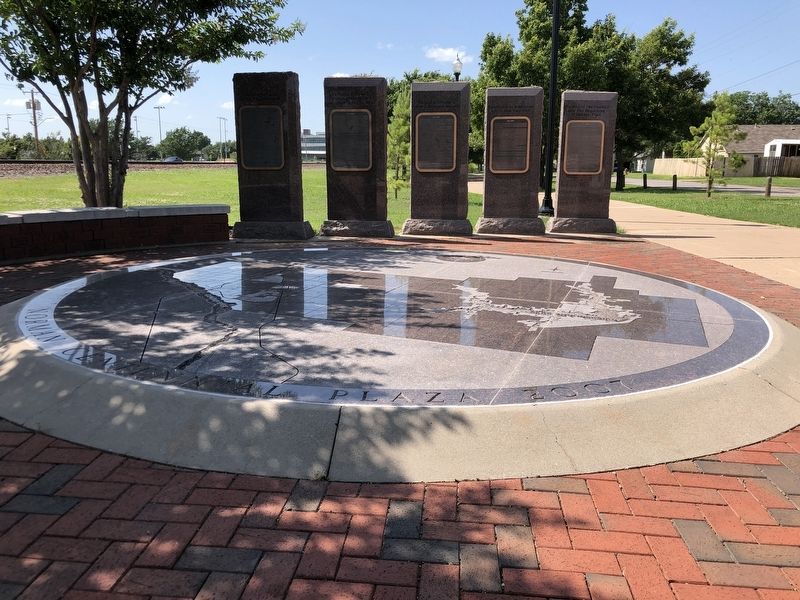
Featured marker is second from left.
In 1976, Moore-Norman Vocational Technical School opened its campus on the city's north side. High-school students and adults learned trade skills needed by industry. Based on the success of championship seasons, the Oklahoma Memorial Stadium was expanded with a westside upper seating deck and donor lounge. Coach Barry Switzer and his football Sooners played host to more than 70,000 on fall Saturdays.
The Moore-Lindsay Historical Home on North Peters, built before the turn of the 20th century, was reopened as the Norman-Cleveland County Historical Museum. Scientists on OU's North Campus analyzed the first dual Doppler radar data obtained from tornadic thunderstorms. It was one of many scientific discoveries that elevated Norman and OU to the top tier of meteorology schools.
To celebrate the nation's Bicentennial in 1976, Norman neighborhoods decorated fire hydrants to resemble Continental soldiers in patriotic colors. If that wasn't enough color, the city got its first yellow fire truck, a 1,000-gallon-a-minute pumper truck replacing the traditional red engines.
Topics. This historical marker is listed in these topic lists: Education • Government & Politics • Industry & Commerce • Sports. A significant historical year for this entry is 1975.
Location. 35° 13.38′ N, 97° 26.687′ W. Marker is in Norman, Oklahoma, in Cleveland County. It is in Old Silk Stocking. It is on North Jones Avenue north of East Tonhawa Street, on the left when traveling north. Marker is on the Norman Legacy Trail, which is parallel to and between Jones Street and the railroad tracks. Touch for map. Marker is in this post office area: Norman OK 73069, United States of America. Touch for directions.

Regionally, this marker is in Central Oklahoma—Frontier Country and in Greater Oklahoma City. It is also in the American South, specifically on the prairies, and on the Southern Plains. Globally, it is in North America, the Western Hemisphere, the Western World, and the Anglosphere. Historically, it finds itself in what was once the territory of the Mississippian Culture and also the Louisiana Purchase.
Other nearby markers. At least 8 other markers are within walking distance of this marker: Bank Troubles Amid Continued Growth (here, next to this marker); Excellence in Education and a New City Hall (here, next to this marker); Annexation and Lake Thunderbird (here, next to this marker); The End of the Century and the Beginning of Legacy Trail (here, next to this marker); The Legacy Years (a few steps from this marker); United States Post Office (about 700 feet away, measured in a direct line); Norman and Oklahoma's Centennial (approx. 0.2 miles away); Sooner Theater (approx. 0.2 miles away). Touch for a list and map of all markers in Norman.
Related markers. Click here for a list of markers that are related to this marker.
Credits. This page was last revised on July 27, 2025. It was originally submitted on July 27, 2025, by Duane and Tracy Marsteller of Murfreesboro, Tennessee. This page has been viewed 82 times since then and 23 times this year. Photos: 1, 2. submitted on July 27, 2025, by Duane and Tracy Marsteller of Murfreesboro, Tennessee.
