Lampasas in Lampasas County, Texas — The American South (West South Central)
William Thomas Campbell
(March 7, 1859 - April 5, 1906)

Photographed by James Hulse, July 25, 2025
1. William Thomas Campbell Marker
Following the Spindletop oil strike near Beaumont in January 1901, former Texas Governor James S. Hogg and colleague James W. Swayne joined the rush for "black gold" and enlisted additional partners to form the Hogg-Swayne syndicate. Campbell joined the partnership and acted as its agent and general manager. The syndicate merged with several other entities in 1902 to form the Texas Company, which eventually became Texaco, Inc. In 1904, the Campbells completed Argyll Heights, a grand estate overlooking the city of Lampasas. The property featured a large mansion (destroyed by fire in 1974), gardens and gatekeeper's cottage. Campbell died at age 47 and was buried in Lampasas' Oak Hill Cemetery. As a newspaper publisher, banker and early oil tycoon, William Thomas Campbell proved instrumental in the economic development of Texas and forged a legacy that would ultimately reach around the world.
Erected 2018 by Texas Historical Commission. (Marker Number 20060.)
Topics. This historical marker is listed in this topic list: Industry & Commerce. A significant historical month for this entry is January 1901.
Location. 31° 4.399′ N, 98° 10.842′ W.
this page online

Regionally, this marker is in Big Country. Globally, it is in North America, a Gulf of Mexico state, the Western Hemisphere, the Western World, and the Anglosphere. Historically, it finds itself in what was once New Spain, the Republic of Texas, and one of the Confederate States of America.
Other nearby markers. At least 8 other markers are within walking distance of this marker: Site of Abney Plunge (approx. ¼ mile away); Saint Mary's Catholic Church (approx. 0.3 miles away); Hanna Springs (approx. 0.3 miles away); Santa Fe Depot, (approx. 0.4 miles away); Murray Kenneth Guthrie (approx. 0.4 miles away); Lampasas Public Library (approx. 0.4 miles away); Pierian Club (approx. 0.4 miles away); W.N. Huling Home, 1877 (approx. half a mile away). Touch for a list and map
Photographed by James Hulse, July 25, 2025
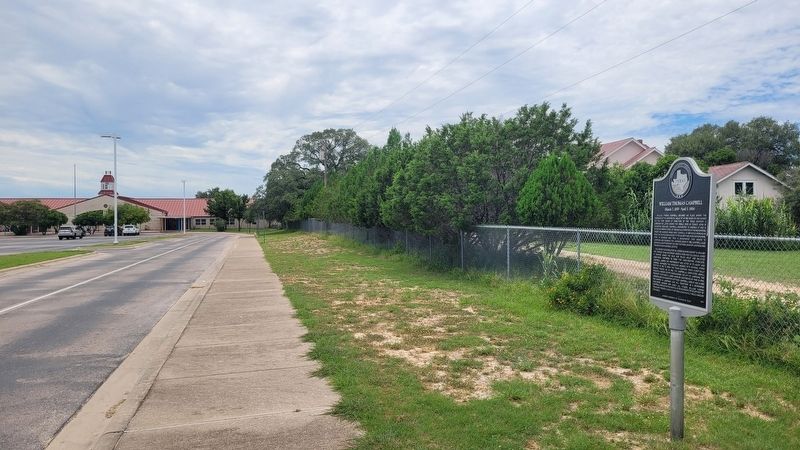
2. The view of the William Thomas Campbell Marker along the driveway to the school
Also see . . . The History of Texaco: From Texas Company to Global Oil Leader. Texas State Historical Association (TSHA)
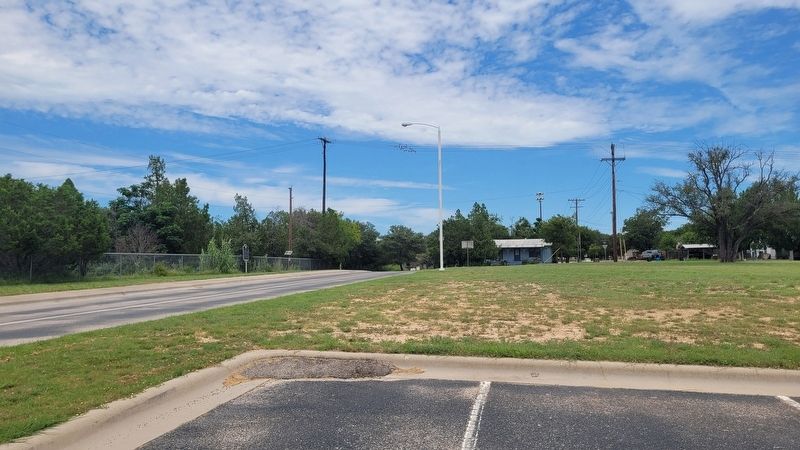
Texaco, Incorporated, known for many years as the Texas Company, was founded in 1902 at Sour Lake by oilman Joseph S. Cullinan and New York investor Arnold Schlaet. In March 1901 Cullinan, with two other promoters, incorporated the Texas Fuel Company at Beaumont. Prominent investors included the Hogg-Swayne Syndicate, John W. Gates, and the Laphams of New York. The company primarily purchased and transported oil from Beaumont's Spindletop oilfield. In April 1902 the Texas Fuel Company's major investors obtained a new charter for a corporation-to be known as the Texas Company-which authorized the company to engage in storage and transportation of mineral solutions. On May 1 the Texas Fuel Company conveyed its assets to the new company and was dissolved shortly afterward. The Texas Company was initially capitalized at $3 million and almost immediately began expanding operations. It used subsidiary companies for oil production and began acquiring barges and rail tank cars. It quickly(Submitted on July 27, 2025, by James Hulse of Medina, Texas.)covered new fields with leases. High production levels at two fields just outside Houston, the Sour Lake oilfield (1903) and the Humble oilfield (1905), provided the company with a secure financial base. In 1905 the Texas Company linked these two fields by pipelines to Port Arthur, ninety miles away, and built its first refinery there. That same year the company acquired an asphalt refinery at nearby Port Neches. In 1908 the company completed the ambitious venture of a pipeline from the Glenn Pool, in the Indian Territory (now Oklahoma), to its Southeast Texas refineries.Photographed by James Hulse, July 25, 20253. The view of the William Thomas Campbell Marker looking toward the street
Credits. This page was last revised on July 27, 2025. It was originally submitted on July 27, 2025, by James Hulse of Medina, Texas. This page has been viewed 234 times since then and 108 times this year. Photos: 1, 2, 3. submitted on July 27, 2025, by James Hulse of Medina, Texas.
