
Canterbury in Kent, England, United Kingdom — Northwestern Europe (the British Isles)
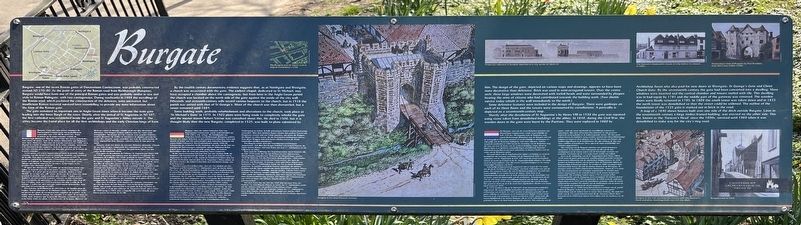
Burgate
Photographed by Ray Gurganus, March 29, 2025
1. Burgate Marker
The gate remained an important one in Anglo-Saxon times when it became the main gate leading into the Inner Burgh of the town. Shortly after the arrival of St Augustine in AD 597, the first cathedral was established inside the gate and St Augustine's Abbey outside it. The abbey became the burial place for all the first archbishops and the early Christian kings of Kent.
By the twelfth century documentary evidence suggests that, as at Northgate and Westgate, a church was associated with the gate. The earliest chapel, dedicated to St Michael, may have occupied
this page online
Some building work, probably refurbishment and alterations to the church, took place at 'St Michael's Gate' in 1475. In 1502 plans were being made to completely rebuild the gate and the master mason Robert Vertue was consulted about this. He died in 1506, but it is thought likely that the new Burgate, completed in 1525, was built to plans submitted by him. The design of the gate, depicted on various maps and drawings, appears to have been more decorative than defensive. Brick was used in semi-octagonal towers. Over the centre Arch, three large windows were decorated with trefoil heads and were surrounded by plaques bearing the arms of citizens who had contributed towards the building work. (Two shields survive today rebuilt in the wall immediately to the north.)
Some
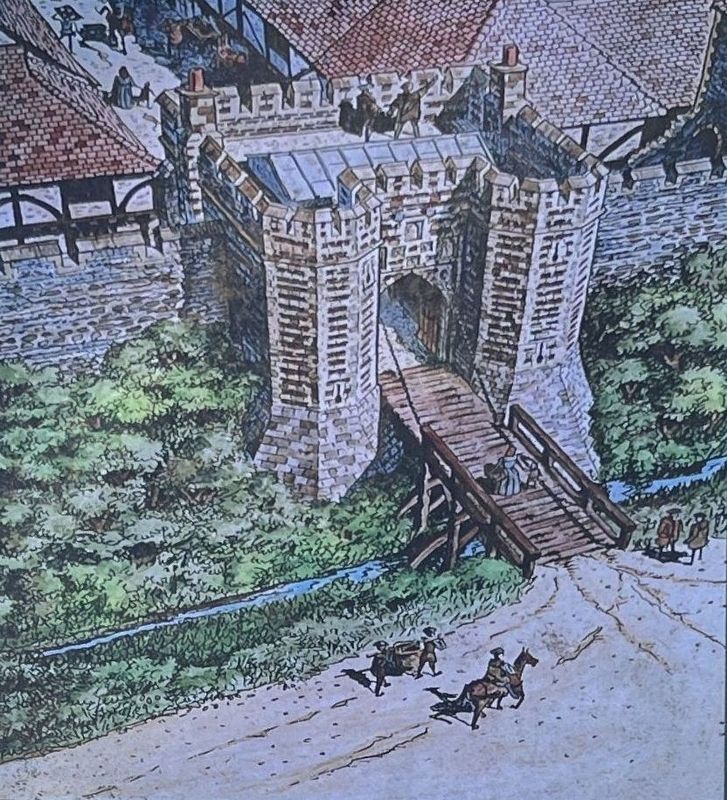
Illustration from marker
2. Burgate in the late fifteenth century
Shortly after the dissolution of St Augustine's by Henry VIII in 1538 the gate was repaired using stone taken from demolished buildings at the abbey. In 1648, during the Civil War, the wooden doors in the gate were burnt by the Puritans. They were replaced in 1660 by Archbishop Juxon who also paid for new doors at Westgate, St George's Gate and Christ Church Gate. By the seventeenth century the gate had been convened into a dwelling. More windows were inserted and the central chamber and towers roofed with tile. This dwelling was in bad repair by 1781 and the middle part of the gateway was removed. The wooden doors were finally removed in 1785. In 1809 the south tower was taken down and in 1822 the north tower was demolished so that the street could be widened. The outline of the foundations of the 1525 gate is marked out in brick in the road.
A map of c1640 shows houses built over one side of the ditch outside Burgate. Later in the seventeenth century a large timber-framed budding, was erected on the other side. This inn known as the 'Saracen's Head' since the 1690s, survived until 1969 when it was demolished to make way for the city's ring road.
(French, German, and Dutch not transcribed)
Topics. This historical marker is listed in this topic list: Forts and Castles. A significant historical year for this entry is 270 CE.
Location. 51° 16.683′ N, 1° 5.076′ E. Marker is in Canterbury, England, in Kent. It is on Burgate. Touch for map. Marker is at or near this postal address: 69 Burgate, Canterbury, England CT1 2LG, United Kingdom. Touch for directions.

Regionally, this marker is in the Greater South East. Globally, it is on the Atlantic Ocean, in the North Atlantic Region, in Europe, in Atlantic Europe, on one of the British Isles, in the Western World, and in the Anglosphere. Historically, it finds itself in what was once the Roman Empire.
Other nearby markers. At least 8 other markers are within walking distance of this marker: The Thomas Ingoldsby (within shouting distance of this marker); Zoar Chapel (within shouting distance of this marker); George Robert Canning (about 120 meters away, measured in a direct line); Baedeker Raid (about 150 meters away); Kent World War I Memorial (about 150 meters away); The Buffs (about 150 meters away); The Friends' Garden (about 150 meters away); The Plane Tree (about 150 meters away). Touch for a list and map of all markers in Canterbury.
Credits. This page was last revised on August 20, 2025. It was originally submitted on July 28, 2025, by Ray Gurganus of Washington, District of Columbia. This page has been viewed 85 times since then and 23 times this year. Photos: 1, 2. submitted on July 28, 2025, by Ray Gurganus of Washington, District of Columbia. • Andrew Ruppenstein was the editor who published this page.
Editor’s want-list for this marker. photo of the marker within its surroundings • Can you help?
