Canterbury in Kent, England, United Kingdom — Northwestern Europe (the British Isles)
Cattle Market Tower
Photographed by Ray Gurganus, March 29, 2025
1. Cattle Market Tower Marker
Inscription.
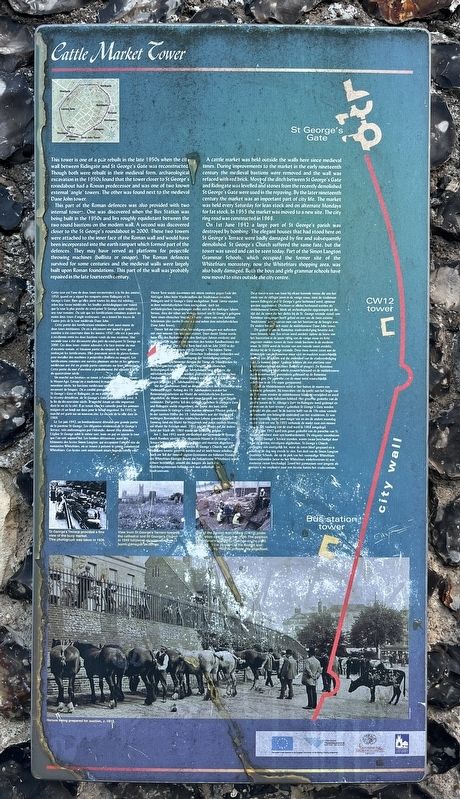
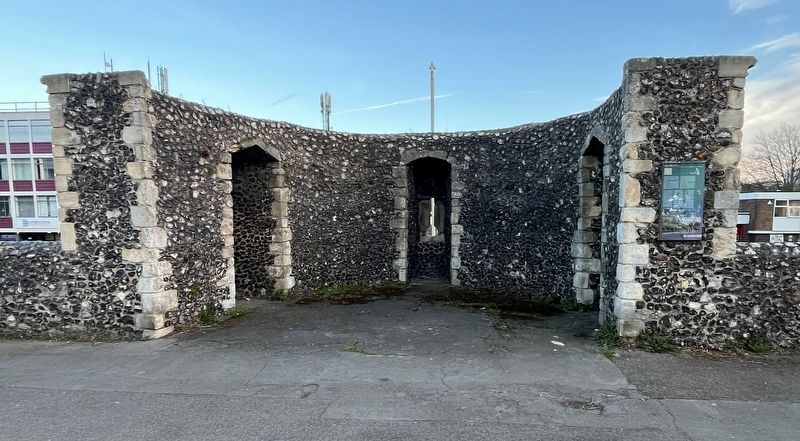
Cattle Market Tower. . This tower is one of a pair rebuilt in the late 1950s when the city wall between Ridingate and St George's Gate was reconstructed. Though both were rebuilt in their medieval form, archaeological excavation in the 1950s found that the tower closer to St George's roundabout had a Roman predecessor and was one of two known external 'angle' towers. The other was found next to the medieval Dane John tower., This part of the Roman defences was also provided with two internal towers. One was discovered when the Bus Station was being built in the 1950s and lies roughly equidistant between the two round bastions on the modern wall. A second was discovered closer to the St George's roundabout in 2000. These two towers were attached to the inner face of the Roman wall and would have been incorporated into the earth rampart which formed part of the defences. They may have served as platforms for projectile throwing machines (ballista or onager). The Roman defences survived for some centuries and the medieval walls were largely built upon Roman foundations. This part of the wall was probably repaired in the late fourteenth century., A cattle market was held outside the walls here since medieval times. During improvements to the market in the early nineteenth century the medieval bastions were removed and the wall was refaced with red brick. Most of the ditch between St George's Gate and Ridingate was levelled and stones from the recently demolished St George's Gate were used in the repaving. By the later nineteenth century the market was an important part of city life. The market was held every Saturday for lean stock and on alternate Mondays for fat stock. In 1955 the market was moved to a new site. The city ring road was constructed in 1968., On 1st June 1942 a large part of St George's parish was destroyed by bombing. The elegant houses that had stood here on St George's Terrace were badly damaged by fire and subsequently demolished. St George's Church suffered the same fate, but the tower was saved and can be seen today. Part of the Simon Langton Grammar Schools, which occupied the former site of the Whitefriars monastery, now the Whitefriars shopping area, was also badly damaged. Both the boys and girls grammar schools have now moved to sites outside the city centre., (French, German, Dutch not transcribed)
This tower is one of a pair rebuilt in the late 1950s when the city wall between Ridingate and St George's Gate was reconstructed. Though both were rebuilt in their medieval form, archaeological excavation in the 1950s found that the tower closer to St George's roundabout had a Roman predecessor and was one of two known external 'angle' towers. The other was found next to the medieval Dane John tower.
This part of the Roman defences was also provided with two internal towers. One was discovered when the Bus Station was being built in the 1950s and lies roughly equidistant between the two round bastions on the modern wall. A second was discovered closer to the St George's roundabout in 2000. These two towers were attached to the inner face of the Roman wall and would have been incorporated into the earth rampart which formed part of the defences. They may have served as platforms for projectile throwing machines (ballista or onager). The Roman defences survived for some centuries and the medieval walls were largely built upon Roman foundations. This part of the wall was probably repaired in the late fourteenth century.
A cattle market was held outside the walls here since medieval times. During improvements to the market in the early nineteenth century the medieval bastions were removed and the wall was refaced with red brick. Most of the ditch between St George's Gate and Ridingate was levelled and stones from the recently demolished St George's Gate were used in the repaving. By the later nineteenth century the market was an important part of city life. The market was held every Saturday for lean stock and on alternate Mondays for fat stock. In 1955 the market was moved to a new site. The city ring road was constructed in 1968.
On 1st June 1942 a large part of St George's parish was destroyed by
Click or scan to see this page online
bombing. The elegant houses that had stood here on St George's Terrace were badly damaged by fire and subsequently demolished. St George's Church suffered the same fate, but the tower was saved and can be seen today. Part of the Simon Langton Grammar Schools, which occupied the former site of the Whitefriars monastery, now the Whitefriars shopping area, was also badly damaged. Both the boys and girls grammar schools have now moved to sites outside the city centre.
Location. 51° 16.57′ N, 1° 4.911′ E. Marker is in Canterbury, England, in Kent. It is on Saint George's Lane. Touch for map. Marker is at or near this postal address: 6 St George's Lane, Canterbury, England CT1 2SY, United Kingdom. Touch for directions.
Regionally, this marker is in the Greater South East. Globally, it is on the Atlantic Ocean, in the North Atlantic Region, in Europe, in Atlantic Europe, on one of the British
Photographed by Ray Gurganus, March 29, 2025
2. Cattle Market Tower Marker
Isles, in the Western World, and in the Anglosphere. Historically, it finds itself in what was once the Roman Empire.
Credits. This page was last revised on July 29, 2025. It was originally submitted on July 29, 2025, by Ray Gurganus of Washington, District of Columbia. This page has been viewed 92 times since then and 25 times this year. Photos:1, 2. submitted on July 29, 2025, by Ray Gurganus of Washington, District of Columbia. • Andrew Ruppenstein was the editor who published this page.