Lancaster in Lancashire, England, United Kingdom — Northwestern Europe (the British Isles)
The Pioneer Line
North Lancashire's historical community lines
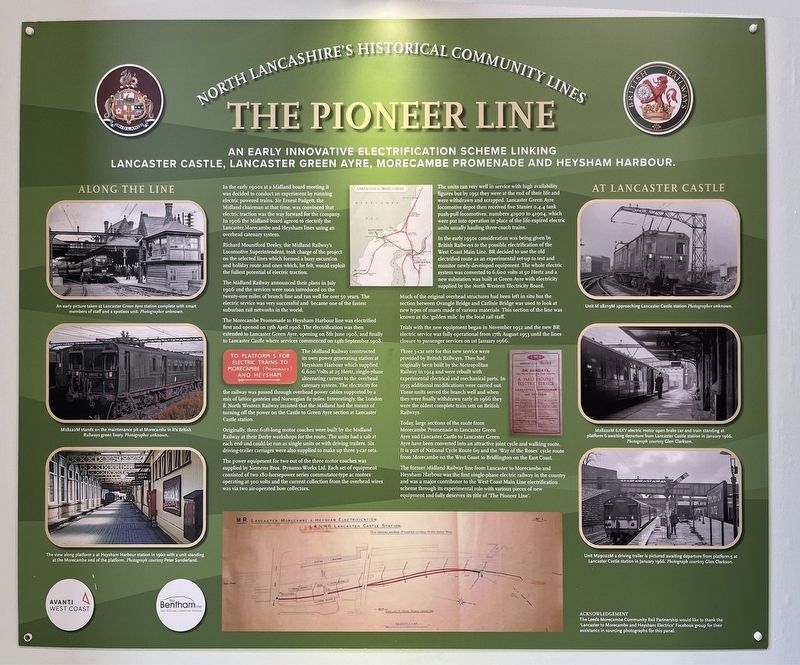
Photographed by Ray Gurganus, April 12, 2025
1. The Pioneer Line Marker
An early innovative electrification scheme linking Lancaster Castle, Lancaster Green Ayre, Morecambe Promenade and Heysham Harbour
In the early 1900s at a Midland board meeting it was decided to conduct an experiment by running electric powered trains. Sir Ernest Padgett, the Midland chairman at that time, was convinced that electric traction was the way forward for the company. In 1906 the Midland board agreed to electrify the Lancaster, Morecambe and Heysham lines using an overhead catenary system.
Richard Mountford Deeley, the Midland Railway's Locomotive Superintendent, took charge of the project on the selected lines which formed a busy excursion and holiday route and ones which, he felt, would exploit the fullest potential of electric traction.
The Midland Railway announced their plans in July 1906 and the services were soon introduced on the twenty-one miles of branch line and ran well for over 50 years. The electric service was very successful and became one of the fastest suburban rail networks in the world.
The Morecambe Promenade to Heysham Harbour line was electrified first and opened on 13th April
this page online
The Midland Railway constructed its own power generating station at Heysham Harbour which supplied 6,600 Volts at 25 Hertz, single-phase alternating current to the overhead catenary system. The electricity for the railway was passed through overhead power cables supported by a mix of lattice gantries and Norwegian fir poles. Interestingly, the London & North Western Railway insisted that the Midland had the means of turning off the power on the Castle to Green Ayre section at Lancaster Castle station.
Originally, three 6oft-long motor coaches were built by the Midland Railway at their Derby workshops for the route. The units had a cab at each end and could be run as single units or with driving trailers. Six driving-trailer carriages were also supplied to make up three 3-car sets.
The power equipment for two out of the three motor coaches was supplied by Siemens Bros. Dynamo Works Ltd. Each set of equipment consisted of two 180-horsepower series commutator-type
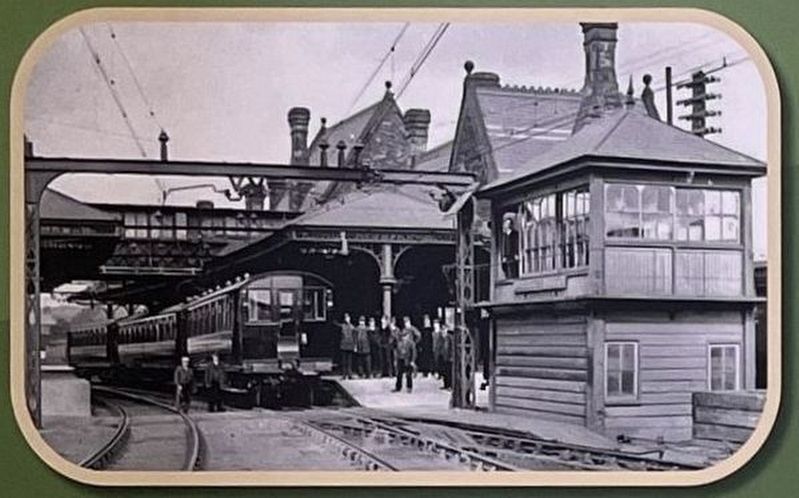
Photograph from the marker
2. Lancaster Green Ayre station
An early picture taken at Lancaster Green Ayre station complete with smart members of staff and a spotless unit. Photographer unknown.
The units ran very well in service with high availability figures but by 1951 they were at the end of their life and were withdrawn and scrapped. Lancaster Green Ayre locomotive depot then received five Stanier 0.4.4 tank push-pull locomotives, numbers 41900 to 41904, which were put into operation in place of the life-expired electric units usually hauling three-coach trains.
In the early 1950s consideration was being given by British Railways to the possible electrification of the West Coast Main Line. BR decided to use the old electrified route as an experimental set-up to test and monitor newly-developed equipment. The whole electric system was converted to 6,600 volts at 50 Hertz and a new substation was built at Green Ayre with electricity supplied by the North Western Electricity Board.
Much of the original overhead structures had been left in situ but the section between Ovangle Bridge and Carlisle Bridge was used to look at new types of masts made of various materials. This section of the line was known as the 'golden mile' by the local rail staff.
Trials with the new equipment began in November 1952 and the new BR electric service was fully operational from 17th August 1953 until the lines closure to passenger services on 1st January 1966.
Three 3-car sets for this new service were provided by British Railways. They had originally been built by the Metropolitan Railway in 1914 and were rebuilt with experimental electrical and mechanical parts. In 1955 additional modifications were carried out. These units served the branch well and when they were finally withdrawn early in 1966 they were the oldest complete train sets on British Railways.
Today, large sections of the route from Morecambe Promenade to Lancaster Green Ayre and Lancaster Castle to Lancaster Green Ayre have been converted into an attractive joint cycle and walking route. It is part of National Cycle Route 69 and the Way of the Roses' cycle route from Morecambe on the West Coast to Bridlington on the East Coast.
The former Midland Railway line from Lancaster to Morecambe and Heysham Harbour was the first single-phase electric railway in the country and was a major contributor to the West Coast Main Line electrification scheme through its experimental role with various pieces of new equipment and fully deserves its title of 'The Pioneer Line'.
Topics. This historical marker is listed in this topic list: Railroads & Streetcars.
Location. 54° 2.932′ N, 2° 48.447′ W. Marker is in Lancaster, England, in Lancashire. It can be reached from Meeting House Lane. On the Lancaster train station platform. Touch for map. Marker is at or near this postal address: 22 Meeting House Lane, Lancaster, England LA1 1TX, United Kingdom. Touch for directions.

Regionally, this marker is in North West England. Globally, it is on the Atlantic Ocean, in the North Atlantic Region, in Europe, in Atlantic Europe, on one of the British Isles, in the Western World, and in the Anglosphere. Historically, it finds itself in what was once the Roman Empire.
Other nearby markers. At least 8 other markers are within walking distance of this marker: Luck to Loyne (1086- ) (within shouting distance of this marker); Ticket's Please! (1792-1851) (about 90 meters away, measured in a direct line); Only for Conscience Sake (1652- ) (about 90 meters away); Quaker Meeting House (about 120 meters away); Lancaster Castle (about 210 meters away); Elizabeth Fry (about 210 meters away); Fruits of the mind (1887 - ) (about 240 meters away); Window to your soul (1750-1982) (about 240 meters away). Touch for a list and map of all markers in Lancaster.
Credits. This page was last revised on July 30, 2025. It was originally submitted on July 29, 2025, by Ray Gurganus of Washington, District of Columbia. This page has been viewed 167 times since then and 52 times this year. Photos: 1, 2. submitted on July 29, 2025, by Ray Gurganus of Washington, District of Columbia. • Andrew Ruppenstein was the editor who published this page.
