St. Catharines in Niagara Region, Ontario — Central Canada (North America)
Rotary International History
Photographed by Kevin Westell, July 28, 2025
1. Rotary International History - Marker
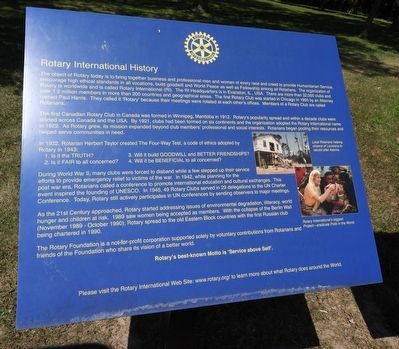
The first Canadian Rotary Club in Canada was formed in Winnipeg, Manitoba in 1912. Rotary's popularity spread and within a decade clubs were started across Canada and the USA. By 1921, clubs had been formed on six continents and the organization adopted the Rotary International name in 1922. As Rotary grew, its mission expanded beyond club members' professional and social interests. Rotarians began
this page online
In 1932, Rotarian Herbert Taylor created The Four-Way Test, a code of ethics adopted by Rotary in 1943:
1. Is it the truth?
2. Is it fair to all concerned?
3. Will it build goodwill and better friendships?
4. Will it be BENEFICIAL to all concerned?
During World War II, many clubs were forced to disband while a few stepped up their service efforts to provide emergency relief to victims of the war. In 1942, while planning for the post war era, Rotarians called a conference to promote international education and cultural exchanges. This event inspired the founding of UNESCO. In 1945, 49 Rotary Clubs served in 29 delegations to the UN Charter Conference. Today, Rotary still actively participates in UN conferences by sending observers to major meetings.
As the 21st Century approached, Rotary started addressing issues of environmental degradation, illiteracy, world hunger and children at risk. 1989 saw women being accepted as members. With the collapse of the Berlin Wall (November 1989 - October 1990), Rotary spread to the old Eastern Block countries
Photographed by Kevin Westell, July 28, 2025
2. Rotary International History - Marker in context
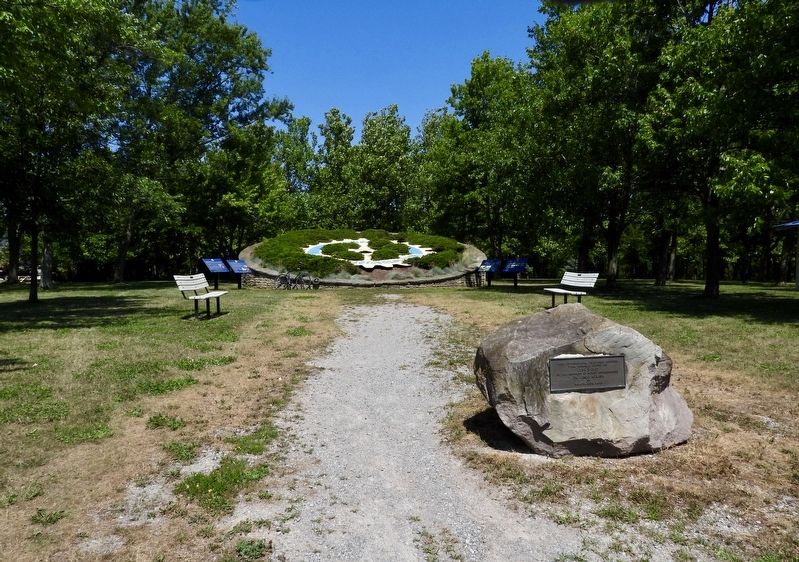
Photo faces north, on the walking path from the parking lot. This panel is one of four arrayed beside the giant Rotary International logo.
The Rotary Foundation is a not-for-profit corporation supported solely by voluntary contributions from Rotarians and friends of the Foundation who share its vision of a better world.
Rotary's best-known Motto is "Service above Self."
Please visit the Rotary International Web Site: www.rotary.org/ to learn more about what Rotary does around the World.
Erected by Rotary International.
Topics and series. This historical marker is listed in these topic lists: Charity & Public Work • Fraternal or Sororal Organizations. In addition, it is included in the Rotary International series list. A significant historical year for this entry is 1905.
Location. 43° 7.427′ N, 79° 15.955′ W. Marker is in St. Catharines, Ontario, in Niagara Region. It can be reached from Pelham Rd, on the right when traveling north. The marker is 50 metres east of the road; and 50 metres north of the Rotary Park's parking lot. Touch for map. Marker is at or near this postal address: 376 Pelham Rd, St Catharines ON L2S 0A2, Canada. Touch for directions.

Regionally, this marker is on the Golden Horseshoe and in Niagara Canada. It is also in Central Canada. Globally, it is in North America, on the Great Lakes, in the Western Hemisphere, in the Western World, and in the Anglosphere. Historically, it finds itself in what was once a British colony, the Viceroyalty of New France, the Haudenosaunee (Iroquois) Confederacy, and Rupert’s Land.
Other nearby markers. At least 8 other markers are within walking distance of this marker: Rotary Club of St. Catharines History (here, next to this marker); History of Rotary Park (a few steps from this marker); The Bridge at Laura's Crossing (approx. one kilometer away); Morningstar Mill - Wilson's Grandchildren (approx. 1.5 kilometers away); Morningstar Mill - The Spiral Staircase (approx. 1.5 kilometers away); Major-General Sir Isaac Brock, K.B. 1769-1812 (approx. 1.5 kilometers away); Morningstar Mill - The Miller's House (approx. 1.5 kilometers away); Brock University (approx. 1.5 kilometers away). Touch for a list and map of all markers in St. Catharines.
Credits. This page was last revised on July 30, 2025. It was originally submitted on July 30, 2025, by Kevin Westell of St. Catharines, Ontario. This page has been viewed 67 times since then and 17 times this year. Photos: 1, 2. submitted on July 30, 2025, by Kevin Westell of St. Catharines, Ontario. • Andrew Ruppenstein was the editor who published this page.
