Tucumcari in Quay County, New Mexico — The American Mountains (Southwest)
Tucumcari Mountain
Photographed by Michael Stroud, June 1, 2003
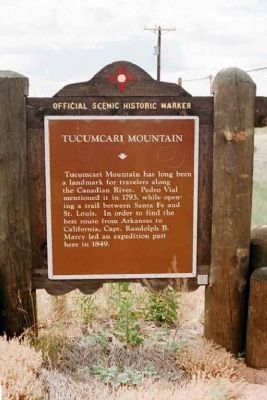
1. Tucumcari Mountain Marker
Tucumcari Mountain has long been a landmark for travelers along the Canadian River. Pedro Vial mentioned it in 1793, while opening a trail between Santa Fe and St. Louis. In order to find the best route from Arkansas to California, Capt. Randolph B. Marcy led an expedition past here in 1849.
Erected by New Mexico Historic Preservation Division.
Topics. This historical marker is listed in these topic lists: Exploration • Landmarks • Settlements & Settlers. A significant historical year for this entry is 1793.
Location. 35° 10.74′ N, 103° 43.533′ W. Marker is in Tucumcari, New Mexico, in Quay County. It is on East Main St (U.S. 54), on the right when traveling east. Touch for map. Marker is in this post office area: Tucumcari NM 88401, United States of America. Touch for directions.

Regionally, this marker is in Eastern New Mexico. It is also in the American Southwest, on the Great Plains, on the Southern Plains, and specifically on the High Plains. Globally, it is in North America, the Western Hemisphere, the Western World, and the Anglosphere. Historically, it finds itself in what was once New Spain, the Comanchería, the Dust Bowl, and the Republic of Texas.
Other nearby markers. At least 8 other markers are within 2 miles of this marker, measured as the crow flies: Tucumcari (within shouting distance of this marker); Fort Bascom (about 700 feet away, measured in a direct line); A Route 66 Classic (approx. 0.7 miles away); Blue Swallow Motel (approx. 0.7 miles away); Yetta Kohn (1843 – 1917) (approx. 1.1 miles away); Comanche Country (approx. 1.2 miles away); a different marker also named Tucumcari Mountain (approx. 1.9 miles away); a different marker also named Tucumcari (approx. 1.9 miles away). Touch for a list and map of all markers in Tucumcari.
Regarding Tucumcari Mountain. Tucumcari
this page online
Also see . . .
1. Tucumcari, New Mexico. Wikipedia entry (Submitted on December 26, 2007, by Mike Stroud of Bluffton, South Carolina.)
2. Blue Swallow. Roadside America website entry (Submitted on December 26, 2007, by Mike Stroud of Bluffton, South Carolina.)
Additional commentary.
1. Tucumcari In Popular Culture
Many of the scenes in the television show Rawhide (1959–1966) starring Clint Eastwood were shot in the Tucumcari area.
One of the killers in Truman Capote’s 1965 book In Cold Blood asks about the travelling distance to Tucumcari. This scene appears in the 1967 film version of the novel.
Tucumcari is where the main action of Sergio Leone’s 1965 film For a Few Dollars More, starring Clint Eastwood, Lee Van Cleef, and Gian Maria Volonte, takes place.
The city is mentioned
Photographed by Michael Stroud, June 1, 2003
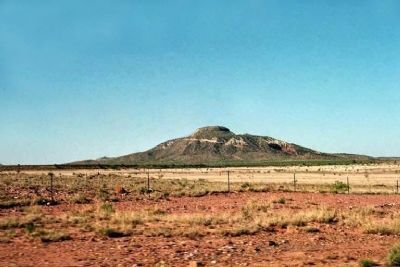
2. Tucumcari Mountain
Location N 35° 08.487 W 103° 43.195
In the 2005 episode “Bugs” of the television show Supernatural, the character played by Jensen Ackles states they will pass through Tucumcari on the way to Bisbee, Arizona.
— Submitted December 26, 2007, by Mike Stroud of Bluffton, South Carolina.
2. Tucumcari is mentioned in several songs, including:
“(Get Your Kicks on) Route 66” written by Bobby Troup in 1946 • “Tucumcari” recorded by Jimmie Rodgers in 1959 • “Willin’ ” recorded by Little Feat on Little Feat (1971) • “Tucumcari” sung by Freedy Johnston on The Trouble Tree (1990) • “Coyote” recorded by Better Than Ezra on Deluxe (1993) • “Last Hobo” recorded by John Denver on All Aboard! (1997) • “Tucumcari Here I Come” recorded by Dale Watson on More Songs Of Route 66 (2001)
— Submitted December 26, 2007, by Mike Stroud of Bluffton, South Carolina.
Photographed by Michael Stroud, June 1, 2003
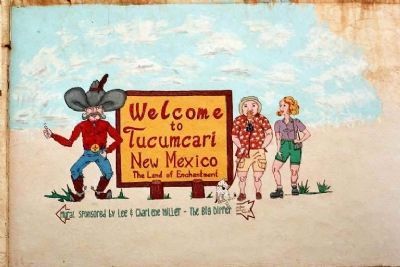
3. Welcome
Photographed by Michael Stroud, June 1, 2003
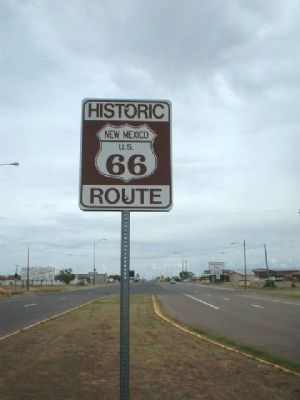
4. Historic Route 66
For many years, Tucumcari has been a popular stop for cross-country travelers on Interstate 40 (former U.S. Route 66). It is the largest city on the highway between Amarillo, Texas and Albuquerque, New Mexico. Billboards reading "TUCUMCARI TONITE!" placed along I-40 for many miles to the east and west of the town invite motorists to stay the night in one of Tucumcari's "2000" (later changed to "1200") motel rooms.
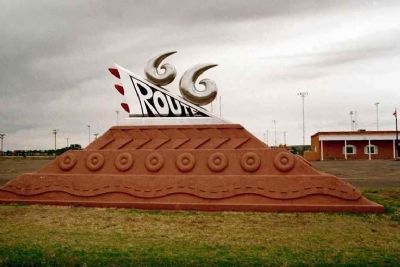
Photographed by Michael Stroud, June 162003
5. Route 66 Monument is located in Tucumcari
A scene in the 1971 movie Two-Lane Blacktop, starring James Taylor, Dennis Wilson, and Warren Oates, was filmed at a gasoline service station on U.S. Highway 54 just northeast of Tucumcari. Tucumcari Mountain is clearly visible at the beginning of this scene.
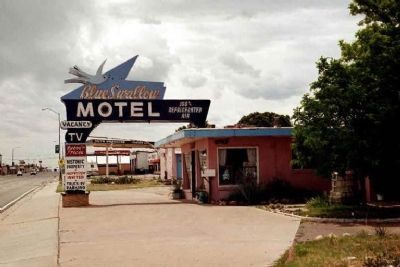
Photographed by Michael Stroud, June 1, 2003
6. Blue Swallow Motel
One of the Most Famous and Popular Motels on all of Route 66
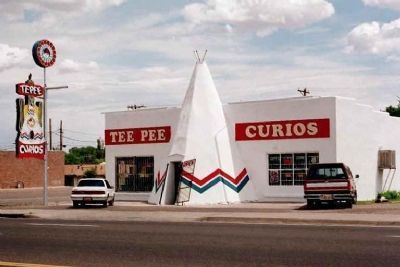
Photographed by Michael Stroud, June 1, 2003
7. Tucumcari Mountain Marker
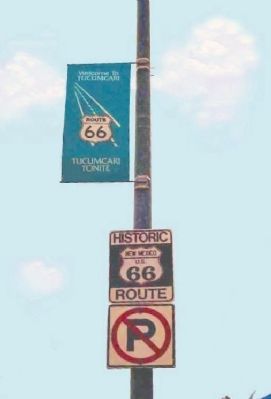
Photographed by Michael Stroud, June 1, 2003
8. Tucumcari Tonight
Credits. This page was last revised on August 1, 2025. It was originally submitted on December 26, 2007, by Mike Stroud of Bluffton, South Carolina. This page has been viewed 6,091 times since then and 188 times this year. Last updated on July 30, 2025, by Bill Wingate of Albuquerque, New Mexico. Photos: 1, 2, 3, 4, 5, 6, 7, 8. submitted on December 26, 2007, by Mike Stroud of Bluffton, South Carolina. • Bill Pfingsten was the editor who published this page.
