Dayton in Rockingham County, Virginia — The American South (Mid-Atlantic)
Frontiers of Faith
Photographed by Bradley Owen, July 22, 2025
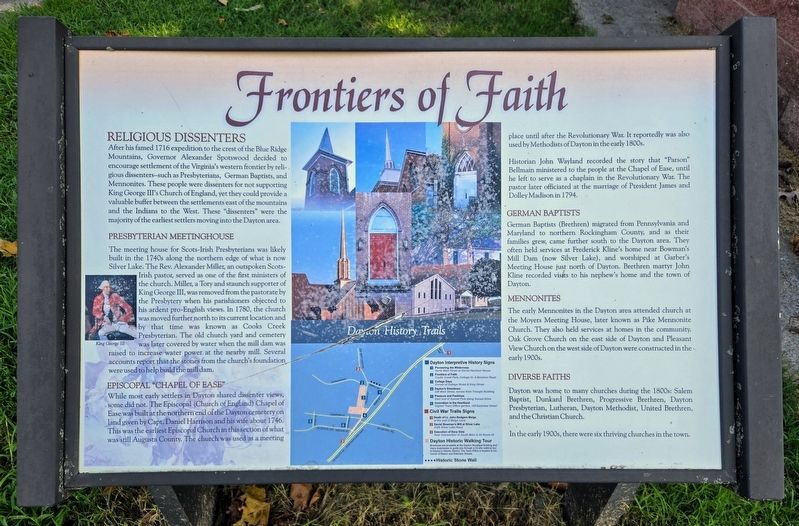
1. Frontiers of Faith Marker
Religious Dissenters
After his famed 1716 expedition to the crest of the Blue Ridge Mountains, Governor Alexander Spotswood decided to encourage settlement of the Virginia's western frontier by religious dissenters-such as Presbyterians, German Baptists, and Mennonites. These people were dissenters for not supporting King George III's Church of England, yet they could provide a valuable buffer between the settlements east of the mountains and the Indians to the West. These "dissenters" were the majority of the earliest settlers moving into the Dayton area.
Presbyterian Meetinghouse
The meeting house for Scots-Irish Presbyterians was likely built in the 1740s along the northern edge of what is now Silver Lake. The Rev. Alexander Miller, an outspoken Scots-Irish pastor, served as one of the first ministers of the church. Miller, a Tory and staunch supporter of King George III, was removed from the pastorate by the Presbytery when his parishioners objected to his ardent pro-English views. In 1780, the church was moved further, north to its current location and by that time was known as Cooks Creek Presbyterian.
this page online
Episcopal "Chapel of Ease"
While most early settlers in Dayton shared dissenter views, some did not. The Episcopal (Church of England) Chapel of Ease was built at the northern end of the Dayton cemetery on land given by Capt. Daniel Harrison and his wife about 1746. This was the earliest Episcopal Church in this section of what was still Augusta County. The church was used as a meeting place until after the Revolutionary War. It reportedly was also used by Methodists of Dayton in the early 1800s.
Historian John Wayland recorded the story that "Parson" Bellmain ministered to the people at the Chapel of Ease, until he left to serve as a chaplain in the Revolutionary War. The pastor later officiated at the marriage of President James and Dolley Madison in 1794.
German Baptists
German Baptists (Brethren) migrated from Pennsylvania and Maryland to northern Rockingham County, and as their
Photographed by Bradley Owen, July 22, 2025
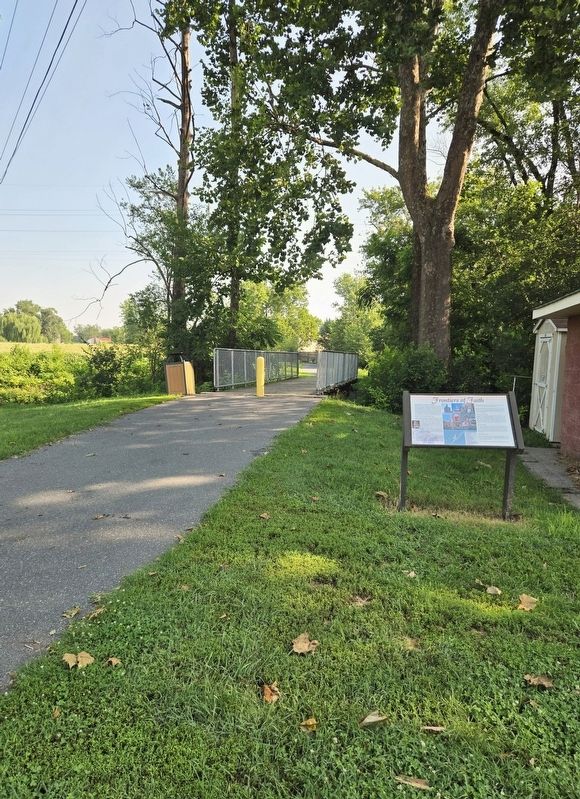
2. Frontiers of Faith Marker
Mennonites
The early Mennonites in the Dayton area attended church at the Moyers Meeting House, later known as Pike Mennonite Church. They also held services at homes in the community. Oak Grove Church on the east side of Dayton and Pleasant View Church on the west side of Dayton were constructed in the early 1900s.
Diverse Faiths
Dayton was home to many churches during the 1800s: Salem Baptist, Dunkard Brethren, Progressive Brethren, Dayton Presbyterian, Lutheran, Dayton Methodist, United Brethren, and the Christian Church.
In the early 1900s, there were six thriving churches in the town.
Erected by The Town of Dayton, Va.
Topics and series. This historical marker is listed in these topic lists: Religion & Religious Structures • Settlements & Settlers. In addition, it is included in the Former U.S. Presidents: #04 James Madison series list. A significant historical year for this entry is 1716.
Location. 38° 25.186′ N, 78° 56.363′ W. Marker is in Dayton, Virginia, in Rockingham County. It is at the intersection of Bowman Road (Virginia Route 732) and High Street, on the right when traveling west on Bowman Road. Touch for map. Marker is at or near this postal address: 220 Bowman Road, Dayton VA 22821, United States of America. Touch for directions.

Regionally, this marker is in the Shenandoah Valley. It is also in the American South and specifically in the Upper South. Globally, it is in North America, the Western Hemisphere, the Western World, and the Anglosphere. Historically, it finds itself in what was once the territory of the Mississippian Culture, one of the original Thirteen Colonies, one of the Confederate States of America, and the Antebellum South.
Other nearby markers. At least 8 other markers are within walking distance of this marker: First Church in Rockingham County (about 500 feet away, measured in a direct line); Veterans Memorial (about 700 feet away); Daniel Bowman Mill at Silver Lake (approx. 0.2 miles away); Shenandoah College and Shenandoah Conservatory of Music (approx. 0.2 miles away); College Days (approx. 0.2 miles away); Silver Lake Historic District (approx. 0.2 miles away); Mysteries along Cooks Creek (approx. 0.2 miles away); Fort Harrison (approx. ¼ mile away). Touch for a list and map of all markers in Dayton.
Regarding Frontiers of Faith. Marker includes a map of Dayton (Dayton History Trails) featuring locations for Dayton Interpretive History Signs, Civil War Trails Signs, the Dayton Historic Walking Tour area and the Historic Stone Wall.
Credits. This page was last revised on August 2, 2025. It was originally submitted on July 30, 2025, by Bradley Owen of Morgantown, West Virginia. This page has been viewed 99 times since then and 21 times this year. Photos: 1, 2. submitted on August 2, 2025, by Bradley Owen of Morgantown, West Virginia.
