Dayton in Rockingham County, Virginia — The American South (Mid-Atlantic)
College Days
Photographed by Bradley Owen, July 22, 2025
1. College Days Marker
Birthplace of a University
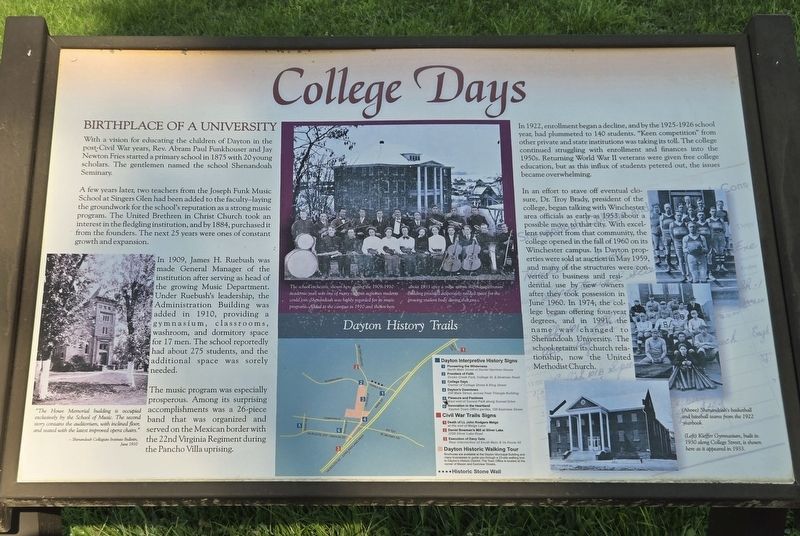
With a vision for educating the children of Dayton in the post-Civil War years, Rev. Abram Paul Funkhouser and Jay Newton Fries started a primary school in 1875 with 20 young scholars. The gentlemen named the school Shenandoah Seminary.
A few years later, two teachers from the Joseph Funk Music School at Singers Glen had been added to the faculty-laying the groundwork for the school's reputation as a strong music program. The United Brethren in Christ Church took an interest in the fledgling institution, and by 1884, purchased it from the founders. The next 25 years were ones of constant growth and expansion.
In 1909, James H. Ruebush was made General Manager of the institution after serving as head of the growing Music Department. Under Ruebush's leadership, the Administration Building was added in 1910, providing a gymnasium, classrooms, washroom, and dormitory space for 17 men. The school reportedly had about 275 students, and the additional space was sorely needed.
The music program was especially prosperous. Among its surprising accomplishments was a 26-piece band that was
this page online
In 1922, enrollment began a decline, and by the 1925-1926 school year, had plummeted to 140 students. "Keen competition" from other private and state institutions was taking its toll. The college continued struggling with enrollment and finances into the 1950s. Returning World War II veterans were given free college education, but as this influx of students petered out, the issues became overwhelming.
In an effort to stave off eventual closure, Dr. Troy Brady, president of the college, began talking with Winchester area officials as early as 1953 about a possible move to that city. With excellent support from that community, the college opened in the fall of 1960 on its Winchester campus. Its Dayton properties were sold at auction in May 1959, and many of the structures were converted to business and residential use by new owners after they took possession in June 1960. In 1974, the college began offering four-year degrees, and in 1991, the name was changed to Shenandoah University. The school retains its church relationship,
Photographed by Bradley Owen, July 22, 2025
2. College Days Marker
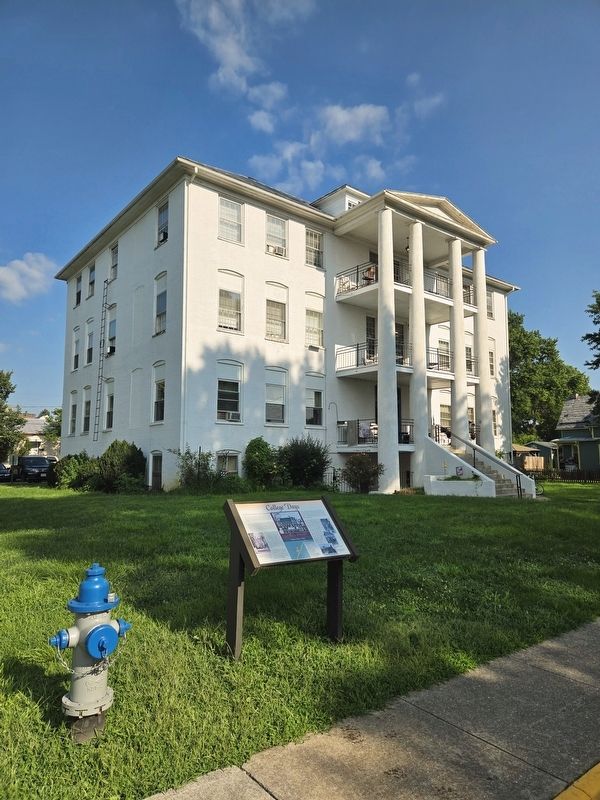
The former location of Shenandoah College and Shenandoah Conservatory of Music, built in 1918, is in the background.
(Captions):
"The Howe Memorial building is occupied exclusively by the School of Music. The second story contains the auditorium, with inclined floor, and seated with the latest improved opera chairs."
Shenandoah Collegiate Institute Bulletin
June 1910
The school orchestra, shown here during the 1909-1910 academic year, was one of many campus activities students could join. Shenandoah was highly regarded for its music programs. Added to the campus in 1910 and shown here about 1933 after a snow storm, the Administration Building provided desperately needed space for the growing student body during that era.
(Above) Shenandoah's basketball and baseball teams from the 1922 yearbook
(Left) Kieffer Gymnasium, built in 1930 along College Street, is shown here as it appeared in 1933.
Erected by The Town of Dayton, Va.
Topics. This historical marker is listed in these topic lists: Arts, Letters, Music • Education • Religion & Religious Structures. A significant historical month for this entry is June 1910.
Location. 38° 25.041′ N, 78° 56.313′ W. Marker is in Dayton, Virginia, in Rockingham County. It is at the intersection of College Street (Virginia Route 701) and King Street, on the right when traveling south on College Street. Touch for map. Marker is at or near this postal address: 355 College Street, Dayton VA 22821, United States of America. Touch for directions.

Regionally, this marker is in the Shenandoah Valley. It is also in the American South and specifically in the Upper South. Globally, it is in North America, the Western Hemisphere, the Western World, and the Anglosphere. Historically, it finds itself in what was once the territory of the Mississippian Culture, one of the original Thirteen Colonies, one of the Confederate States of America, and the Antebellum South.
Other nearby markers. At least 8 other markers are within walking distance of this marker: Shenandoah College and Shenandoah Conservatory of Music (within shouting distance of this marker); Lt. Col. Thomas F. Wildes (about 600 feet away, measured in a direct line); Establishing a Home (about 800 feet away); Prospering in the Back Country (about 800 feet away); Working Hard at Home (about 800 feet away); Fort Harrison (approx. 0.2 miles away); Mysteries along Cooks Creek (approx. 0.2 miles away); Pioneering the Wilderness (approx. 0.2 miles away). Touch for a list and map of all markers in Dayton.
Regarding College Days. Marker includes a map of Dayton (Dayton History Trails) featuring locations for Dayton Interpretive History Signs, Civil War Trails Signs, the Dayton Historic Walking Tour area and the Historic Stone Wall.
Credits. This page was last revised on July 31, 2025. It was originally submitted on July 30, 2025, by Bradley Owen of Morgantown, West Virginia. This page has been viewed 105 times since then and 35 times this year. Photos: 1, 2. submitted on July 31, 2025, by Bradley Owen of Morgantown, West Virginia.
