Sentrum in Oslo, Norway — Northern Europe (a Nordic Country in Scandinavia)
Foreldreaksjonen
⎯⎯⎯
“Parental Response”
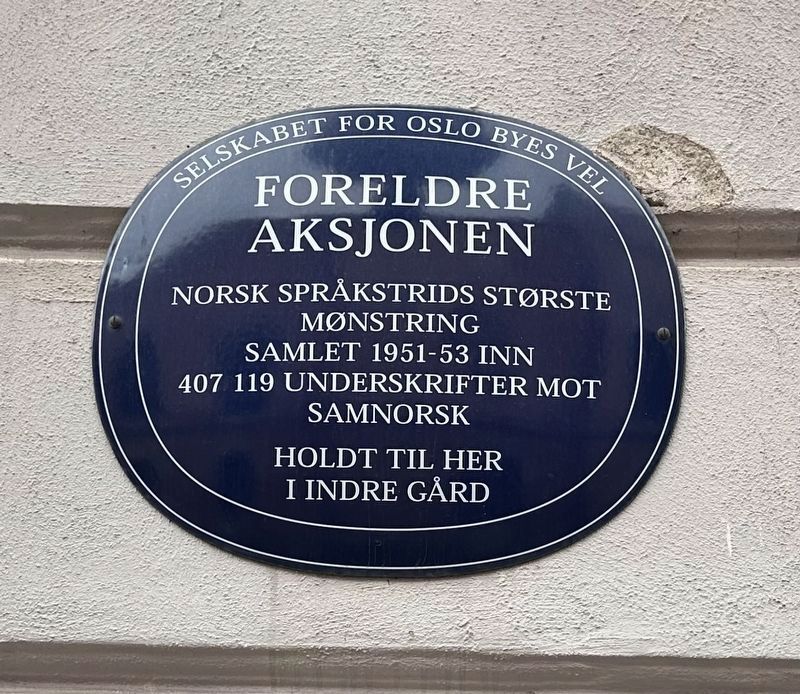
Photographed by Andrew Ruppenstein, June 23, 2025
1. Foreldreaksjonen / “Parental Response” Marker

Holdt til her i indre gård
Erected by Selskabet For Oslo Byes Vel.
Topics and series. This historical marker is listed in these topic lists: Arts, Letters, Music • Education. In addition, it is included in the Selskabet For Oslo Byes Vel series list. A significant historical date for this entry is December 7, 1951.
Location. 59° 54.968′ N, 10° 44.289′ E. Marker is in Oslo. It is in Sentrum. It is on Universitetsgata, on the right when traveling north. Touch for map. Marker is at or near this postal address: Universitetsgata 14, Oslo 0164, Norway. Touch for directions.

Regionally, it is in the North Atlantic Region, on the Atlantic Arc, in Europe, in Atlantic Europe, in Scandinavia, in the Nordic Countries, in the Schengen Area, and in the Western World.
Other nearby markers. At least 8 other markers are within walking distance of this marker: Det Norske Studentersamfund / The Norwegian Students’ Society
this page online
Also see . . .
1. Norwegian language conflict (Wikipedia). Overview:
The Norwegian language conflict (Norwegian: språkstriden, Danish: sprogstriden) is an ongoing controversy in Norwegian culture and politics about the different varieties of written Norwegian. From 1536/1537 until 1814, Danish was the standard written language of Norway due to the union of crowns with Denmark. As a result, the proximity of modern written Norwegian to Danish underpins controversies in nationalism, rural versus urban cultures, literary history, diglossia (colloquial and formal dialects, standard language), spelling reform, and orthography.
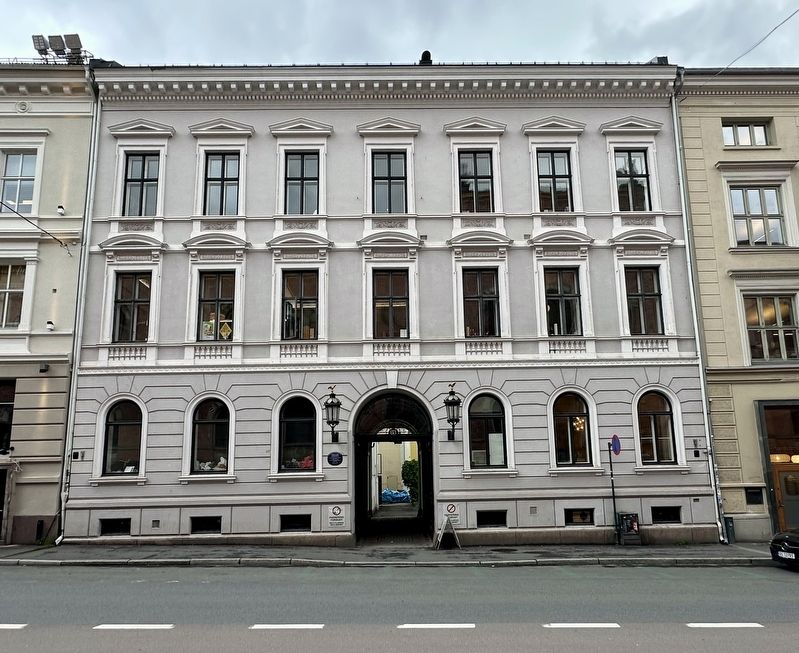
Photographed by Andrew Ruppenstein, June 23, 2025
2. Foreldreaksjonen / “Parental Response” Marker - wide view
2. Samnorsk (Wikipedia). Overview:
Samnorsk is a written standard of the Norwegian language that was proposed between the 1930s and the 1950s as a way to bridge the gap between the existing varieties.…(Submitted on August 3, 2025.)
3. Foreldreaksjonen (Selskabet For Oslo Byes Vel, in Norwegian). Excerpt (in translation):
The “Parental Reaction against Samnorsk” was founded on December 7, 1951. Three days later, large advertisements with the headline “Have you read your children’s schoolbooks?” dominated the front pages of the Oslo newspapers. It was the start of a protest action without parallel in Norwegian history. The idea behind Samnorsk was to create a single Norwegian language by taking radical and systematic action and merging Riksmål/Bokmål and Nynorsk. A decision by the Oslo City Council in 1939 led to the reading and textbooks in Bokmål in the post-war years being given a very “Samnorsk” language form. This triggered the Parental Reaction, in which 407,119 Norwegians supported the demands…(Submitted on August 3, 2025.)
The action represented a new type of grassroots action democracy in Norway.
Additional keywords. blå skilt, linguistics
Credits. This page was last revised on August 3, 2025. It was originally submitted on August 3, 2025, by Andrew Ruppenstein of Lamorinda, California. This page has been viewed 67 times since then and 6 times this year. Photos: 1, 2. submitted on August 3, 2025, by Andrew Ruppenstein of Lamorinda, California.
