
Welland in Niagara Region, Ontario — Central Canada (North America)
The Reilly/Coulson House 1873
Photographed by Kevin Westell, August 1, 2025
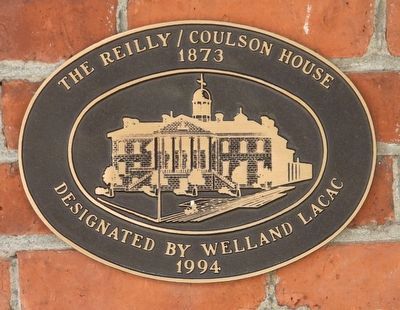
1. The Reilly / Coulson House 1873 - Marker
The Reilly / Coulson House
1873
Designated by Welland LACAC
1994
Erected 1994 by Welland LACAC.
Topics. This historical marker is listed in this topic list: Notable Buildings. A significant historical year for this entry is 1873.
Location. 42° 59.389′ N, 79° 15.26′ W. Marker is in Welland, Ontario, in Niagara Region. It is on Maple Avenue, on the right when traveling east. Touch for map. Marker is at or near this postal address: 53 Maple Avenue, Welland ON L3C 5E9, Canada. Touch for directions.

Regionally, this marker is on Ontario’s Golden Horseshoe and in Niagara Canada. It is also in Central Canada. Globally, it is in North America, on the Great Lakes, in the Western Hemisphere, in the Western World, and in the Anglosphere. Historically, it finds itself in what was once a British colony, the Viceroyalty of New France, the Haudenosaunee (Iroquois) Confederacy, and Rupert’s Land.
Other nearby markers. At least 8 other markers are within walking distance of this marker: 1873 The Reilly - Coulson House (here, next to this marker); The Hooker House 1856 (within shouting distance of this
this page online
Regarding The Reilly/Coulson House 1873. https://www.welland.ca/Heritage/tour_info/Heritage_Welland_brochure.pdf
claims:
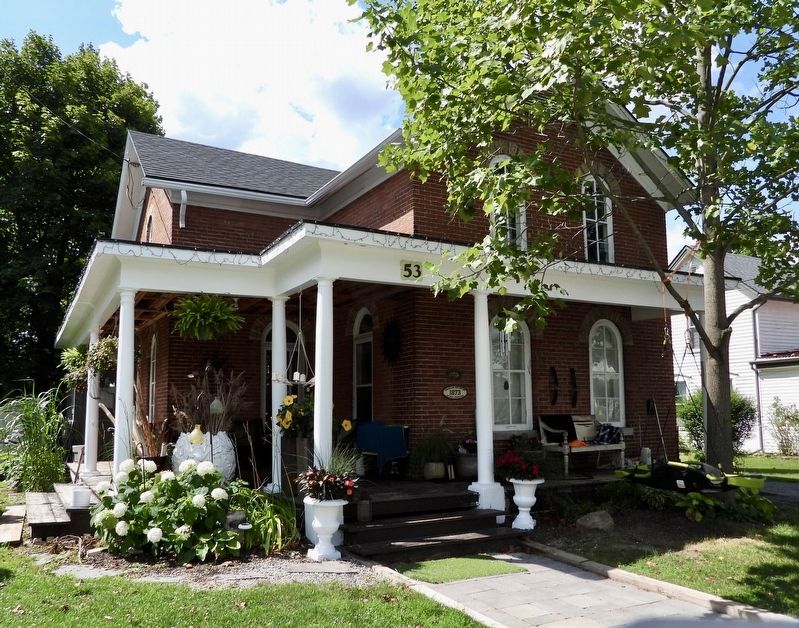
Built in 1873 for the Buchner family and later owned by Daniel Hooker, son of Thaddeus (see No. 13). Daniel was a Town Councilor and Mayor of Welland 1898-1899. It passed to the Reilly family in 1906 and remained in that family for almost 100 years. Constructed of red Hooker brick, its wide eaves and narrow, round-arched windows capped with buff brick are characteristic of the Italianate style.
Photographed by Kevin Westell, August 1, 2025
2. The Reilly / Coulson House
The marker is one of two on the front face of the house.
Credits. This page was last revised on August 4, 2025. It was originally submitted on August 3, 2025, by Kevin Westell of St. Catharines, Ontario. This page has been viewed 75 times since then and 11 times this year. Photos: 1, 2. submitted on August 3, 2025, by Kevin Westell of St. Catharines, Ontario. • Andrew Ruppenstein was the editor who published this page.
