Berlin in Coos County, New Hampshire — The American Northeast (New England)
New Hampshire Lilacs
Photographed by William Fischer, Jr., July 29, 2025
1. New Hampshire Lilacs Marker
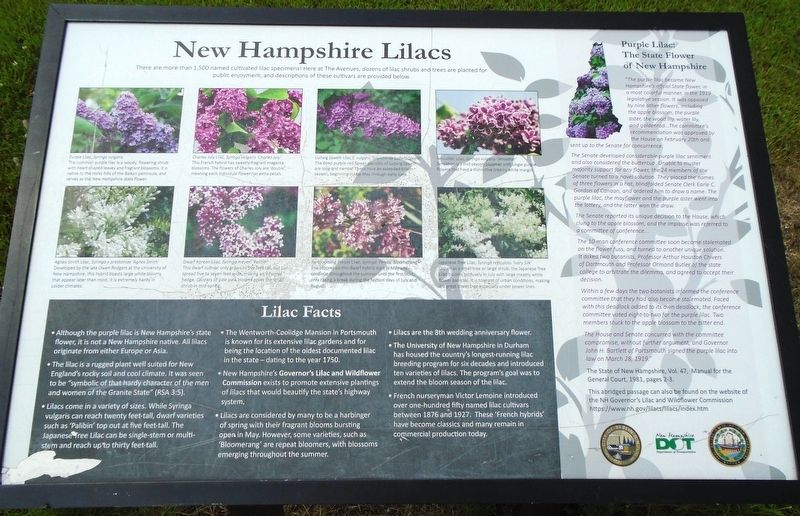
There are more than 1,500 named cultivated lilac specimens! Here at The Avenues, dozens of lilac shrubs and trees are planted for public enjoyment, and descriptions of these cultivars are provided below.
Purple Lilac, Syringa vulgaris
The common purple lilac is a woody, flowering shrub with heart-shaped leaves and fragrant blossoms. It is native to the rocky hills of the Balkan peninsula, and serves as the New Hampshire state flower.
Charles Joly Lilac, Syringa vulgaris 'Charles Joly'
[No historical information]
Ludwig Spaeth Lilac, S. vulgaris 'Souvenir de Ludwig Spaeth'
[No historical information]
Sensation Lilac, Syringa vulgaris 'Sensation'
[No historical information]
Agnes Smith Lilac, Syringa x prestoniae 'Agnes Smith'
Developed by the late Owen Rodgers at the University of New Hampshire, this hybrid boasts large white blooms that appear later than most. It is extremely hardy in colder climates.
Dwarf Korean Lilac, Syringa meyeri 'Palibin'
[No historical information]
Re-blooming Purple Lilac, Syringa 'Penda Bloomerang'
[No historical information]
Japanese Tree Lilac, Syringa reticulata 'Ivory Silk'
[No
this page online
Lilac Facts
• Although the purple lilac is New Hampshire's state flower, it is not a New Hampshire native. All lilacs originate from either Europe or Asia.
• The lilac is a rugged plant well suited for New England's rocky soil and cool climate. It was seen to be "symbolic of that hardy character of the men and women of the Granite State" (RSA 3:5).
• [No historical information]
• The Wentworth-Coolidge Mansion in Portsmouth is known for its extensive lilac gardens and for being the location of the oldest documented lilac in the state-dating to the year 1750.
• New Hampshire's Governor's Lilac and Wildflower Commission exists to promote extensive plantings of lilacs that would beautify the state's highway system.
• [No historical information]
• Lilacs are the 8th wedding anniversary flower.
• The University of New Hampshire in Durham has housed the country's longest-running lilac breeding program for six decades and introduced ten varieties of lilacs. The program's goal was to extend the bloom season of the lilac.
• French nurseryman Victor Lemoine introduced over one-hundred fifty named lilac

Photographed by William Fischer, Jr., July 29, 2025
2. New Hampshire Lilacs Marker
Purple Lilac:
The State Flower of New Hampshire
"The purple lilac became New Hampshire's offcial State flower, in a most colorful manner, in the 1919 legislative session. It was opposed by nine other flowers, including the apple blossom, the purple aster, the wood lily, water lily, and goldenrod...The committee's recommendation was approved by the House on February 20th and sent up to the Senate for concurrence.
The Senate developed considerable purple lilac sentiment and also considered the buttercup. Unable to muster majority support for any flower, the 24 members of the Senate turned to a novel solution. They placed the names of three flowers in a hat, blindfolded Senate Clerk Earle C. Gordon of Canaan, and ordered him to draw a name. The purple lilac, the mayflower and the purple aster went into the lottery, and the latter won the draw.
The Senate reported its unique decision to the House, which clung to the apple blossom, and the impasse was referred to a committee of conference....
The 10-man conference committee soon became stalemated on the flower fuss, and turned to another unique solution. It asked two botanists, Professor Arthur Houston Chivers of Dartmouth and Professor Ormond Butler of the state college to arbitrate the dilemma, and agreed to accept their decision.
Within a few days the two botanists informed the conference committee that they had also become stalemated. Faced with this deadlock added to its own deadlock, the conference committee voted eight-to-two for the purple lilac. Two members stuck to the apple blossom to the bitter end.
The House and Senate concurred with the committee compromise, without further argument, and Governor John H. Bartlett of Portsmouth signed the purple lilac into law on March 28, 1919."
The State of New Hampshire, Vol. 47, Manual for the General Court, 1981, pages 2-3.
This abridged passage can also be found on the website of the NH Governor's Lilac and Wildflower Commission
https://www.nh.gov/lilacs/lilacs/index.htm
Erected by the City of Berlin and the New Hampshire Dept of Transportation.
Topics. This historical marker is listed in these topic lists: Government & Politics • Horticulture & Forestry. A significant historical date for this entry is March 28, 1919.
Location. 44° 28.347′ N, 71° 11.191′ W. Marker is in Berlin, New Hampshire, in Coos County. It is at the intersection of Mannering Street and 2nd Street, on the left when traveling east on Mannering Street. Touch for map. Marker is at or near this postal address: 108 Mannering Street, Berlin NH 03570, United States of America. Touch for directions.

Regionally, this marker is in the White Mountains. It is also in the American Northeast and in New England. Globally, it is in North America, the Great North Woods, the Western Hemisphere, the Western World, and the Anglosphere. Historically, it finds itself in what was once one of the original Thirteen Colonies.
Other nearby markers. At least 8 other markers are within walking distance of this marker: "The City That Trees Built" (approx. 0.2 miles away); World War Memorial (approx. 0.3 miles away); Holiday Center [Former City National Bank] (approx. 0.4 miles away); Superior Courthouse (approx. 0.4 miles away); Sgt Daniel J. Albert (approx. 0.4 miles away); Berlin Central Fire Station (approx. 0.4 miles away); Berlin Public Library (approx. 0.4 miles away); SSG. Randy S. Rosenberg, US A[rmy] (approx. half a mile away). Touch for a list and map of all markers in Berlin.
Credits. This page was last revised on August 5, 2025. It was originally submitted on August 5, 2025, by William Fischer, Jr. of Reynoldsburg, Ohio. This page has been viewed 146 times since then and 69 times this year. Photos: 1, 2. submitted on August 5, 2025, by William Fischer, Jr. of Reynoldsburg, Ohio.
