Denver & Rio Grande Railroad San Juan Extension
Cumbres & Toltec Scenic Railroad

has been designated a
National Historic Landmark
This site possesses national significance in illustrating the history of the United States of America
2012
National Park Service
United States Department of the Interior
Topics and series. This historical marker is listed in these topic lists: Architecture • Industry & Commerce • Notable Buildings • Railroads & Streetcars. In addition, it is included in the National Historic Landmarks, and the National Register of Historic Places (NRHP) series lists. A significant historical year for this entry is 1880.
Location. 37° 4.203′ N, 106° 0.725′ W. Marker is in Antonito, Colorado, in Conejos County. It can be reached from the intersection of U.S. 285 and State Highway 17, on the right when traveling north. The marker is mounted at eye-level on the east/front side of the Antonito Railroad Depot. Touch for map. Marker is at or near this postal address: 5234 US Highway 285, Antonito CO 81120, United States of America. Touch for directions.

Regionally, this marker is in the San Juan Mountains and in the San Luis Valley. It is also in the American Mountain West. Globally,
this page online
Other nearby markers. At least 8 other markers are within walking distance of this marker: Railroad Boom Town (about 400 feet away, measured in a direct line); Foundations of Faith (about 400 feet away); Welcome to El Valle de San Luis (about 400 feet away); La Sociedad (about 400 feet away); The Cumbres & Toltec (about 500 feet away); Welcome to Colorado / Antonito Country (about 500 feet away); The Horse and the Indian (about 500 feet away); Warshauer Mansion (approx. 0.4 miles away). Touch for a list and map of all markers in Antonito.
More about this marker. There is an identical marker on the former D&RG Railroad Depot in Chama, New Mexico. The Denver & Rio Grande Railroad San Juan Extension National Historic Landmark comprises the entire 64-mile right-of-way, including numerous associated historic structures, such as the former D&RG Section House at Cumbres Pass and the former D&RG Railroad Depot at Chama, on the narrow-gauge

Regarding Denver & Rio Grande Railroad San Juan Extension. National Register of Historic Places № 73000462 (original, 1973) & 07000374 (increase, 2007). Also on the Colorado Register of Historic Places, Site № 5AA.664/5CN.65.
From the 2007 National Register Nomination prepared by Keith E. Hayes, 10/10/2005:
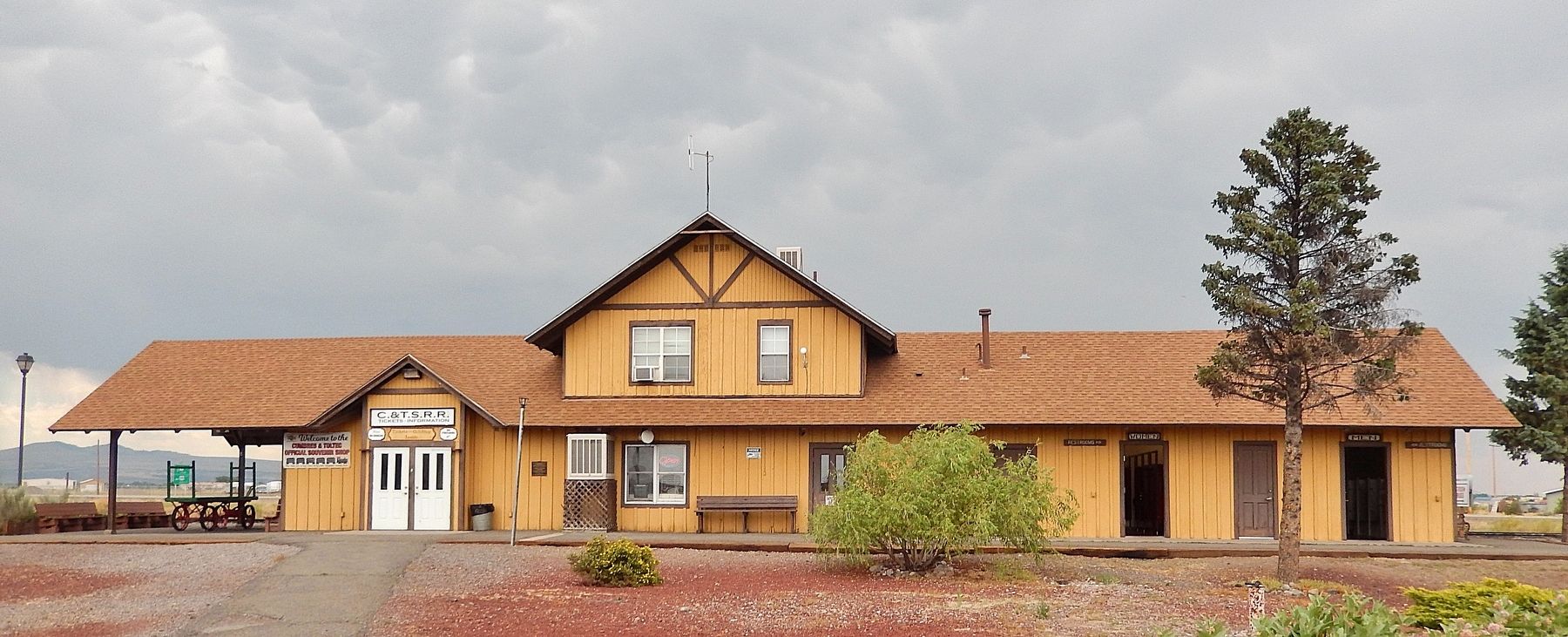
When the railroad segment was listed in the National Register in 1973, the name “Cumbres and Toltec Scenic Railroad” was recorded as the official resource name. As this name was not used until after the railroad’s period of significance, this amendment uses the historic name of the property during the period of significance; “Denver & Rio Grande Railroad San Juan Extension.” The right-of-way consists of 64 miles of three-foot gauge railroad track between the communities of Antonito, Colorado, and Chama, New Mexico, along the Colorado-New Mexico border. Trackage crosses the state border eleven times, sometimes multiplecrossings within hundreds of feet. The route travels over Cumbres Pass at an elevation of 10,015 feet.Photographed by Cosmos Mariner, July 12, 20253. Antonito Railroad Depot (southeast elevation)At Antonito, Colorado, the eastern terminus, there is a small frame depot, built in 1971. This was designed to conform with the architecture of the other structures along the line, which is typical of western railroad design of the 1880's. Condition of the Antonito depot is excellent. A wye, a passing siding, and a new handcar shed complete the inventory at Antonito. The condition of the rails and roadbed is generally good, as is the condition of the two operating and three repairable locomotives. Most of the rolling stock is in fair-to-poor condition. The physical appearance of the railroad is much the same today as it was in 1880, when the line was built, except for the size of the locomotives and the weight of the rail.
As part of the boom and bust west, the Denver & Rio Grande as a corporate entity was born, died and reborn under a variety of names. These include:
• Denver & Rio Grande Railway, 1870-1886
• Denver & Rio Grande Railroad Company, 1886-1921
• Denver & Rio Grande Western Railroad 1921-1970.In July 1970, the D&RG sold
the line along with its buildings, fixed structures and significant amounts of operating equipment to the states of Colorado and New Mexico.Photographed by Cosmos Mariner, July 12, 20254. Antonito Railroad Depot (northeast elevation)


Related markers. Click here for a list of markers that are related to this marker. Denver & Rio Grande Railroad San Juan Extension
Also see . . .
1. Cumbres and Toltec Scenic Railroad (Wikipedia).
Excerpt: On February 20, 1880, track crews of the Denver and Rio Grande Railway (D&RG) began to lay the first rails of the San Juan Extension going south from Alamosa, Colorado, toward Antonito, Colorado, arriving in March of that year. The company chose the narrow gauge of three feet instead of the standard gauge of four feet eight and a half inches. This was because the narrow gauge was cheaper to build, and a narrow-gauge railway can accommodate tighter-radius curves. This allowed laying track where standard gauge would not fit. From Antonito, the line continued west to Chama, New Mexico, arriving there on December 31, 1880. The track had come 64 miles through two tunnels, over a 10,015-foot mountain pass, and skirted a 600-foot gorge.(Submitted on August 7, 2025, by Cosmos Mariner of Cape Canaveral, Florida.)
The major issue with the line was Cumbres Passitself. The high elevation and various other factors lead to many terrible snowstorms. This prompted the railroad to purchase "rotary snowplows". The two that were used on the Cumbres Pass line were Rotary OM and Rotary OY. Both rotaries are still in existence in Chama, New Mexico, but historically they are dispatched from Alamosa. Every five or six years, the winter season has as much as 500 inches of snow fall on Cumbres. These snowstorms were a huge financial burden for the railroad. The "Granddaddy of All Snowstorms" hit in the winter of 1951–1952. This was the worst recorded winter on the line and one of the deciding factors when abandonment was considered in the 1960s.Photographed by Cosmos Mariner, July 12, 20255. Antonito Railroad Depot (southwest elevation)The Denver & Rio Grande narrow-gauge tracks run parallel to the west side of the depot.

2. Denver & Rio Grande Western Railroad San Juan Extension (History Colorado).
Excerpt: This nationally significant narrow-gauge railroad segment exists as one of only two operating sections of what was once a state wide network of three foot gauge tracks built and operated by the Denver and Rio Grande Railroad. The 64-mile route straddles the Colorado-New Mexico border on(Submitted on August 7, 2025, by Cosmos Mariner of Cape Canaveral, Florida.)the western edge of the San Luis Valley and is an outstanding representation of the larger 1,000-mile network that opened the central Rocky Mountain region for development. The right-of-way includes narrow gauge track in its original alignment, depots, water tanks, trestles, telegraphone booths, section houses, tunnels, livestock loading pens, ten steam locomotives, and over a hundred other pieces of rolling stock.Photographed by Cosmos Mariner, July 12, 20256. Antonito Railroad Depot (front/east elevation)The so-called Narrow Gauge Movement of the late nineteenth century was one of the most distinctive epochs in American railroading. The network defined by the Denver & Rio Grande, its affiliated companies, and especially the San Juan Extension represented an ambitious, extensive, and successful expression of narrow gauge (36") railroading as a viable alternative to the prevailing system of standard gauge (52 ½") track. The segment served as a de facto narrow gauge "proof of concept" project demonstrating the ability of 36" railroads to penetrate mountainous regions, operate over long distances, and scale equipment and infrastructure to meet heavy traffic demand.


Credits. This page was last revised on August 24, 2026. It was originally submitted on August 5, 2025, by Cosmos Mariner of Cape Canaveral, Florida. This page has been viewed 234 times since then and 52 times this year. Photos: 1, 2, 3, 4, 5, 6, 7, 8. submitted on August 7, 2025, by Cosmos Mariner of Cape Canaveral, Florida.
