Sentrum in Oslo, Norway — Northern Europe (a Nordic Country in Scandinavia)
Frivillig Eksil
⎯⎯⎯
Voluntary Exile
Photographed by Andrew Ruppenstein, June 24, 2025
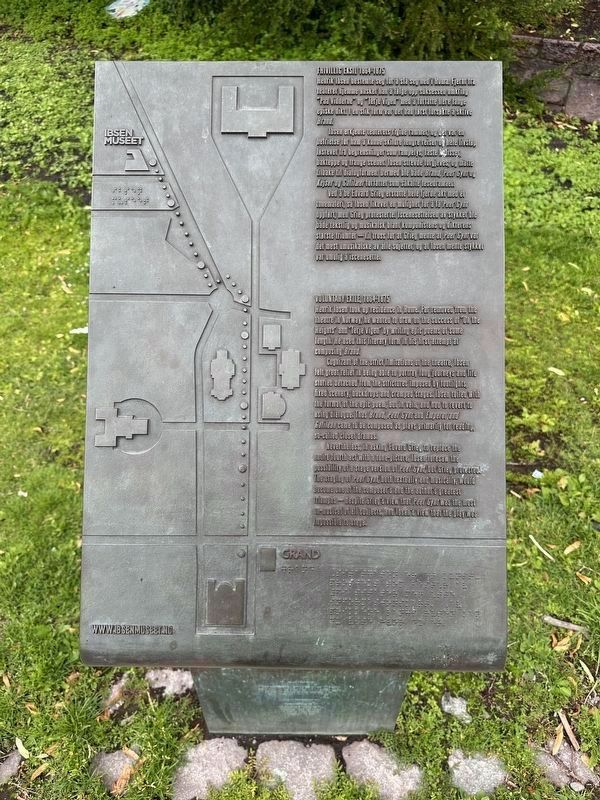
1. Frivillig Eksil / Voluntary Exile Marker
On the left half of the marker is the 8-station route of Ibsen-related historical markers, from Rosenkrantz’ gate to Ibsen’s former home on Henrik Ibsens gate. This is the 5th marker on the route.

Frivillig Eksil 1864-1875
Henrik Ibsen bestemte seg for å slå seg ned i Roma. Fjernt fra teateret hjemme ønsket han å følge opp suksessen omkring “Paa Vidderne” og “Terje Viyen” med a forfatte flere lange episke dikt. I en slik form var det han först forsøkte å skrive Brand.
Ibsen erkjente teaterets rigide rammer, og det var en befrielse for ham å kunne skildre lengre reiser og hele livsløp løsrevet fra begrensninger som rampelys, faste kulisser, bakteppe og trange scener. Ibsen strevde forgjeves, og måtte tilbake til dialogformen. Dermed ble både Brand, Peer Gynt up Kejser og Galilæer forfattet som såkalte lesedramaer.
Ved å be Edvard Grieg erstatte hele fjerde akt med et tonemaleri, så Ibsen likevel en mulighet for å få Peer Gynt oppført, men Grieg protesterte. Iscenesettelsen av stykket ble både tekstlig og musikalsk blant komponistens og dikterens største triumfer - til tross for at Grieg mente at Peer Gynt var det mest umusikalske av alle sujetter, og at Ibsen mente stykket var umulig å iscenesette.
Voluntary Exile, 1864-1875
Henrik Ibsen took up residence in Rome. Far removed from
this page online
Cognizant of the strict limitations of the theatre, Ibsen felt great relief in being able to portray long journeys and life stories detached from the strictures imposed by footlights, fixed scenery, backdrops and cramped stages. Ibsen toiled with the format of the epic poem, but in vain, and had to revert to using dialogue. Thus Brand, Peer Gynt and Emperor and Galilean came to be composed as plays primarily for reading, so-called closet dramas.
Nevertheless, in asking Edvard Grieg to replace the entire fourth act with a tone-picture, Ibsen foresaw the possibility of a stage version of Peer Gynt, but Grieg protested. The staging of Peer Gynt, both textually and musically, would become one of the composer's and the author's greatest triumphs despite Grieg's view that Peer Gynt was the most un-musical of all subjects, and Ibsen's view that the play was impossible to stage.
Erected 2006.
Topics. This historical
Photographed by Andrew Ruppenstein, June 24, 2025
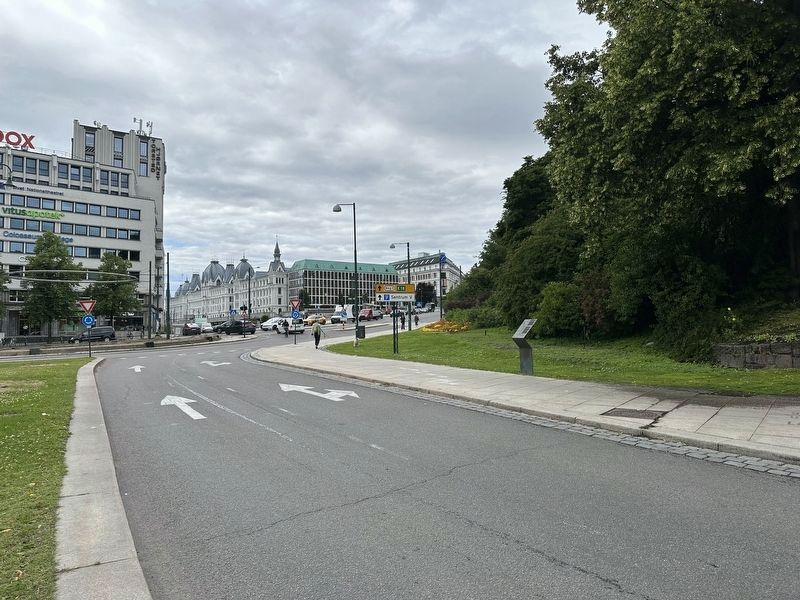
2. Frivillig Eksil / Voluntary Exile Marker - wide view
Location. 59° 54.921′ N, 10° 43.965′ E. Marker is in Oslo. It is in Sentrum. It is at the intersection of Johanne Dybwads plass and Karl Johans gate, on the right on Johanne Dybwads plass. Touch for map. Marker is at or near this postal address: Johanne Dybwads plass 1, Oslo 0162, Norway. Touch for directions.

Regionally, it is in the North Atlantic Region, on the Atlantic Arc, in Europe, in Atlantic Europe, in Scandinavia, in the Nordic Countries, in the Schengen Area, and in the Western World.
Other nearby markers. At least 8 other markers are within walking distance of this marker: Ruseløkken (within shouting distance of this marker); Ære og Fortvilelse 1857-1864 / Honour and Despair, 1857-1864 (about 90 meters away, measured in a direct line); Brødrene Hals’ Pianofortefabrik / Hals Brothers Piano Factory (about 120 meters away); Lærearene / Learning the Craft, 1850-1857 (about 180 meters away); Hotel Continental (about 180 meters away); «Tivoliporten» / Tivoli Gate (about 210 meters away); Trygve Haavelmo (1911-99) (about 210 meters away); Ragnar Frisch (1895-1973) (about 210 meters away). Touch for a list and map of all markers in Oslo.
Also see . . . Henrik Ibsen (Wikipedia). Overview:
Henrik Johan Ibsen (20 March 1828 – 23 May 1906) was a Norwegian play writer, who was considered one of the world's pre-eminent writers of the 19th century and is often referred to as "the father of modern drama." He pioneered theatrical realism, but also wrote lyrical epic works. His major works include Brand , Peer Gynt , Emperor and Galilean , A Doll's House , Ghosts , An Enemy of the People , The Wild Duck , Rosmersholm , Hedda Gabler , The Master Builder , and When We Dead Awaken . Ibsen is the most frequently performed dramatist in the world after Shakespeare,…(Submitted on August 7, 2025.)
Credits. This page was last revised on August 7, 2025. It was originally submitted on August 6, 2025, by Andrew Ruppenstein of Lamorinda, California. This page has been viewed 80 times since then and 15 times this year. Photos: 1. submitted on August 6, 2025, by Andrew Ruppenstein of Lamorinda, California. 2. submitted on August 7, 2025, by Andrew Ruppenstein of Lamorinda, California.
