Rione IX Pigna in Roma in Città metropolitana di Roma Capitale, Latium, Rome, Italy — Central Italy (Tyrrhenian Coast)
Grand Hotel de la Minerve

Photographed by Sean P. Flynn, August 5, 2025
1. Grand Hotel de la Minerve Marker
Il prestigioso Grand Hotel de la Minerve è uno dei pochi alberghi superstiti della Roma papale, incluso nel censimento alberghiero della città effettuato dal cavalier Rufini nel 1855. L'albergo attuale vanta origini antiche, una locanda della Minerva esisteva infatti ancor prima della costruzione dello stabile ottocentesco sulla piazzetta omonima, contraddistinto dal nome derivato dal tempio intitolato a Minerva Calcidica nell'area dell'Iseo Campense, su cui fu poi costruita la chiesa di S. Maria, anch'essa detta "della Minerva". La prima attività dell'albergo è ascrivibile all'iniziativa del francese Giuseppe Sauve, che arrivò a Roma con idee innovatrici nel campo della ricettività alberghiera. Acquisto l'immobile seicentesco situato sulla piazza in posizione adiacente al palazzo dei Porcari, già di pertinenza dei Fonseca, quindi passato ai Conti ai primi dell'Ottocento, e lo trasformó in una locanda di lusso. Fin dall'inizio in essa ebbero alloggio personalità di spicco della Roma papale, tra cui, seppur di passaggio, papa Pio IX (1846-1878), oltre che centinaia di cardinali, basti pensare che vi si poteva celebrare la messa in una piccola cappella privata. Fu questo uno dei motivi, unitamente ad un'accorta e mirata pubblicità, che fece del Minerva uno dei primi, se non il primo in assoluto, "grande albergo" romano, in cui dimorarono personalità come George Sand e Stendhal. Il palazzo fu sopraelevato alla fine del secolo ed ampiamente ristrutturato nel 1924, con l'aggiunta di un raffinato apparato scultoreo messo a punto da Rinaldo Rinaldi, allievo di Antonio Canova. Completamente rinnovato ad opera di Paolo Portoghesi, che lo ha ricondotto all'antico splendore, il Grand Hotel de la Minerve può offrire alla propria clientela l'accoglienza di una dimora aristocratica e una delle viste più belle della città eterna, dalla sua terrazza infatti si può dominare la cupola del Pantheon in tutti i suoi particolari, tra il suggestivo lanternino di S. Ivo alla Sapienza e l'altana del Quirinale.
The prestigious Grand Hotel de la Minerve is one of the few hotels surviving from papal Rome, included in the city hotel census made by Cavalier Rufini in 1855. The present-day hotel boasts a very old origin: a Minerva inn existed even before the construction of the nineteenth-century building in the little Piazza Minerva, which takes its name from the temple dedicated to Chalcidian Minerva in the Iseo Campense area, where the Santa Maria church was built, at that time also known as the "Minerva" church. The first activity of the hotel is to be ascribed to the initiative of the Frenchman Joseph Sauve, who arrived in Rome with innovating ideas in the field of hotel accommodation. He purchased the seventeenth-century building in the piazza adjacent to Palazzo dei Porcari, which previously belonged to the Fonsecas and then went to the Contis at the start of the nineteenth century, and turned it into a luxury inn. Major personalities of papal Rome stayed there right from the start, including Pope Pius IX (1846-1878), though he was just passing through, as well as hundreds of cardinals; in this connection, it is worth mentioning that mass could be celebrated there in a small private chapel. This was one of the factors, together with shrewd and well-directed advertising, that made Minerva one of the first, if not absolutely the first, "great hotel" in Rome, where personalities like Georges Sand and Stendhal stayed. The building was raised higher at the end of the century and largely restructured in 1924, with the addition of refined sculptures done by Rinaldo Rinaldi, an alumnus of Antonio Canova. Completely renovated by Paolo Portoghesi, who gave it back its sometime splendour, the Grand Hotel de la Minerve can offer its guests the welcome of an aristocratic abode and one of the most beautiful sights in the eternal city: from its terrace you can see the dome of the Pantheon in all its details, between the charming little lantern of Sant'Ivo alla Sapienza and the rooftop loggia of the Quirinale.
Erected by Ministry
this page online
Topics. This historical marker is listed in these topic lists: Architecture • Arts, Letters, Music • Industry & Commerce • Religion & Religious Structures. A significant historical year for this entry is 1855.
Location. 41° 53.866′ N, 12° 28.651′ E. Marker is in Roma, Lazio (Latium, Rome), in Città metropolitana di Roma Capitale. It is in Rione IX Pigna. It is on Piazza della Minerva, on the right when traveling east. The marker is to the right of the hotel's main entrance. Touch for map. Marker is at or near this postal address: Piazza della Minerva 69, Roma, Lazio 00186, Italy. Touch for directions.

Regionally, it is in Europe, the European Union, the Schengen Area, a coastal Mediterranean country, and the Western World. Historically, it finds itself in what was once the Roman Empire.
Other nearby markers. At least 8 other markers are within walking distance of this marker: Don José de San Martín (here, next to this marker); Santa Maria sopra Minerva (a few steps from this marker); Elephant and Obelisk (a few steps from this marker); Tommaso Badia of Modena (within shouting distance of this marker); Tommaso de Vio, Cardinal Cajetan (within shouting distance of this marker); Pantheon (about 150 meters away, measured in a direct line); Giuseppe Gioachino Belli (about 180 meters away); Rione III Colonna / Colonna District III (about 180 meters away). Touch for a list and map of all markers in Roma.
Also see . . . La Minerva hotel official website. (Submitted on August 7, 2025, by Sean P. Flynn of Oak Park, Illinois.)

Photographed by Sean P. Flynn, August 5, 2025
2. Grand Hotel de la Minerve
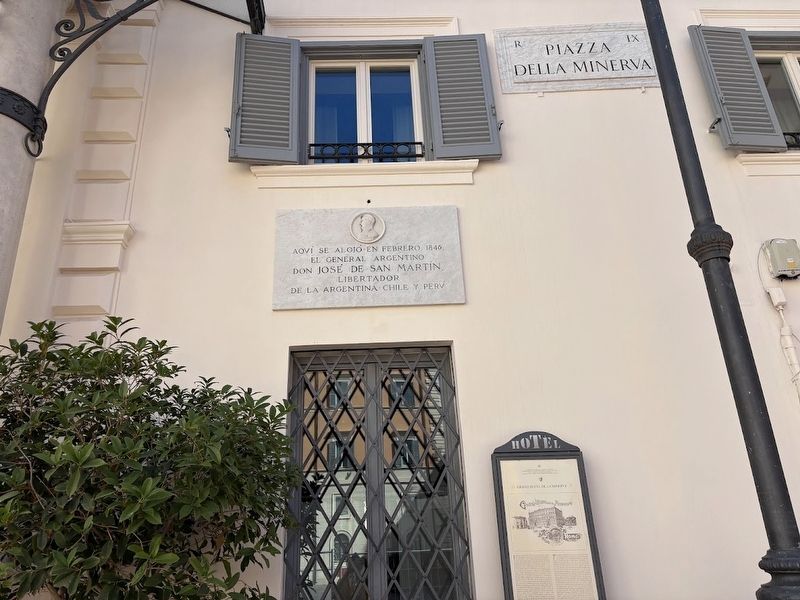
Photographed by Sean P. Flynn, August 5, 2025
3. Grand Hotel de la Minerve Marker
Above the marker for the hotel is another about Jose de San Martin, the Argentine general known as the liberator of Chile and Peru.
Credits. This page was last revised on August 7, 2025. It was originally submitted on August 7, 2025, by Sean P. Flynn of Oak Park, Illinois. This page has been viewed 126 times since then and 18 times this year. Photos: 1, 2, 3. submitted on August 7, 2025, by Sean P. Flynn of Oak Park, Illinois.
