Oswego in Oswego County, New York — The American Northeast (Mid-Atlantic)
Fort Ontario in World War I

Photographed by Steve Stoessel, July 23, 2025
1. Fort Ontario in World War I Marker
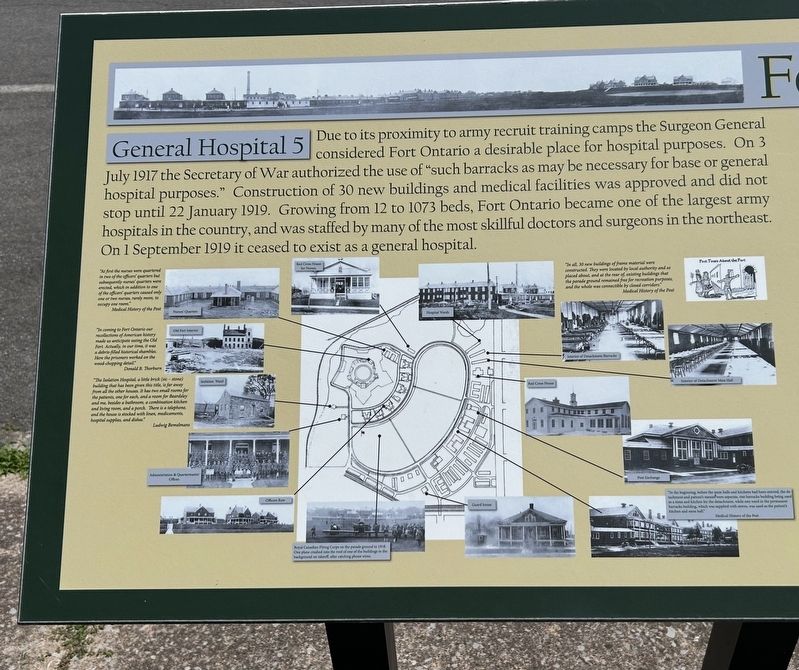
General Hospital 5
Due to its proximity to army recruit training camps the Surgeon General considered Fort Ontario a desirable place for hospital purposes. On 3 July 1917 the Secretary of War authorized the use of "such barracks as may be necessary for base or general hospital purposes." Construction of 30 new buildings and medical facilities was approved and did not stop until 22 January 1919. Growing from 12 to 1073 beds, Fort Ontario became one of the largest army hospitals in the country, and was staffed by many of the most skillful doctors and surgeons in the northeast. On 1 September 1919 it ceased to exist as a general hospital.
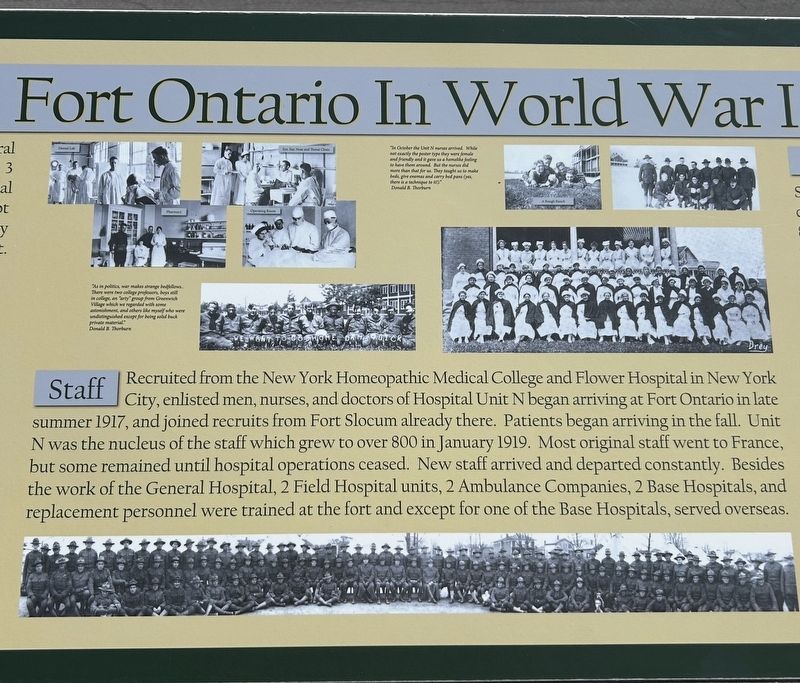
Staff
Recruited from the New York Homeopathic Medical College and Flower Hospital in New York City, enlisted men, nurses, and doctors of Hospital Unit N began arriving at Fort Ontario in late summer 1917, and joined recruits from Fort Slocum already there. Patients began arriving in the fall. Unit N was the nucleus of the staff which grew to over 800 in January 1919. Most original staff went to France, but some remained until hospital operations ceased. New staff arrived and departed
this page online
Patients
Soldier patients were initially received from recruit camps in Syracuse and the northeast, but later 90% came from overseas. At its peak 1,000 patients were treated every month. Some civilians were treated at the fort due to the medical expertise available and wartime shortages of doctors in local hospitals. Fort Ontario functioned as a general hospital for the treatment of around 8,000 medical, surgical, and venereal cases; it also served as a reconstruction hospital. Approximately 200 patients died at General Hospital 5, including 70 from Spanish Influenza during the 1918-19 pandemic.
Welfare Organizations
Welfare organizations connected with the hospital performed efficient service and included the Red Cross, Y.M.C.A., Knights of Columbus, and the Jewish Welfare Association. The Reconstruction Service and Aides were civilian women hired by the army to provide physiotherapy and occupational
Photographed by Steve Stoessel, July 23, 2025
2. Left Side of Marker
[Quotations, starting right and moving left: ]
- Gladys McMahon on the hospital steps. On 12 December 1918 her 13 year old sister Florence died in the hospital of peritonitis of the spleen, after diphtheria.
- Ralph Stillson (left) best friend of pharmacist Ralph Young (second from left) died of Spanish Influenza 12 October 1918.
- "Almost at once the literary-lights among the enlisted men of Unit N published a weekly newspaper, THE ONTARIO POST, which had an amazing circulation in Oswego County." - Donald B. Thorburn
- "In October the Unit N nurses arrived. While not exactly the poster type they were female and friendly and it gave us a homelike feeling to have them around. But the nurses did more than that for us. They taught us to make beds, give enemas and carry bed pans (yes, there is a technique to itl)." - Donald B. Thorburn
- "As in politics, war makes strange bedfellows.. There were two college professors, boys still in college, an "arty" group from Greenwich Village which we regarded with some astonishment, and others like myself who were undistinguished except for being solid buck private material." - Donald B. Thorburn
- "In all, 30 new buildings of frame material were constructed. They were located by local authority and so placed about, and at the rear of, existing buildings that the parade ground remained free for recreation purposes, and the whole was connectible by closed corridors." - Medical History of the Post
- "The Isolation Hospital, a little brick (sic - stone) building that has been given this title, is far away from all the other houses. It has two small rooms for the patients, one for each, and a room for Beardsley and me, besides a bathroom, a combination kitchen and living room, and a porch. There is a telephone, and the house is stocked with linen, medicaments, hospital supplies, and dishes." - Ludwig Bemelmans
- "In coming to Fort Ontario our recollections of American history made us anticipate seeing the Old Fort. Actually, in our time, it was a debris-filled historical shambles. Here the prisoners worked on the wood-chopping detail." - Donald B. Thorburn
- "At first the nurses were quartered in two of the officers' quarters but subsequently nurses' quarters were erected, which in addition to one of the officers' quarters caused only one or two nurses, rarely more, to occupy one room." - Medical History of the Post
Topics.
Photographed by Steve Stoessel, July 23, 2025
3. Middle Section of Marker
Location. 43° 27.851′ N, 76° 30.424′ W. Marker is in Oswego, New York, in Oswego County. It can be reached from Fourth Street north of Barbara Donahue Drive, on the left when traveling north. Marker is at the first parking area for Fort Ontario on western side the lot. Touch for map. Marker is in this post office area: Oswego NY 13126, United States of America. Touch for directions.

Regionally, this marker is in Upstate New York, specifically in Central New York, and in the Syracuse Metropolitan Area. It is also in the American Northeast and in the Mid-Atlantic. Globally, it is in North America, on the Great Lakes, in the Western Hemisphere, in the Western World, and in the Anglosphere. Historically, it finds itself in what was once New Netherland and also one of the original Thirteen Colonies.
Other nearby markers. At least 8 other markers are within walking distance of this marker: The Post Ghost (a few steps from this marker); Fort Ontario in the American Revolution (a few steps

Photographed by Steve Stoessel, July 23, 2025
4. Right Side of Marker
More about this marker. This is a long marker, difficult to capture in single photograph.
Also see . . . Fort Ontario (NYS Parks). (Submitted on August 8, 2025, by Steve Stoessel of Niskayuna, New York.)

Photographed by Steve Stoessel, July 23, 2025
5. Fort Ontario in World War I Marker

Photographed by Steve Stoessel, July 23, 2025
6. Fort Ontario in World War I Marker
Credits. This page was last revised on August 8, 2025. It was originally submitted on August 7, 2025, by Steve Stoessel of Niskayuna, New York. This page has been viewed 105 times since then and 34 times this year. Photos: 1, 2, 3, 4, 5. submitted on August 7, 2025, by Steve Stoessel of Niskayuna, New York. 6. submitted on August 8, 2025, by Steve Stoessel of Niskayuna, New York.
