Poncha Springs in Chaffee County, Colorado — The American Mountains (Southwest)
Cities in the Wilderness
Photographed by Cosmos Mariner, July 22, 2025
1. Cities in the Wilderness Marker
"It is a town of only eight days' growth, but full of life.... There are now about 300 inhabitants, with fifty houses, tents, etc., and quite a number of buildings in process of construction, comprising one hotel, one boarding house, two saloons, four retail stores, one wholesale store, one livery and one feed stable.... Large numbers of people are arriving daily. Two wagon loads came in from Silver Cliff to-day who report that many more are on the point of starting"
— letter from Chaffee City, Aug. 14, 1879
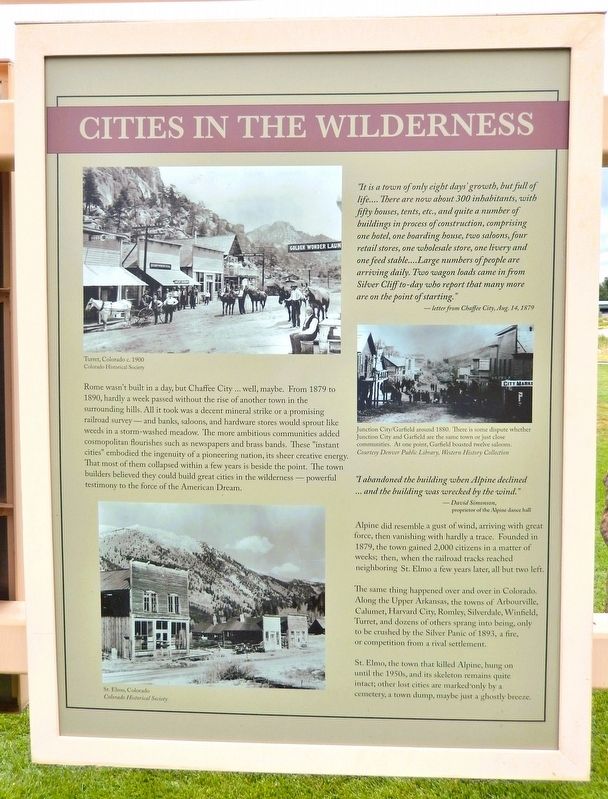
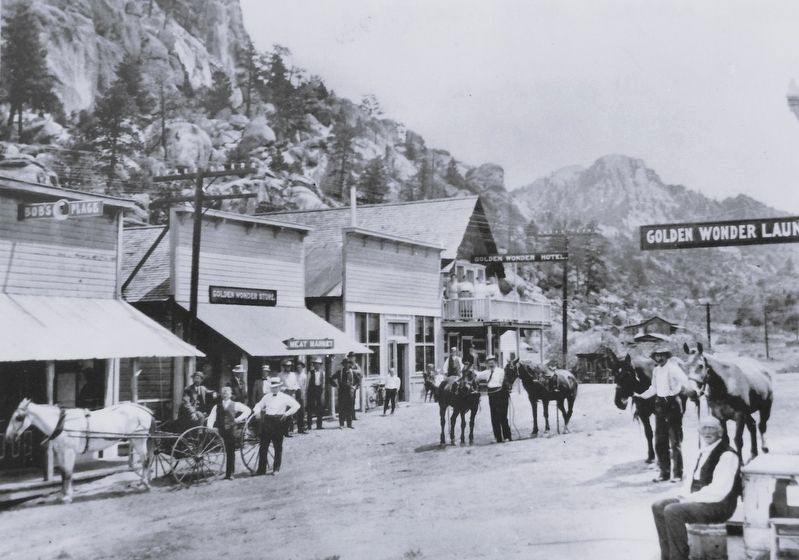
Rome wasn't built in a day, but Chaffee City ... well, maybe. From 1879 to 1890, hardly a week passed without the rise of another town in the surrounding hills. All it took was a decent mineral strike or a promising railroad survey — and banks, saloons, and hardware stores would sprout like weeds in a storm-washed meadow. The more ambitious communities added cosmopolitan flourishes such as newspapers and brass bands. These "instant cities" embodied the ingenuity of a pioneering nation, its sheer creative energy. That most of them collapsed within a few years is beside the point. The town builders believed they could build
this page online
"I abandoned the building when Alpine declined ... and the building was wrecked by the wind."
— David Simonson, proprietor of the Alpine dance hall
Alpine did resemble a gust of wind, arriving with great force, then vanishing with hardly a trace. Founded in 1879, the town gained 2,000 citizens in a matter of weeks; then, when the railroad tracks reached neighboring St. Elmo a few years later, all but two left.
The same thing happened over and over in Colorado. Along the Upper Arkansas, the towns of Arbourville, Calumet, Harvard City, Romley, Silverdale, Winfield, Turret, and dozens of others sprang into being, only to be crushed by the Silver Panic of 1893, a fire, or competition from a rival settlement.
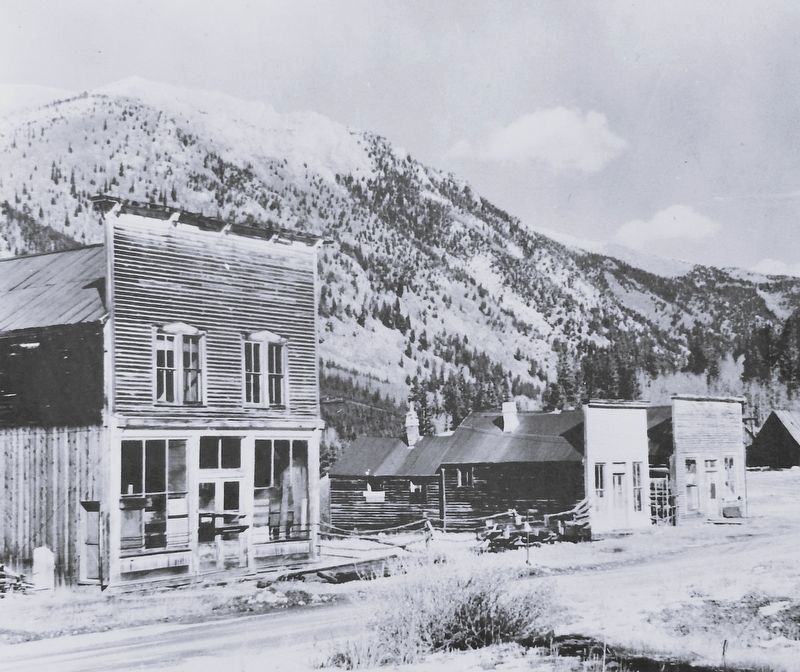
St. Elmo, the town that killed Alpine, hung on until the 1950s, and its skeleton remains quite intact; other lost cities are marked only by a cemetery, a town dump, maybe just a ghostly breeze.
Erected by Town of Poncha Springs.
Topics. This historical marker is listed in these topic lists: Industry & Commerce • Settlements & Settlers. A significant historical year for this entry is 1879.
Location. 38° 31.284′ N,
Colorado Historical Society
2. Marker detail: Turret, Colorado c. 1900

Regionally, this marker is in the Arkansas River Valley, in the Colorado High Rockies and on the Continental Divide. It is also in the American Mountain West. Globally, it is in North America, the Rocky Mountains, the Western Hemisphere, the Western World, and the Anglosphere.
Other nearby markers. At least 8 other markers are within 4 miles of this marker, measured as the crow flies: Crossroads of the Rockies (here, next to this marker); The Roof of the Rockies (here, next to this marker); Poncha Springs Country (here, next to this marker); Crossroads Town (within shouting distance of this marker); Meeting Midpoint (within shouting distance of this marker); Crossing Paths (within shouting distance of this marker); The Jackson Hotel
Colorado Historical Society
3. Marker detail: St. Elmo, Colorado
Also see . . . Alpine, Chaffee County, Colorado (Wikipedia).
Excerpt: It was founded as a mining town. The Alpine post office operated from October 26, 1874, until June 30, 1904. When the mines played out, the Mary Murphy Mine about four miles from St. Elmo was the last to close in 1910, and both Alpine and St. Elmo became ghost towns. There were still a few residents who continued to live in the two towns, but the towns were nearly empty for half a century. Then in the 1950s and 1960s people rediscovered the quiet beauty of Chalk Creek gulch and built summer homes. Some of the salvageable buildings in Alpine and St. Elmo were fixed up and still stand.(Submitted on August 9, 2025, by Cosmos Mariner of Cape Canaveral, Florida.)
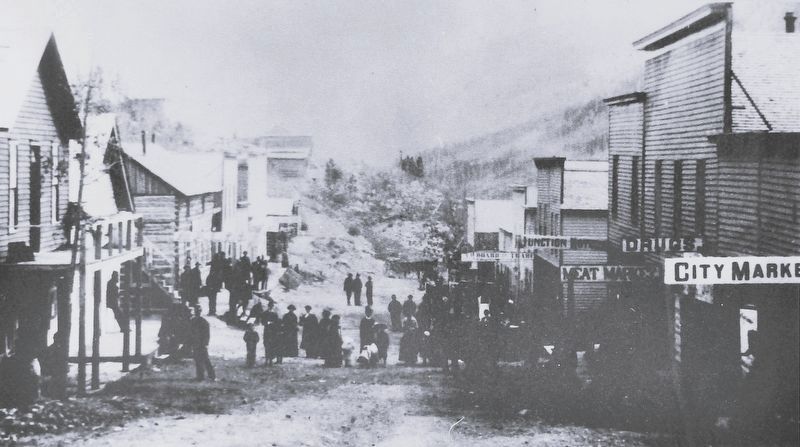
The San Isabel National Forest completely surrounds Alpine and St. Elmo and prevents more extensive development. St. Elmo remains a local tourist attraction as a ghost town with a part-time general store and some year-round residents. Alpine is more residential and has no tourist interest. Alpine has about 10 families who live there year-round,and a summer population of several hundred.Denver Public Library, Western History Collection4. Marker detail: Junction City/Garfield around 1880There is some dispute whether Junction City and Garfield are the same town or just close communities. At one point, Garfield boasted twelve saloons.
Photographed by Cosmos Mariner, July 22, 2025
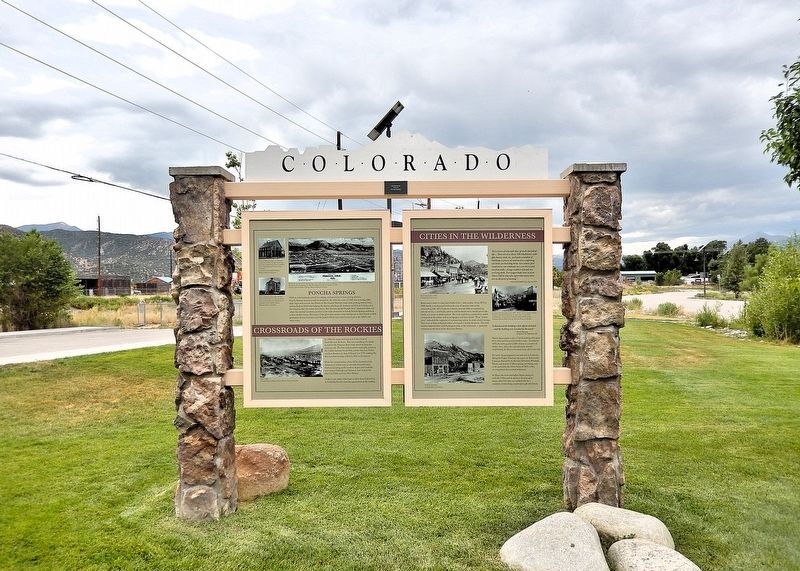
5. Poncha Springs Crossroads Interpretive Kiosk
This marker is the rightmost of 2 interpretive panels on the east side of the kiosk.
Credits. This page was last revised on August 9, 2025. It was originally submitted on August 8, 2025, by Cosmos Mariner of Cape Canaveral, Florida. This page has been viewed 109 times since then and 28 times this year. Photos: 1, 2, 3, 4, 5. submitted on August 9, 2025, by Cosmos Mariner of Cape Canaveral, Florida.
